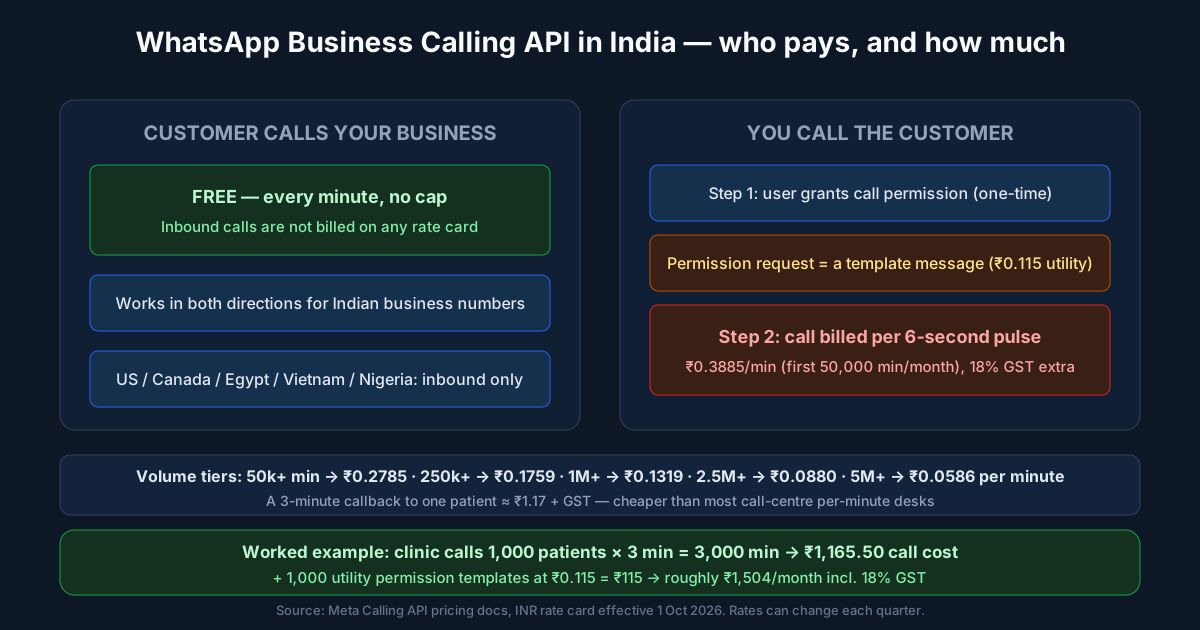
On the WhatsApp Business Calling API, calls customers make to you are free and unlimited. Calls your business places bill per six-second pulse: ₹0.3885 per minute to Indian numbers for the first 50,000 minutes a month, dropping to ₹0.0586 above 5 million minutes, plus 18% GST and any provider fee. Outbound calls also require the customer's permission first.
What Is the WhatsApp Business Calling API, and What Actually Costs Money?
Meta launched the WhatsApp Business Calling API on 15 July 2025, letting businesses place and receive voice calls with WhatsApp users over VoIP. It runs on the same Cloud API account you already use for templates and broadcasts. There is no separate licence and no monthly platform charge from Meta. The only line items are call minutes you place and the template messages you send.
The billing asymmetry is the whole story. When a patient rings your clinic number or a customer taps the call button on your WhatsApp profile, that conversation costs you nothing, on any volume. The moment your business dials out, Meta starts a meter. Every outbound minute bills in six-second pulses, rounded up, at a rate set by the country code of the number you call. A 56-second call to a Delhi customer is 9.33 pulses, billed as 10.
One detail people miss: if a call crosses a volume tier mid-month, the entire call is priced at the lower (higher-volume) rate, not split. Meta can revise rates only on 1 January, 1 April, 1 July or 1 October, with notice, so the numbers below are stable until at least 1 January 2027.
What Are the India Rates on Meta's Calling Rate Card?
On Meta's INR rate card effective 1 October 2026, calls from an Indian business number to Indian numbers cost:
| Business-initiated minutes per month (to +91 numbers) | Rate per minute | Per 6-second pulse |
|---|---|---|
| Up to 50,000 | ₹0.3885 | ₹0.03885 |
| 50,001 – 250,000 | ₹0.2785 | ₹0.02785 |
| 250,001 – 1,000,000 | ₹0.1759 | ₹0.01759 |
| 1,000,001 – 2,500,000 | ₹0.1319 | ₹0.01319 |
| 2,500,001 – 5,000,000 | ₹0.0880 | ₹0.00880 |
| Above 5,000,000 | ₹0.0586 | ₹0.00586 |
Two caveats on top of the card. First, 18% GST applies to Meta's charges, and your Business Solution Provider (Interakt, AiSensy, Wati and similar) may add a per-minute markup or platform fee, so get their calling price in writing before you budget. Second, calling requires a valid payment method on file. Since 1 October 2026, Meta stops delivering service messages to accounts without one, and calling is even less forgiving.
India is also in the good half of the availability list. Business-initiated calling is blocked only from US, Canada, Egypt, Vietnam and Nigeria business numbers. An Indian number can call and receive in both directions, including to Indian customers who have moved abroad, at the rate for the country they call.
How Does the Call Permission Rule Work?
Meta does not let you cold-call WhatsApp users. Before your business can dial a number, that user must grant call permission to your business number. This is Meta's answer to the robocall problem, and it changes your outbound cost model in a specific way: every permission request is itself a message, and messages bill at messaging rates.
Your options, with current India rates: send a utility template at ₹0.115 per delivered message, use a marketing template at ₹0.8631 if you are promoting, or ask inside an open 24-hour customer service window, which bills at the service rate (free up to 1,000 messages per number each month, ₹0.115 after). Permission persists, so you request it once per customer, not once per call. Recording and transcription features exist on the platform; Meta does not bill them separately today, but treat that as temporary — rate cards change quarterly.
There is a strategic upside here worth naming. Because the customer has to opt in to being called, your agents call people who actually expect the conversation. Complaint and block rates stay low, which protects your number's quality rating and messaging tiers. The permission friction filters out the calls that were never going to convert anyway.
What Does a Real Callback Programme Cost Per Month?
Here is the arithmetic on the two scenarios we get asked about most, using the first-tier rate and utility permission templates:
| Scenario | Call minutes | Call cost | Permission templates | Monthly total (ex-GST) |
|---|---|---|---|---|
| Clinic: 1,000 appointment callbacks × 3 min | 3,000 | ₹1,165.50 | 1,000 × ₹0.115 = ₹115 | ≈ ₹1,281 (+GST) |
| D2C brand: 2,000 delivery-issue calls × 2 min | 4,000 | ₹1,554 | Replies in window: free tier | ≈ ₹1,554 (+GST) |
| Insurance sales team: 10,000 follow-ups × 4 min | 40,000 | ₹15,540 | 10,000 × ₹0.115 = ₹1,150 | ≈ ₹16,690 (+GST) |
Compare the insurance row against a legacy outbound desk: agent-seat telephony and traditional dialers in India typically cost ₹2 to ₹6 per handled call once you count telecom minutes, IVR licences and seat rentals. At ₹1.65 per four-minute WhatsApp call including permission messages, the platform cost is not the constraint. The constraint is agent time, which is identical in both channels.
And the inbound side is where clinics feel it most. A missed phone call on a mobile clinic line is a lost appointment that nobody records. A WhatsApp call the front desk misses becomes a chat thread the customer can still write into, and the query is recoverable. We looked at this while designing appointment flows for a clinic client: the phone rang four times during a two-hour window while the front desk was with patients, and none of those callers left a voicemail. On WhatsApp, the same caller at minimum shows up in the inbox with a timestamp.
WhatsApp Calling vs Traditional Telephony: Which Should Your Business Pick?
| Factor | WhatsApp Calling API | Traditional call centre / IVR |
|---|---|---|
| Inbound call cost | Free, unlimited | Telecom minutes + seat charges |
| Outbound cost (3-min call) | ≈ ₹1.17 + GST | ≈ ₹2 – ₹6 per handled call |
| Permission needed to call out | Yes, per customer (once) | No, but DND/TRAI rules apply |
| Call history and chat in one thread | Yes, same conversation | Separate systems |
| Cold-calling allowed | No | Yes, within regulations |
| Setup effort | Needs Cloud API integration or a BSP | Vendor-managed, faster start |
The honest read: WhatsApp calling wins on cost and context for callback, support and reminder calls to customers who already message you. Traditional telephony still wins for genuine cold outreach, high-volume telemarketing, and any audience segment that has not adopted WhatsApp deeply. Both is not a cop-out answer here; it is the right answer for most Indian businesses above a few hundred monthly enquiries.
When Is the Calling API Worth Switching On? A Business Checklist
- You already run the Cloud API: calling is enabled on the same number and account, so there is no migration, just a media server or BSP feature to configure.
- Your enquiries arrive on WhatsApp: if customers message you, they can call you for free, and your team gets voice context in the same thread as the chat history.
- Missed calls cost you revenue: clinics, salons, repair services and travel agents lose bookings to unanswered phones; WhatsApp calls are recoverable through chat follow-up.
- Your callback list is permission-friendly: customers who opted in during a chat will grant call permission readily; a purchased lead list will not.
- You have a payment method and a BSP quote in writing: confirm both the Meta charges and the provider's per-minute markup before committing to a monthly volume.
How We Would Set This Up for a Client
We have not yet shipped a calling integration to production for a client, so treat this as an implementation plan, not a case study. When we evaluate it for a clinic WhatsApp flow, the sequence is: confirm the BSP supports the Calling API and get their per-minute fee in writing; enable calling on the existing Cloud API number; point inbound calls at the front desk during hours and at a voicemail-plus-chat fallback after hours; build the permission request as a utility template sent after any chat where the customer asks for a call; and log every outbound call against the appointment record so callbacks are auditable. The measurable outcome we would track is simple: recovered missed enquiries per week, against the ₹1.17-per-callback platform cost.
The failure mode to plan for is capacity, not technology. Front-desk staff who already juggle walk-ins and chat cannot suddenly absorb voice calls in the same window. If your inbound call volume is more than a handful per hour, route calls to a dedicated agent or a voice AI layer before you switch the channel on, otherwise you have bought a free inbound channel that nobody answers.
Limitations and Risks to Price In Before You Commit
Rate-card risk first. Meta moves prices quarterly and has raised India's marketing rate once already in 2026. Build your budget with the 1 January 2027 rate card as a checkpoint, not as a settled number. Second, the permission gate caps outbound growth: you cannot dial a list, so any sales playbook built on volume dialing does not translate to WhatsApp calling. Third, provider fees vary widely; the ₹0.3885 list rate is a floor, not your invoice. Fourth, call quality depends on your media server and network setup rather than on Meta, so test voice quality with your BSP before announcing the channel. And fifth, keep DPDP-consent hygiene: a customer's WhatsApp permission to be called is not the same as consent to be sold to, so separate the two in your scripts.
Frequently Asked Questions
Are WhatsApp calls between a customer and a business free in India?
When the customer calls your business number on WhatsApp, the call is free for both sides on every rate card Meta publishes. You pay only when your business places the call, at ₹0.3885 per minute to Indian numbers for the first 50,000 minutes each month, billed in six-second pulses plus 18% GST.
How much does one business-initiated WhatsApp call cost in India?
A call to an Indian number bills at ₹0.3885 per minute in six-second pulses, rounded up. A 56-second call counts as 10 pulses and costs ₹0.3885. A typical three-minute callback costs about ₹1.17, and 1,000 such callbacks cost roughly ₹1,165.50 before GST.
Do I need permission before calling a customer on WhatsApp?
Yes. Meta requires the WhatsApp user to grant call permission to your business number before you can place an outbound call. You request permission with a message: a utility template bills at ₹0.115 per delivery, a marketing template at ₹0.8631, and an in-window reply at the service rate. Permission persists per customer.
Is WhatsApp calling cheaper than a traditional call centre in India?
For outbound campaigns, usually yes. A 3-minute WhatsApp callback costs about ₹1.17 in Meta charges, while legacy contact-centre telephony with agent seats, IVR licences and telecom minutes typically lands between ₹2 and ₹6 per handled call. Inbound WhatsApp calls are free, which also removes the missed-call problem clinic and service desks deal with daily.
Can every Indian business use the WhatsApp Business Calling API?
Businesses on the WhatsApp Business Platform (Cloud API) in India can use calling in both directions. US, Canada, Egypt, Vietnam and Nigeria business numbers can receive calls but cannot place them. You need a valid payment method on file, and your Business Solution Provider may add its own calling fees on top of Meta's list rate.
Planning to add WhatsApp voice calling to your customer support or clinic flow? See our conversational AI solutions and automation services, browse how we approach digital marketing for Indian businesses, read our guide to WhatsApp Business App vs API and the October 2026 WhatsApp support cost changes, or contact us for a calling integration quote.