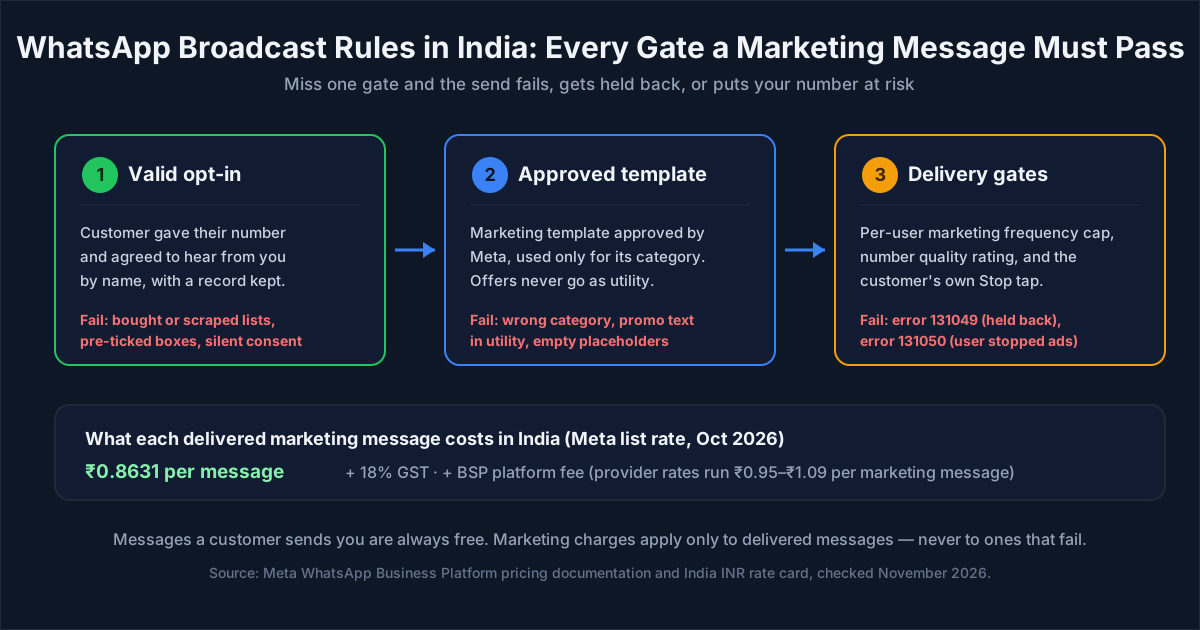
A compliant WhatsApp broadcast in India needs three things: recorded opt-in from every recipient, an approved marketing template used only for marketing, and respect for WhatsApp's delivery gates such as per-user marketing limits and Stop taps. Meta charges ₹0.8631 per delivered marketing message plus 18% GST, and bought lists are never allowed.
A client sent us their "festive offer blast" list last month: 14,000 numbers exported from a decade of invoices. Their question was simple — can we push this out on WhatsApp before Diwali? The honest answer was no, and not because of cost. Roughly 11,000 of those people had never agreed to hear marketing from them on WhatsApp, and sending anyway would have burned the business number we had just helped them verify.
We build WhatsApp ordering, appointment and support flows for businesses across India — D2C food brands, clinics, coaching centres — so broadcast compliance is something we handle weekly. The rules are not secret. Meta publishes them, enforcement is automated, and the businesses that get burned are the ones that assumed a customer database equals a messaging list. Here is the full picture.
What Counts as a Broadcast on WhatsApp?
On the WhatsApp Business Platform (the API), a broadcast is any marketing template sent to many people at once. Outside the 24-hour customer service window, you cannot free-type messages at all — every business-initiated message must use a template Meta has approved. Templates fall into categories: marketing, utility, authentication, and service replies. Only marketing templates can carry offers, announcements or win-back content, and only marketing messages draw the highest rate.
This matters because the category decides both approval and price. A "your order has shipped" notification sent as a marketing template pays ₹0.8631 instead of ₹0.115. A discount offer smuggled into a utility template gets rejected, and repeated mismatches drag your account quality down. We have seen template rejections take three extra days off a campaign simply because someone picked the wrong category at submission.
If you are still on the free WhatsApp Business app, broadcasts cap at 256 contacts per list and there is no template system — a different tool with different limits. This article is about the API side, where real campaigns run. For how the two compare, see our WhatsApp Business app vs API breakdown.
Who Can You Legally Broadcast To?
Meta's Business Messaging Policy is blunt: you may contact people only if they gave you their number and opted in to receive messages from you. Since late 2024, the opt-in does not have to mention WhatsApp specifically, but it must name your business and clearly state that the person is agreeing to hear from you. You choose the method — website checkbox, checkout tick box, QR code at the counter, a reply in chat — and you are responsible for keeping records.
| Counts as valid opt-in | Does not count |
|---|---|
| Unticked checkbox on your site: "Send me order updates and offers from [Business Name] on WhatsApp" | A pre-ticked box or bundled consent hidden in terms and conditions |
| A customer messaging you first and saying yes when you ask about updates | A number from a purchased, rented or scraped list |
| A QR-code or paper form at the counter with the consent wording visible | A number collected only for delivery calls or GST invoices |
| Opt-in collected at checkout with the message type clearly described | Silence after an unsolicited message you already sent |
One line from that table causes most of the trouble: numbers collected for another purpose. A delivery phone number is not a marketing consent. If your opt-in wording says "order updates" and you send festive offers, you have exceeded the consent you collected — Meta's own best-practices guide asks businesses to get explicit consent for promotional messages rather than bundle them with other communication types.
Keep a record for each contact: the number, date, exact wording shown, and source. When someone complains or Meta reviews your flows, that record is the whole defence. When a customer asks to stop — in chat, by email, on a call — remove them everywhere, immediately.
Why Do Marketing Templates Get Rejected?
Template review is automated, fast, and unforgiving of the three mistakes we see most:
Category mismatch. Anything promotional or persuasive belongs in marketing. "Book now and get 20% off" filed as utility gets rejected. So does a genuinely transactional update submitted as marketing — you would pay 7.5× the necessary rate if it passed.
Placeholder problems. Variables must use the approved format, map to real content, and never be empty in the example. A template full of {{1}} and {{2}} with no sample text is a near-certain rejection.
Policy violations in the wording. Unrealistic claims, restricted products, misleading urgency, or content that reads like spam all fail review. Meta also reserves the right to pause or reject any template at any time, even one already approved.
Our practical rule: write the template, wait a day, and reread it as a recipient. If it would annoy you as a text message, it will not survive review at scale.
Why Do Some Broadcasts Never Get Delivered?
Approval is not the last gate. Two delivery mechanisms sit between your send button and the customer's screen.
Per-user marketing limits. WhatsApp tracks how actively each person reads marketing messages and how many they already receive. When someone is over their limit, your message is held back and the send fails with error 131049. There is no published cap number — it is individual and adaptive. The practical consequence: a 20,000-recipient broadcast does not deliver to 20,000 people, and your cost model should assume a delivered fraction.
The Stop tap. Every marketing message now carries an easy way to stop. When a customer taps Stop, WhatsApp blocks your marketing messages to that person — they still get OTPs and order updates. Sending a marketing template anyway fails with error 131050. Treat that list as permanent until they tap Resume, and never retry those contacts.
Behind both sits your number's quality rating, driven by blocks, reports and Stop taps. Quality dips first, limits shrink next, and sustained abuse ends in restriction. That is why the bought-list shortcut is so expensive: one bad blast can damage a number you spent weeks verifying.
What Does a Broadcast Cost in India?
Meta's list rate for marketing messages to Indian numbers is ₹0.8631 per delivered message, plus 18% GST. Your BSP or platform adds its own fee on top — as of October 2026, published provider rates for marketing messages to Indian numbers run roughly ₹0.95 to ₹1.09 (AiSensy ₹1.09, Interakt ₹0.949–0.970, Wati ₹0.9667–1.0357). Rates checked against Meta's INR rate card and provider rate cards in November 2026.
| Recipients | Meta list rate (₹0.8631 each) | With 18% GST | Typical with provider fee |
|---|---|---|---|
| 1,000 | ₹863 | ₹1,018 | ₹1,120–₹1,290 |
| 5,000 | ₹4,316 | ₹5,093 | ₹5,600–₹6,440 |
| 10,000 | ₹8,631 | ₹10,185 | ₹11,200–₹12,880 |
| 25,000 | ₹21,578 | ₹25,462 | ₹28,000–₹32,200 |
Two adjustments before you budget. First, only delivered messages are charged — messages lost to 131049 holds cost nothing at the Meta layer, though some providers charge their platform fee differently, so check your provider's billing terms. Second, messages from Click-to-WhatsApp ad entry points fall inside a free window, which is why CTWA campaigns often beat cold broadcasts on cost per conversation. Our Click-to-WhatsApp ads cost guide covers that route.
What Does the DPDP Act Change for Broadcast Lists?
The Digital Personal Data Protection Act, 2023 overlays Indian law on top of Meta's policy. Consent must be free, specific, informed, unconditional and unambiguous — given by a clear affirmative action — and withdrawing it must be as easy as giving it. The DPDP Rules bring the detailed notice and consent obligations into force from May 2027, but the direction of travel is already clear, and consent-based messaging is the only safe footing either way.
In practice, the DPDP requirements and good WhatsApp practice point at the same checklist: say who you are, say what you will send, keep proof of consent, and make opting out one tap. We walk Indian businesses through the wider website-side obligations in our DPDP compliance checklist.
Pre-Broadcast Compliance Checklist
Every contact on the list has a recorded opt-in
Number, date, wording and source logged for each recipient. No exceptions, no "probably opted in".
The opt-in covers marketing
Consent for order updates does not extend to festive offers. Separate consent for promotional messages where the original wording did not cover them.
Opt-outs removed across every system
Stop taps, chat requests, and complaints honoured everywhere the number lives — CRM, sheets, and the WhatsApp platform itself.
Template approved and correctly categorised
Marketing content in a marketing template. Variables mapped to real data with valid sample values.
Sender number healthy
Quality rating green, no unresolved policy issues, business verification current.
Reply path staffed
A broadcast that says "reply YES for details" needs someone answering within the 24-hour window. Replies are now billable service messages after the first 1,000 per number each month — plan for it in the budget.
Common Mistakes That Get WhatsApp Numbers Restricted
The imported list blast. Thousands of cold numbers, one template, one afternoon. Blocks and reports spike, quality drops, and the account spends the next month climbing back. We have talked more than one business out of exactly this the week before a festival.
Marketing disguised as utility. It saves ₹0.75 per message until Meta's automated checks catch it. Then rejections, quality damage, and sometimes the utility category itself gets restricted for the account.
Ignoring 131049 and 131050. Retrying failed sends looks like persistence in your dashboard and looks like spam inside WhatsApp's systems. Held-back and stopped contacts belong on a suppression list, not a retry queue.
No answer behind the broadcast. The template promises a response, the customer replies, and nothing comes back for two days. The broadcast paid for a conversation the business never had.
Frequently Asked Questions
Can I send a WhatsApp broadcast to all my customers?
Only those with a recorded opt-in that covers the kind of message you are sending. A customer list built from invoices, delivery calls or enquiries does not count as messaging consent. Segment the list by consent status before the first send, not after the first complaint.
What happens if I broadcast without opt-in?
Recipients block and report, your number's quality rating falls, and Meta progressively lowers your messaging limits — in serious cases the number gets restricted. Sends to people who tapped Stop fail with error 131050. There is no version of this that ends well for the number.
Why was my marketing template rejected?
Most rejections come from a category mismatch (promotional content filed as utility), malformed or empty placeholders, or wording that breaks Meta's commerce and messaging policies. Fix the category and content, resubmit, and keep an eye on repeat violations — they count against your account.
Is there a limit on how many broadcast messages I can send?
Number-level limits scale with your quality rating, and WhatsApp applies a per-user marketing frequency cap that holds back messages to people already saturated with marketing (error 131049). No fixed campaign cap is published, so budget on delivered messages rather than queued ones.
How much does a 10,000-person WhatsApp broadcast cost in India?
At Meta's list rate of ₹0.8631 per delivered marketing message, 10,000 recipients cost ₹8,631 before GST — about ₹10,185 with 18% GST. With typical provider fees of ₹0.95–₹1.09 per marketing message, plan for roughly ₹11,200–₹12,880, charged only on delivered messages.
Does the DPDP Act apply to WhatsApp marketing?
Yes. Consent under the DPDP Act, 2023 must be free, specific, informed, unconditional and unambiguous, with withdrawal as easy as consent. The detailed rules take effect from May 2027, but consent records, clear notices and easy opt-outs are already the operating standard for Indian campaigns.
Planning a WhatsApp broadcast campaign?
We set up compliant opt-in flows, approved templates, and broadcast systems for D2C brands, clinics and service businesses across India — remotely or on-site.
Talk to us about your campaign See our digital marketing servicesThe rules look strict until you run a compliant list, and then they become your advantage: every message lands with someone who asked for it, replies come back, and your number's reputation compounds instead of decaying. Consent-first is not the compliance tax on WhatsApp marketing. It is the reason the channel works.
For the full rate card across all message categories, read our WhatsApp Business API pricing guide for India, and for choosing the platform layer, see our WhatsApp CRM comparison for small businesses.