Google has spent 2026 quietly rewiring Search campaigns. AI Max, the company's one-click automation suite for Search ads, came out of beta in April and by September Google started upgrading existing campaigns to it automatically. If you run ads for a clinic in Jaipur, a coaching institute in Lucknow or a D2C food brand shipping across India, some of your campaigns may already be running on it without you ever clicking anything.
Quick answer: AI Max lets Google match your Search ads to queries beyond your keyword list using broad match and keywordless technology, and it can rewrite your headlines and pick different landing pages automatically. Google reports about 14% more conversions at a similar cost per acquisition. It works well when your campaign has conversion data, room in the budget and tight controls, and it hurts when your budget is small, your margins are thin or nobody reviews the search terms report.
This guide walks through what actually changed, why your campaign may have been upgraded without asking, what it means for an Indian ad budget, and the exact checks we run before letting AI Max spend a client's money.
What Is AI Max and What Did Google Change in 2026?
AI Max is not a new campaign type. It is a layer that sits on top of a normal Search campaign and changes three things at once:
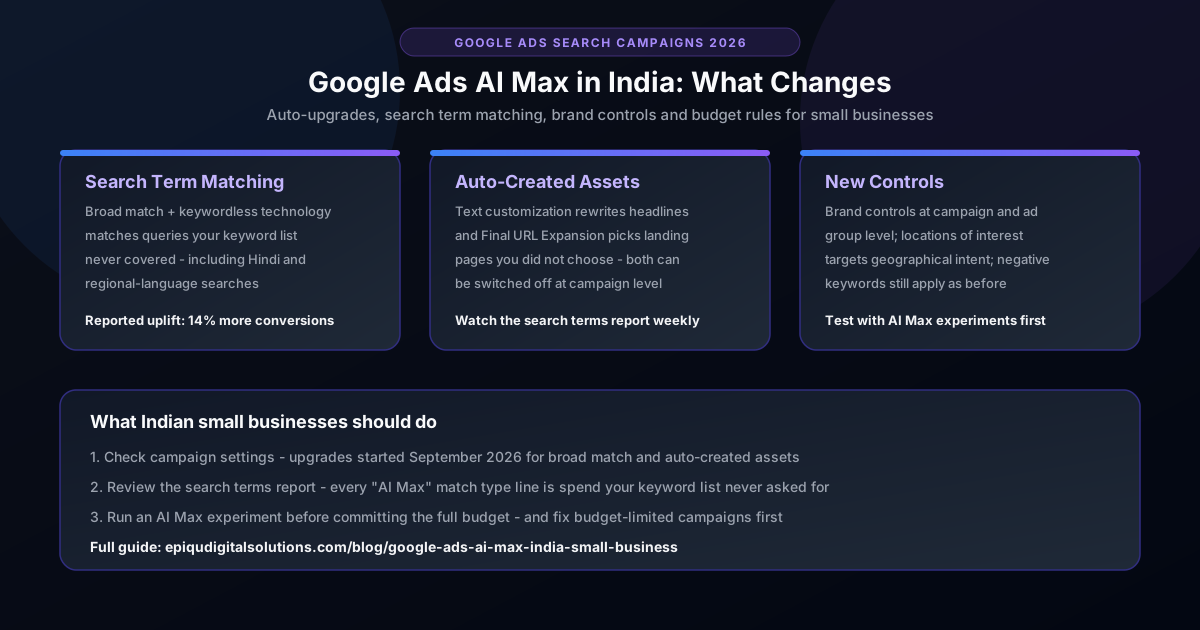
- Search term matching. Your ads become eligible for queries matched by broad match and keywordless technology, not just the keywords you typed in. A campaign built on exact match keywords like "root canal cost" can now show for "why does my tooth hurt when I chew" if Google's systems think it converts.
- Automatically created assets. Text customization can rewrite your ad headlines to better match a query, and Final URL Expansion can send the click to a page on your site you never selected. Both can be switched off, and we strongly recommend most service businesses switch off URL expansion at least initially.
- New controls. Brand controls at campaign and ad group level let you restrict which brands your ads associate with. Locations of interest, an ad group level setting, targets people based on geographical intent in their query rather than just their physical location.
Google's own AI Max documentation frames it as a "continuous optimization layer" for Search campaigns. The launch announcement cites a typical 14% increase in conversions or conversion value at similar CPA/ROAS, rising to 27% for campaigns that were mostly exact and phrase keywords. Treat those as Google's own averages, not promises. Averages include accounts with sloppy keyword lists that had a lot of headroom to gain.
Why Did Your Search Campaign Move to AI Max Without Asking You?
This is the part that has caught many Indian advertisers off guard. In August 2026, the Google Ads developer blog announced that starting September, campaigns using the campaign-level broad match setting or automatically created assets would be upgraded to AI Max automatically. No opt-in prompt. No confirmation email most people noticed.
We found this the practical way. A campaign we manage for a service business looked normal on Monday and was matching queries in a regional language we had never targeted by Friday. The budget had not changed. The keywords had not changed. Only the settings label in the campaign had: it now said AI Max.
Check your accounts this week. Open each Search campaign, go to Settings, and look for the AI Max section. Three things to note down: whether the campaign was upgraded, whether text customization and Final URL Expansion are on, and what date the upgrade happened. That date matters, because your search terms report from that date onward is running under different matching rules than the months you based your budget on.
What Actually Changes When AI Max Switches On
Most coverage stops at "Google uses AI." Useless. Here is the mechanic-level view:
| Feature | What It Does | What to Watch |
|---|---|---|
| Search term matching | Matches ads to broad match and keywordless queries beyond your keyword list | Spend on queries you never chose. Filter the search terms report by the "AI Max" match type |
| Text customization | Rewrites headlines to fit the query, using your existing assets | Claims your ad never made. If a headline promises something your business does not deliver, switch it off |
| Final URL Expansion | Sends clicks to landing pages Google picks from your site | Clicks landing on your blog or a generic page instead of the booking or enquiry page. Switch off for lead gen until proven |
| Brand controls | Restricts which brands your ads appear alongside, at campaign and ad group level | Reseller and competitor queries. Set the exclusion lists before the spend, not after |
| Locations of interest | Targets geographical intent in the query, not just the searcher's location | Good for "interior designer in Pune" searches from anywhere. Confirm your ad group geography matches where you actually serve |
One more thing that does not change: negative keywords still work, conversion tracking still works, and your language and location settings stay as they were. AI Max is an expansion layer, not a replacement for the campaign you built.
Will AI Max Work With a Small Indian Ad Budget?
Honest answer: often not, at least not first. Google's documentation says it directly: AI Max won't be effective if campaigns are limited by budget.
Think about what that means for a clinic spending ₹20,000 a month, or about ₹670 a day after the 18% GST Google adds to Indian ad invoices. If that budget is already exhausted by 4pm every day, the campaign's problem is not a shortage of matching queries. Adding more ways to match queries just changes which searches eat the same limited budget. The exact-match keywords that already convert may lose impressions to new AI Max matches that convert worse.
Before touching AI Max, check these in order:
- Is "Limited by budget" showing in the campaign status? Fix this first with better keywords or a higher budget.
- Has the campaign recorded at least 30 to 50 conversions? AI Max optimizes toward your conversion data. No data means it is guessing, and guessing with your money.
- Is your cost per qualified lead actually a problem? If exact match is delivering leads at a cost your sales team is happy with, expansion is optional, not urgent.
- Do you have conversion values set up? For D2C brands this matters most, because AI Max's claimed ROAS-neutrality is measured on conversion value, not lead counts.
Where small budgets do benefit: accounts with messy, outdated keyword lists. A photographer whose campaign still targets keywords from 2023 has real headroom. The automation is not adding intelligence so much as replacing neglect. That is a legitimate use, but know that is what you are doing.
Which Indian Businesses Should Switch It On, and Which Should Wait
| Business Type | Verdict | Why |
|---|---|---|
| Established service business, ₹50k+/month, steady lead flow | Test it | Has conversion data and budget headroom. Run an experiment and judge on cost per qualified lead |
| D2C brand with clean conversion value tracking | Test it | Shopping-adjacent searches and regional language queries are exactly where keyword lists miss demand |
| New campaign, under 30 conversions, no conversion values | Wait | Nothing for the automation to optimize toward. Build keyword-level data first |
| Campaign limited by budget most days | Not yet | Google says it directly: AI Max won't be effective when budget is the constraint |
| High-ticket B2B with long sales cycles | Careful | One wasted click costs thousands of rupees. Tight exact match often beats broad expansion here |
How We Test AI Max Before a Client's Full Budget Goes In
Whenever we enable AI Max on a managed account, the process is the same, and it is deliberately boring:
- Snapshot the baseline. Four weeks of cost, clicks, conversions, cost per conversion and search term mix, exported before any change. Without this you cannot prove anything later.
- Switch off Final URL Expansion. For service businesses we keep landing page selection manual until the matching layer has proven itself. Text customization stays on but gets its headlines reviewed against what the business actually delivers.
- Set brand controls and locations of interest before the first rupee of expanded spend, not after the first irrelevant lead.
- Run an AI Max experiment for four to six weeks. Google's experiment tool splits traffic between the original setup and AI Max, so both run at once and the comparison is fair.
- Review search terms weekly. Every line labelled "AI Max" match type gets one of three verdicts: relevant, add as negative, or worth adding as an explicit keyword so we can control its bid.
- Judge on cost per qualified lead, never raw conversions. Automation is very good at finding cheap conversions that your sales team cannot close. The phone call transcript matters more than the dashboard.
The weekly search terms review is where most of the value lives, and it is the step that gets skipped when business owners manage ads in their spare time. Twenty minutes a week in the first month. If you cannot commit to that, either keep AI Max off or hand the account to someone who will.
Common Mistakes Indian Advertisers Are Making With AI Max
Mistake one: not noticing the upgrade. Campaigns moved silently in September. If you have not opened Settings since, you do not actually know what your money is doing right now.
Mistake two: blaming the algorithm for old landing pages. AI Max sends traffic to a wider variety of queries, which punishes a generic landing page faster than exact match ever did. If cost per lead jumped after the upgrade, audit the landing pages before blaming the matching.
Mistake three: judging in week one. Broad match layers need conversion data to settle. A five-day panic pause gives you no signal in either direction.
Mistake four: ignoring regional language queries. AI Max will happily match your English campaign to Tamil, Hindi or Telugu searches. For many Indian businesses that is a gain, because buyers search in the language they think in. But only if your landing page and whoever answers the phone can handle that language.
Mistake five: turning it on everywhere at once. One campaign, one experiment, one verdict. Then decide.
Where does this fit in the bigger picture? If you are still deciding between platforms, our Google Ads vs Meta Ads cost comparison for India covers channel choice, and our Click-to-WhatsApp ads cost guide covers the ad format most Indian service businesses actually run. For the landing page side of the equation, the dental foundation website case study shows the kind of page structure that converts paid traffic, and our digital marketing services page explains how we manage ad accounts end to end.
Frequently Asked Questions
What is AI Max in Google Ads?
AI Max is a one-click feature suite for Search campaigns that combines search term matching (broad match plus keywordless technology), automatically created assets such as text customization and Final URL Expansion, and new controls like brand restrictions and locations of interest. There is no separate fee for the feature itself; you pay for the additional clicks and conversions it generates.
Does AI Max cost extra money in India?
Google charges nothing extra for the feature. The real cost impact is volume: AI Max matches your ads to more queries, so spend can rise even at the same cost per click. Google reports advertisers typically see about 14% more conversions or conversion value at a similar CPA or ROAS, and around 27% for campaigns that were mostly exact and phrase keywords. Add 18% GST on top of your ad spend as usual.
Why did my Search campaign switch to AI Max without my permission?
From September 2026, Google began automatically upgrading Search campaigns that use the campaign-level broad match setting or automatically created assets to AI Max. The change was announced on the Google Ads developer blog in August 2026. Open each campaign, check Settings, and look for the AI Max section to see whether your campaign was upgraded and which features are on.
Can I stop AI Max from matching irrelevant searches in Hindi, Tamil or other languages?
Negative keywords still work normally, and the search terms report labels AI Max matches with an "AI Max" match type so you can find them quickly. Review the report weekly in the first month, add negatives for every irrelevant query, and use the brand controls and locations of interest settings to restrict where your ads can appear. Language targeting settings are unchanged.
Should a business with a small budget of ₹15,000 to ₹25,000 per month use AI Max?
Be careful. Google states plainly that AI Max will not be effective if campaigns are limited by budget. If your campaign regularly exhausts its daily budget before the day ends, fixing campaign structure, keywords and landing pages usually returns more than switching on another matching layer. Run an experiment first, or wait until your budget is not the limiting factor.
How do I test AI Max without risking my whole budget?
Use AI Max experiments inside Google Ads. An experiment splits one campaign's traffic, with part running exactly as before and part running with AI Max on, so you can compare cost per lead side by side. Run it for four to six weeks, judge it on cost per qualified lead rather than raw conversions, and only roll it out campaign-wide if the experiment wins clearly.
Running Google Ads That Actually Convert?
Automation only pays off on top of a campaign structure that works: clean conversion tracking, landing pages built to convert, and weekly search term hygiene. We manage Google Ads and the websites behind them for clinics, D2C brands and service businesses across India. See our digital marketing services, browse our service locations, or talk to us directly.
Get an Ads & Landing Page Review →