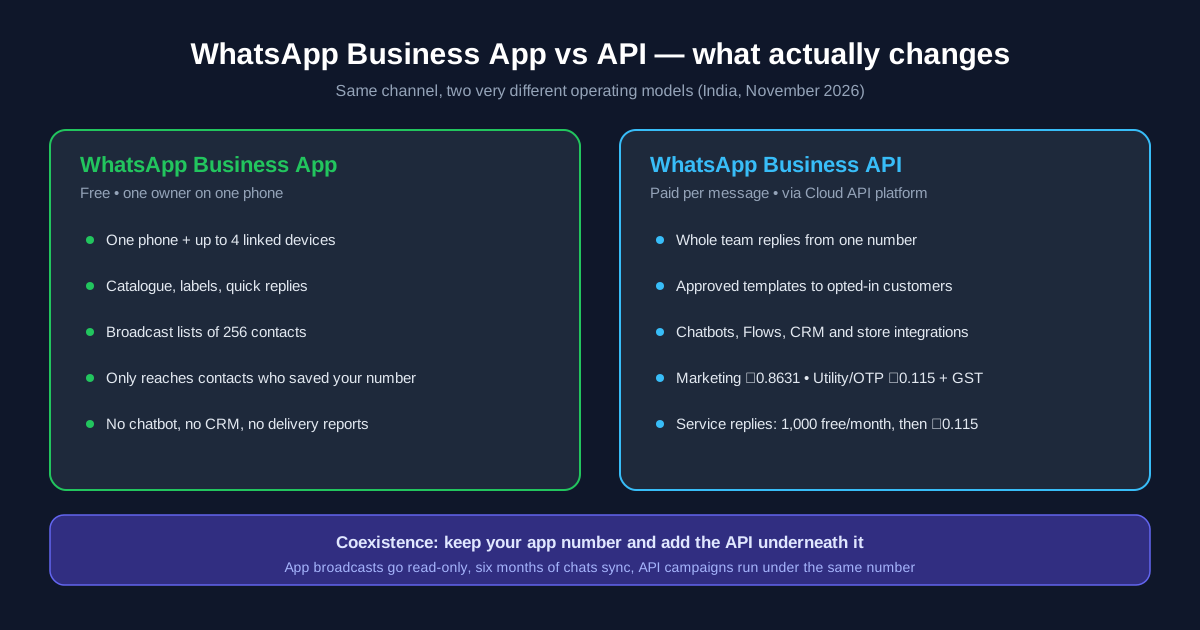
The WhatsApp Business app is free and fits one owner answering customers by hand: a catalogue, labels, quick replies and broadcast lists of 256 contacts. The WhatsApp Business API (Platform) runs your number through Meta's Cloud API so a team, chatbots and your systems can message at scale — Meta bills per delivered message (marketing ₹0.8631, utility ₹0.115, plus GST) and platforms add ₹999–₹2,999 a month. Coexistence lets one number run both.
Every client conversation about WhatsApp automation starts one level earlier than they expect: not "which chatbot should we buy" but "which WhatsApp are you actually on?" Most Indian small businesses run the free WhatsApp Business app — and there is nothing wrong with that. The trouble starts when a clinic, D2C brand or service business outgrows it and nobody has explained what the API changes, what it costs, and what you quietly lose in the switch.
We set up WhatsApp flows for clinics and food businesses regularly — our dental clinic project runs patient enquiries through the Cloud API — so this is the comparison we give clients before any vendor demo. No platform was paying us to write it.
The One-Minute Verdict
Stay on the app if one or two people answer customers personally, you message dozens of customers a day rather than hundreds, and nothing in your business needs to send a message automatically. It is free, and the catalogue and quick replies cover more than most owners use.
Move to the API when any of these is true: a team needs to reply from one number, your broadcasts have outgrown 256 saved contacts, order or appointment messages should send themselves, WhatsApp needs to talk to your store or CRM, or you want AI replies — including for clinics and finance businesses that Meta's own AI agent does not permit.
And the part most articles bury: you do not have to pick one. Coexistence runs both on the same number, so the owner keeps the phone while the automation runs underneath. We will cover what that costs you later, because it is not free of quirks.
What the WhatsApp Business App Actually Gives You
The app is normal WhatsApp with a business layer: a profile with hours and address, a catalogue of up to 500 items, labels for organising chats, quick replies for the questions you answer twenty times a day, and automatic greeting and away messages. Setup takes minutes and costs nothing.
The limits are the parts vendors skip. One owner on one phone, plus up to four linked devices total if you count WhatsApp Web. No chatbot, no CRM connection, no delivery or read reports, and basic in-app stats only. Every reply is typed by a human. For a boutique, a tuition centre or a home bakery, that is genuinely fine — we tell several clients a year not to upgrade, because the API would only add a monthly bill to a workflow that works.
What the WhatsApp Business API Adds
The API — Meta calls it the WhatsApp Business Platform, and everyone reaches it through the Cloud API — is not an app you download. Your number connects to Meta's systems, and you use it through software: a provider's shared inbox, your own CRM, or a custom build like the ones we assemble for clinics.
What that unlocks: unlimited agents replying from one number with per-agent logins and chat assignment, approved message templates sent to any opted-in customer (they do not need to have saved your number), chatbots and WhatsApp Flows that answer and qualify without staff, webhooks that push every message into your CRM or store, and per-recipient delivery and read reporting. Business verification through this route is also the free path to the WhatsApp blue tick, while the app tier only offers it through a paid Meta Verified subscription.
The trade-off is real money and real setup: template approvals, a Meta Business verification, a payment method for message charges, and days rather than minutes of onboarding.
WhatsApp Business App vs API: Feature Comparison
| Feature | WhatsApp Business App | WhatsApp Business API |
|---|---|---|
| Cost | Free | Meta per-message charges + platform fee |
| Who replies | One owner, up to 4 linked devices | Unlimited agents, shared inbox |
| Broadcasts | Lists of 256 contacts, only if they saved your number | Approved templates to any opted-in customer |
| Automation | Greeting, away messages, quick replies | Chatbots, Flows, triggers, AI agents |
| Integrations | None | CRM, store, billing, custom systems |
| Reports | Basic in-app stats | Delivery, read and campaign reporting |
| Blue tick | Paid Meta Verified subscription | Free via Meta business verification |
| Setup | Minutes, on a phone | Verification, templates, platform — days |
What the WhatsApp Business API Costs in India
The API bill has two parts, and quotes that blend them into one number are the most common way businesses end up overpaying. First, Meta charges per delivered message, varying by category. Second, the platform you use it through — WATI, Interakt, AiSensy or a custom build — charges its own subscription.
| Charge | Rate (India, + 18% GST) | What it covers |
|---|---|---|
| Marketing template | ₹0.8631 per message | Offers, launches, festive campaigns, cart recovery |
| Utility template | ₹0.115 per message | Order updates, payment reminders, appointment alerts |
| Authentication | ₹0.115 per message | OTPs and login codes |
| Service replies | First 1,000/number/month free, then ₹0.115 | Free-form replies inside the 24-hour customer window (billable since 1 October 2026) |
| Platform subscription | ₹999–₹2,999/month typical | Shared inbox, chatbot builder, campaigns, integrations |
Two worked examples from real client maths. A clinic answering 1,400 incoming patient queries a month pays nothing for the first 1,000 and about ₹54 for the rest at ₹0.115 plus GST — the delivery cost is trivial; the platform subscription is the real line item. A D2C brand blasting 5,000 marketing messages in a Diwali campaign pays 5,000 × ₹0.8631 × 1.18, roughly ₹5,100, before the platform fee. We keep the full rate card and the category rules in our WhatsApp Business API pricing guide for India.
The Broadcast Limit That Surprises Everyone
This is the single most misunderstood app feature we get asked about. A WhatsApp Business app broadcast list holds 256 contacts — and the message only reaches people who have saved your number in their phone. Anyone who has not saved it receives nothing, silently, and you get no error and no report telling you so.
A shop with 2,000 past customers is therefore not broadcasting to 2,000 people. It is broadcasting to the subset who saved the number, 256 at a time, with no delivery data. On the API, approved templates reach any opted-in customer — no saved-number requirement — with per-recipient delivery and read status, and volume scales through Meta's messaging tiers from 250 unique customers a day up to 100,000 and beyond as quality holds.
If broadcast marketing is why you are reading this comparison, this row alone usually decides it. Our Click-to-WhatsApp ads cost guide covers the paid side of building an opted-in list worth messaging.
Coexistence: Keeping Your Number Without Giving Up the App
For years the switch meant surrender: the number left the app and moved entirely to the API. Coexistence ended that. The same number stays on the WhatsApp Business app for the owner's daily chats while the API runs campaigns, chatbots and integrations underneath it.
It is the route we default to, because clinic and shop numbers carry years of customer history nobody wants to orphan. But it has fine print worth knowing before you commit:
- App broadcasts go read-only. Once the API is live on the number, campaigns move to approved templates. Your old broadcast lists remain visible but cannot be used to send.
- Six months of chats sync, not all of them. Contacts and up to the last six months of one-to-one chat history carry over to the platform. Group chats do not.
- Linked devices get unlinked. Companion devices like a spare phone or an old laptop drop off during onboarding, and disappearing messages and view-once media switch off.
- Throughput is capped. A number running both is limited to 20 messages per second on the API side — irrelevant for most SMEs, worth knowing if you run flash-sale campaigns.
How We Decide for Clients
When a client asks us to "set up WhatsApp automation", we run the same four checks before recommending anything, because the wrong answer costs either a wasted subscription or a lost season of campaigns:
- Count the people answering. One owner on the phone is app territory. Two or more staff replying to the same number is where shared inboxes earn their fee.
- Audit the message mix. Mostly inbound questions and order confirmations? Utility rates make the API cheap. Campaign sends to thousands? Marketing rates plus a platform fee — model the monthly bill before committing.
- Check what must happen without a human. Appointment confirmations, payment links, order status, after-hours FAQ answers — anything that should fire automatically points to the API, and often to a chatbot. For clinics, where Meta's own AI agent is not permitted, we build compliant agents on the Cloud API instead, as covered in our WhatsApp AI customer support guide.
- Check the inbox you will live in. The API is a pipe; the platform is where your team works daily. We compare the realistic options in our WhatsApp CRM guide for Indian small businesses.
Setup through a ready-made platform usually takes a few days, most of it waiting on Meta business verification and template approvals. A custom build — the kind we assemble when a clinic needs its booking flow wired in — takes longer and depends on the client's systems, and we say so in the first call rather than promising a weekend.
Frequently Asked Questions on WhatsApp Business App vs API
What is the main difference between the WhatsApp Business app and the API?
The app is a free phone app for one owner: catalogue, labels, quick replies and 256-contact broadcast lists. The API connects your number to Meta's Cloud API so a team, chatbots and your own systems can send approved template messages at scale, billed per delivered message.
How much does the WhatsApp Business API cost per month in India?
Meta's message charges — marketing ₹0.8631, utility and authentication ₹0.115, service replies free up to 1,000 per number monthly then ₹0.115, all plus 18% GST — plus a platform subscription, typically ₹999–₹2,999 a month. A support-heavy clinic can run under ₹1,200 a month all-in; a campaign-heavy brand pays for every marketing send.
Can I use both the app and the API on the same number?
Yes — that is coexistence. The owner keeps the app for daily chats while the API handles campaigns and automation under the same number. Old broadcast lists go read-only, six months of chats sync across, and companion devices unlink during setup.
Do I lose my chats and contacts when I move to the API?
With coexistence, contacts and up to six months of one-to-one chats carry over; group chats do not. We set clients up through coexistence for exactly this reason — a number with years of patient or customer history should never start from zero.
Why do my app broadcasts reach only some contacts?
App broadcast lists only deliver to contacts who have saved your number, and cap at 256 per list, with no delivery report. API template messages reach any opted-in customer with per-recipient delivery and read status.
Is the API worth it for a small business?
If one person handles customers and nothing needs automation, no — the free app covers it. It becomes worth it when a team shares the number, broadcasts outgrow 256 saved contacts, or order and appointment messages should send themselves. Model the monthly bill against the hours saved before deciding.
Not Sure Which WhatsApp You Need?
Tell us how many people answer customers, your monthly message volume and what should happen automatically. We will tell you plainly whether the free app still covers you or the API pays for itself — and set up either one. We build WhatsApp-first websites and automation for clinics, D2C brands and service businesses across India. See our AI and automation services, the work behind our service locations, or WhatsApp Flows vs landing pages.
Get a Straight Recommendation →