The Digital Personal Data Protection Act (DPDP Act 2023) and the notified DPDP Rules 2025 mark a permanent shift in how commercial websites operate across India. If your business collects contact details, runs quote forms, schedules clinic appointments, or accepts online orders, your website must meet verifiable statutory standards before the May 13, 2027 statutory enforcement deadline.
Quick Summary: What Makes an Indian Website DPDP-Compliant?
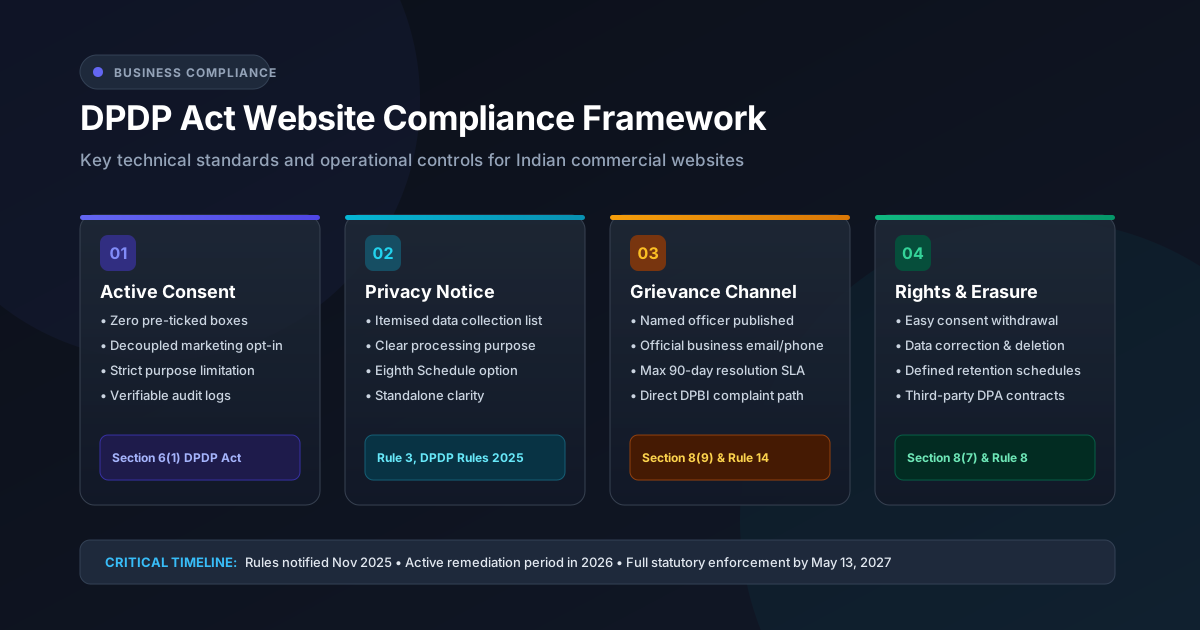
To make a website DPDP-compliant in India, businesses must replace pre-ticked checkboxes with clear affirmative consent, publish a standalone privacy notice specifying exact data collected and purpose, display a named Grievance Redressal Officer with response mechanisms under 90 days, provide verifiable consent withdrawal, and log data storage schedules before the May 2027 statutory enforcement deadline.
Who Must Comply with the DPDP Act in India?
Many founders assume the DPDP Act applies only to tech giants or enterprise banks. That belief is incorrect. Section 3 of the DPDP Act states that the law governs any entity processing digital personal data within India, or outside India if offering goods or services to people in India.
In legal terms, your company is a Data Fiduciary whenever you decide why and how personal data gets collected on your website. The Act creates no revenue exemptions, employee count exemptions, or industry carve-outs. Whether you manage a boutique architectural firm in Bengaluru, a healthcare clinic in Pune, a direct-to-consumer apparel brand in Jaipur, or an industrial parts supplier in Ahmedabad, every lead generation form and checkout screen falls squarely under the law.
While the Central Government designates certain high-volume entities as Significant Data Fiduciaries (SDFs) with stricter audit duties, standard Data Fiduciaries still face mandatory requirements: explicit consent, itemised notices, grievance resolution within 90 days, and data erasure once a business purpose ends.
Why a Copied Privacy Policy Fails Legal Scrutiny
For over a decade, Indian websites treated privacy policies as a decorative footer link copied from an overseas template or generated through a free online tool. These legacy policies relied on passive consent statements such as “By continuing to browse this website, you agree to our terms and cookie policy.”
Under Section 6(1) of the DPDP Act, that approach is legally void. The statute mandates that consent must be free, specific, informed, unconditional, and unambiguous, given through a clear affirmative action. If your contact form sends customer details without an unticked checkbox, or bundles marketing newsletter signups into a service quote request, that consent does not stand up in front of the Data Protection Board of India (DPBI).
The DPDP Rules 2025 specifically require a standalone privacy notice that individuals can read and understand independently of other terms. Linking to a twenty-page general terms document no longer satisfies the statutory standard.
Website Architecture: Traditional Setup vs DPDP Compliance
Upgrading your web presence requires concrete front-end and operational adjustments. Review this architectural comparison to identify where your existing site falls short:
| Website Touchpoint | Traditional Practice (Non-Compliant) | DPDP-Compliant Standard | Statutory Clause |
|---|---|---|---|
| Lead & Contact Forms | Pre-checked agreement boxes; auto-subscribing form submitters to email blasts. | Unticked checkboxes; distinct opt-in for marketing; exact statement of service purpose. | Section 6(1) & Rule 3 |
| Privacy Notice | Generic 3,000-word foreign legal template buried in footer; English only. | Itemised list of data points collected; clear purpose; option to view in Eighth Schedule languages. | Section 5 & Rule 3 |
| Grievance Redressal | Generic contact form or an unmonitored info@ email address. | Published name and official contact of Grievance Redressal Officer; response SLA under 90 days. | Section 8(9) & Rule 14 |
| Consent Withdrawal | No mechanism to revoke data usage; leads retained indefinitely in CRM spreadsheets. | Dedicated web form or email workflow enabling users to withdraw consent or request deletion as easily as giving it. | Section 6(4) & Section 12 |
| Analytics & Pixels | Loading ad trackers, session recorders, and remarketing tags prior to consent. | Cookieless tracking or clear notice of analytical tooling; strict ban on tracking children. | Section 9 & Rule 10 |
| Data Retention | Storing customer records indefinitely on shared web hosting databases. | Defined data life-cycle policy; systematic erasure once customer inquiry or contract completes. | Section 8(7) & Rule 8 |
When auditing websites for our clients, the most frequent failure point is form design. Marketing teams want as much customer data as possible, but under the DPDP Act, collecting unnecessary fields exposes the business to regulatory scrutiny.
The 7-Step DPDP Website Compliance Checklist
To prepare your website systematically, implement this seven-step technical and operational framework:
- 1. Enforce Data Minimisation on All Web Forms: Review every input field across contact forms, booking modules, and quote calculators. Eliminate fields that do not directly serve the immediate interaction. For example, a business inquiry form needs a name, company, email, and phone number; it does not need home addresses, dates of birth, or secondary identifiers.
- 2. Remove Pre-Checked Consent Boxes: Under Section 6, default-checked boxes are invalid. Web visitors must physically click an unticked box to confirm consent. If you want to send periodic marketing emails or WhatsApp product updates, provide a separate, distinct checkbox. Never bundle marketing opt-ins with service delivery consent.
- 3. Publish an Itemised, Standalone Privacy Notice: Your privacy notice must list the specific categories of personal data collected, describe the exact purpose for processing, explain how users can withdraw consent, and provide links to exercise statutory rights. Section 5(3) requires making this notice available in English or any language listed in the Eighth Schedule to the Indian Constitution upon request.
- 4. Appoint and Publish a Grievance Redressal Officer: Section 8(9) mandates that every Data Fiduciary publish the contact information of a designated individual who answers data processing questions. Display the officer's name, official designation, physical business address, and dedicated email address prominently on your website footer and within the privacy notice.
- 5. Deploy a Clear Consent Withdrawal Workflow: Section 6(4) establishes that withdrawing consent must be as effortless as giving it. Provide a simple online request form or an active privacy email where customers can submit access, correction, or erasure requests. Establish an internal protocol to acknowledge requests promptly and resolve them well within the statutory 90-day ceiling.
- 6. Audit Third-Party Scripts and Data Processors: Every external tag on your site (Google Analytics, Meta Pixel, payment gateways, live chat widgets, and CRM forms) acts as a Data Processor under Section 8(2). You remain legally accountable for how these partners handle visitor information. Ensure you execute Data Processing Agreements (DPAs) with vendors and verify whether data stays in approved territories.
- 7. Build an Internal Data Retention and Deletion Schedule: Personal data cannot sit in web hosting databases indefinitely. Establish clear schedules: prospect inquiries that do not convert get scrubbed after 12 months; transactional billing records stay for required tax periods under the Companies Act and GST rules, then get permanently purged.
If your enterprise plans to revamp its web structure or implement compliant customer capture systems, explore our custom web development services and bespoke software solutions to build clean, compliant lead funnels.
Realistic Implementation Costs & Timelines for Indian MSMEs
Achieving DPDP compliance does not require millions of rupees or an enterprise legal department. For an established Indian business operating a corporate website or an e-commerce storefront, the implementation divides into four tangible stages:
| Phase | Key Deliverables | Typical Timeline | Estimated Investment |
|---|---|---|---|
| 1. Data Audit & Mapping | Inventory all forms, cookies, tracking tags, CRM integrations, and server databases. | 1 to 2 weeks | Rs 10,000 – Rs 20,000 |
| 2. Notice & Front-End Redesign | Draft custom itemised privacy notice; unbundle form checkboxes; deploy multi-language links. | 2 to 3 weeks | Rs 15,000 – Rs 30,000 |
| 3. Grievance & Rights Workflow | Setup data request submission channel, response tracker, and named officer protocol. | 1 week | Rs 8,000 – Rs 15,000 |
| 4. Vendor Agreements & Logs | Review DPA terms with hosting, CRM, and SMS providers; document retention policies. | 1 to 2 weeks | Rs 10,000 – Rs 20,000 |
For most Indian small businesses, a complete website compliance overhaul costs between Rs 35,000 and Rs 75,000 depending on platform complexity. In comparison, penalties for significant security failures or deliberate non-compliance under the Schedule to Section 33 reach up to Rs 250 crore. Proactive compliance is fundamentally affordable risk management.
Operational Trade-Offs and Common Pitfalls
Transitioning to DPDP compliance introduces practical operational trade-offs that management teams must anticipate:
- Conversion Rate Friction: Requiring explicit unticked checkboxes adds a fraction of friction to web forms. In our testing, conversion rates drop by 2% to 4% initially. However, the leads that do submit are higher-intent prospects who genuinely want contact, improving sales team efficiency downstream.
- Multi-Language Notice Maintenance: Offering privacy notices in regional languages requires proper human translation rather than machine auto-translation, particularly for legal terms. Start with English and your primary regional customer language before expanding further.
- CRM and Spreadsheet Discipline: Many sales executives download customer inquiries into unsecured desktop spreadsheets or WhatsApp groups. This creates severe compliance vulnerabilities. Centralise all incoming leads into access-controlled CRM software with automated deletion triggers.
- Third-Party Vendor Dependence: If your web hosting provider or payment gateway experiences a security breach, your brand remains accountable to affected customers. Choose reputable Indian infrastructure providers and audit their compliance credentials annually.
For an example of how service enterprises build secure, conversion-focused online systems, review our healthcare platform digital architecture case study.
Frequently Asked Questions
Does the DPDP Act apply to small businesses and MSMEs with low web traffic?
Yes. The DPDP Act does not provide small business exemptions based on revenue or traffic volume. If your website collects personal data from individuals in India, such as names, phone numbers, or email addresses, your business operates as a Data Fiduciary and must comply with core notice, consent, grievance redressal, and data erasure provisions.
Can I continue using pre-ticked consent checkboxes on website forms?
No. Under Section 6(1) of the DPDP Act, consent must be free, specific, informed, unconditional, and unambiguous through clear affirmative action. Pre-ticked checkboxes do not represent affirmative action and are invalid under Indian law. All consent boxes must remain unticked by default.
What is the difference between a traditional privacy policy and a DPDP privacy notice?
A traditional privacy policy is often a broad legal document explaining general corporate practices. A DPDP privacy notice, defined under Section 5 and Rule 3, must be presented with or before each consent request. It must provide an itemised list of personal data collected, specify the exact purpose for processing, explain how to exercise statutory rights, and display Grievance Redressal Officer contact details in plain language.
How much time does a business have to answer customer data grievances?
Under Rule 14 of the DPDP Rules 2025, Data Fiduciaries must specify and publish their grievance response timeframe, which cannot exceed 90 days from receiving the request. Individuals must exhaust the business's internal grievance mechanism before filing a complaint with the Data Protection Board of India.
What are the statutory penalties for non-compliance under the DPDP Act?
Under Section 33 and the Schedule to the DPDP Act, financial penalties depend on the nature and severity of the breach. Failure to implement reasonable security safeguards resulting in a personal data breach carries penalties up to Rs 250 crore. Failure to notify the Board and affected individuals carries penalties up to Rs 200 crore, while breaches of specific duties regarding children carry penalties up to Rs 200 crore.
Whether you need to audit existing web forms, implement compliant lead capture systems, or redesign your corporate platform for higher trust and search visibility across India, explore our regional technology centers or contact our team to discuss your requirements.