AI Overviews now answer many informational searches before anyone clicks a result — a 2026 ISB–CMU field experiment measured a 38% drop in organic clicks when one appears — and Google's November 2026 core update is re-ranking results all this fortnight. Compare clicks against impressions in Search Console, protect your money pages, and hold off big changes until the rollout finishes.
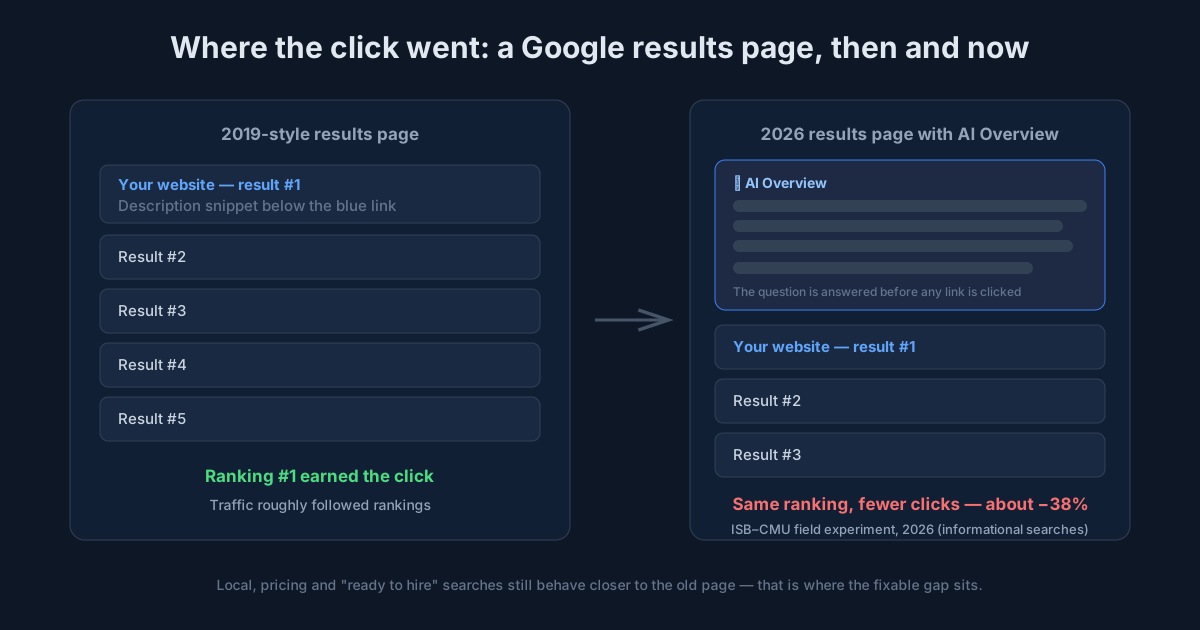
Two things hit business owners' inboxes and group chats this month at the same time. Google started rolling out its November 2026 core update on 10 November. And the slow click-bleed from AI Overviews, which has been building all year, finally got a measured number attached to it. If your website still ranks well but the enquiry form is quieter, this post explains what is actually happening, how to tell the two apart in your own Search Console account, and what is worth fixing before the end of the month.
We build and maintain websites for clinics, D2C brands and service businesses across India, so we open a lot of Search Console accounts. Everything below follows Google's own documentation and published research — no panic-selling, no "AI killed SEO" headlines. Where a number exists, we cite it. Where nobody can measure something yet, we say so.
What Changed in Google Search This Month?
Three separate things, and they are easy to confuse:
- November 2026 core update. Started 10 November, applies to all countries and languages, and per Google's Search Status Dashboard can take up to two weeks to finish. A core update is Google re-weighting how it judges relevance and quality across the whole index — not a penalty, and nothing technical is "broken" on your site.
- AI Overviews keep expanding. Industry tracking puts AI Overviews on close to half of all queries now, up sharply from a year ago. The first rigorous measurement, a field experiment by researchers at the Indian School of Business and Carnegie Mellon University, found organic clicks drop about 38% on searches where an AI Overview appears.
- A Search Console reporting bug. Google confirmed the Search generative AI performance report under-counted impressions from 9 to 11 November 2026. If your dip sits exactly on those dates, it is a data problem, not lost traffic.
One more change worth knowing: since 31 August 2026, every website has a separate Search generative AI performance report in Search Console, plus a control to opt out of AI Overviews entirely. Both matter for the diagnosis below.
Which Searches Still Send Clicks — and Which Don't?
This is the part most coverage skips. AI Overviews have barely touched the searches where someone is ready to act. What got absorbed is the informational middle of the funnel: definitions, how-tos, generic advice. The practical consequence is that not all traffic loss is equal.
| Search type | Example | AI Overview risk | What to do |
|---|---|---|---|
| Local intent | "dental clinic in Anna Nagar", "interior designer near me" | Low — rarely triggers | Keep the Google Business Profile verified, reviewed and matching the site's name, phone and address |
| Commercial / pricing | "website development cost in India", "Zoho vs Tally" | Medium — summary appears, links get cited | Publish real prices and honest comparisons; being cited sends qualified visitors |
| Informational | "what is DPDP Act", "how does UPI AutoPay work" | High — answer shown, click often lost | Accept fewer clicks; make the answer clear enough to be cited, and lead readers to a next step |
| Branded | "Epiqu digital solutions", "clinic name + city" | Low | Consistent name, reviews and listings make the branded click the reliable one |
Notice the pattern. The searches that still send clicks are the ones that were always paying the bills: local, pricing, booking, brand. If your service and location pages hold steady while blog traffic dips, the site is still doing its job.
How Do You Know If AI Overviews Are Eating Your Traffic?
An hour in Search Console settles it. Do this, in order:
- Open Performance and compare clicks against impressions over three months. Pages whose impressions held while clicks fell are losing to AI answers, not to competitors. Pages where both fell are a ranking problem — that is the core update's territory.
- Check the Search generative AI performance report. It shows impressions and clicks from AI Overviews and AI Mode by page, country and device. Rising impressions there with flat web clicks is the signature of an AI answer absorbing demand.
- Separate the dates. Lost clicks on 9–11 November? Treat the generative AI report numbers for those days as unreliable — Google confirmed the under-count.
- Look at enquiries, not sessions. Tie organic landing pages to WhatsApp messages, form fills and calls. Lower traffic with steady leads is a better outcome than a traffic report suggests — and it changes what you decide to fix.
- Only then compare pre- and post-update rankings. Wait until the Search Status Dashboard marks the rollout complete, then compare a full week against a full week, same days. Day-three comparisons are noise.
What Should You Fix on Your Website?
Google's own guidance is short, and its most useful line is a negative: there are no additional requirements and no special optimisations for AI Overviews or AI Mode. No llms.txt file. No magic schema. What still works is the unglamorous stuff, aimed at the searches that still click:
- Publish real prices and real process. An AI Overview can summarise "websites typically cost X". It cannot match a page with your actual packages, timelines and inclusions. Buyers click through for specifics.
- Strengthen commercial pages before writing more explainers. If traffic losses sit on informational posts, the fix is usually a stronger service and pricing page, not another article.
- Treat the Business Profile as a homepage. For local searches, the profile card now does more work than the blue links. Recent reviews, correct hours, real photos, categories that match what you sell.
- Keep claims quotable. Pages with clear, verifiable specifics get cited inside AI answers — and a citation sends a warmer visitor than a bare ranking ever did.
We covered the cost side of this in our SEO cost guide for India and the local side in our Google Business Profile setup guide. If you run multiple branches, our multi-location local SEO guide covers the page structure that survives updates like this one.
What Should You NOT Do During a Core Update?
Rollout runs to roughly 24 November. Until it settles:
- Don't rewrite the whole website mid-rollout — you will never know what worked.
- Don't delete pages because traffic dipped for three days.
- Don't buy cheap backlinks or "ranking guarantee" packages; they create new problems without fixing old ones.
- Don't judge on one keyword. Judge on total clicks across your important pages, and leads.
The honest exception: if a page has been weak for a year — thin content, no prices, no real experience shown — the update is a convenient deadline, not a reason. Improve it because it deserves it.
A 30-Day Plan for Indian Business Websites
- Week 1 (now): export Search Console clicks and impressions for the week before 10 November as your baseline. Note the date in your reports. Change nothing.
- Week 2: once the rollout is marked complete, compare full weeks, same weekdays. List pages that lost the most clicks and split them into "lost impressions" (update) versus "held impressions, lost clicks" (AI Overview).
- Week 3: fix commercial pages first — pricing clarity, service detail, Business Profile. Re-check the generative AI report for pages being cited.
- Week 4: consolidate the informational content worth keeping, with clear next steps on every page. Leave the opt-out switch on "include" unless you have a specific legal reason to exclude.
Frequently Asked Questions
Is my traffic drop caused by the November 2026 core update?
The core update started rolling out on 10 November 2026 and can take up to two weeks. Check the Google Search Status Dashboard first. If rankings moved but impressions stayed steady, the update is the likely cause. If impressions held while clicks fell, AI Overviews are absorbing the click instead.
Can I opt my website out of AI Overviews?
Yes. Search Console has a Search generative AI control, available to every site since 31 August 2026, that excludes your content from AI Overviews, AI Mode and generative AI in Discover. It also removes the clicks and impressions those features send you, so most businesses should leave it on include.
Do I need llms.txt or special schema to appear in AI answers?
No. Google states there are no additional requirements and no special optimisations for AI Overviews or AI Mode. A page needs to be indexed and eligible to appear in Search with a snippet. Structured data helps Google understand what is visible on the page, but nothing new is needed.
Does blocking Google-Extended protect my content from AI?
No, not from Google Search. Google-Extended controls Gemini training and grounding. Blocking it does not remove your site from Search results or AI Overviews, and it could cost you the citation traffic those features send. Most Indian businesses should not block it.
Are local businesses affected by AI Overviews?
Much less than informational publishers. Searches with clear local intent — nearby, pricing, booking, contact — rarely trigger an AI Overview and still send calls. A verified, well-reviewed Google Business Profile matters more for local visibility now than it did two years ago.
Why did my Search Console impressions drop on 9 to 11 November?
Google confirmed a reporting bug: the Search generative AI performance report under-counted impressions on those dates. If your dip lines up exactly with 9 to 11 November 2026 in that report, it is a data problem, not a real traffic loss.
Not sure whether your site has an update problem or an AI problem?
We audit Search Console data for clinics, D2C brands and service businesses across India and tell you plainly which pages to fix first — and which are fine. If a rebuild would help, we will say that too; if it would not, we will say that louder.
Get a traffic diagnosis See our digital marketing servicesSources: Google's Search Status Dashboard and AI features and your website documentation; Agarwal and Sen (2026), Google AI Overviews and Publisher Traffic: Evidence from a Field Experiment, Indian School of Business and Carnegie Mellon University. All checked November 2026.
Related reading: what SEO costs in India in 2026, our Google Business Profile local SEO guide, the multi-location local SEO guide, and what the AI website builder vs web developer choice means for a real business site.