Scaling a service enterprise, clinic chain, or commercial brand across Indian metropolitan centers is an operational milestone. An established healthcare group in Bengaluru opening branches in Chennai and Hyderabad, or a B2B packaging firm expanding from Pune into Ahmedabad and Noida, naturally wants incoming customer inquiries from day one. Yet hundreds of expanding Indian companies hit a digital brick wall: their new branch profiles get suspended on Google Maps within 48 hours, or their website fails to appear in organic local searches outside their founding city.
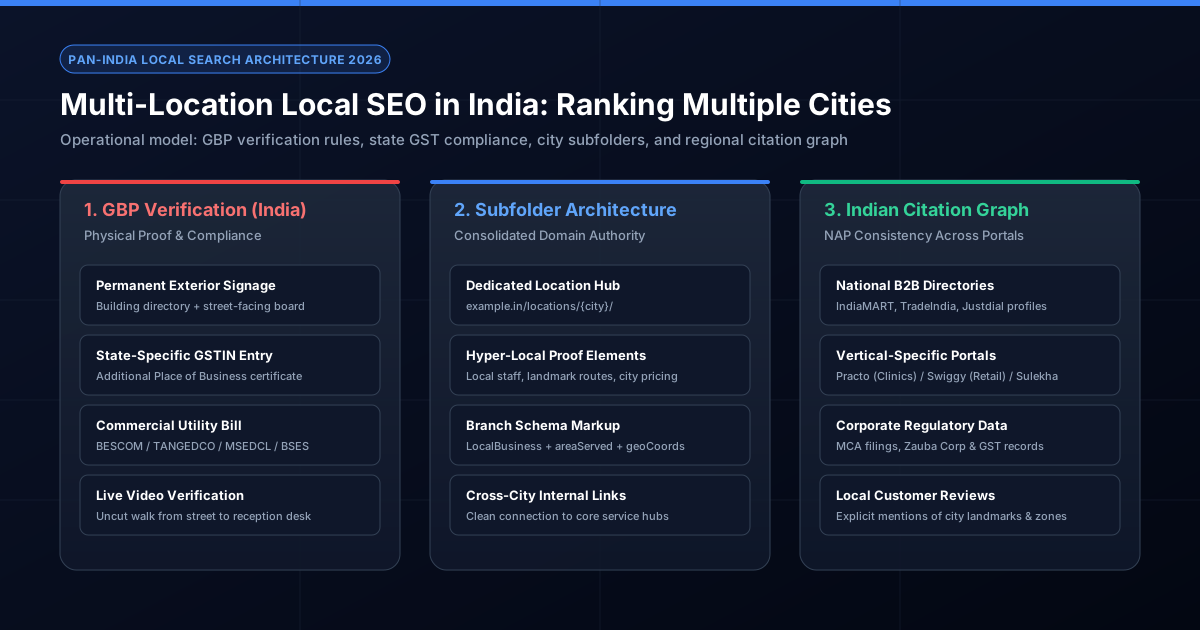
Ranking across multiple Indian cities requires a three-tier structure: individual Google Business Profiles verified with state GST certificates and physical signboards, dedicated city subfolder landing pages (such as /locations/city-name/) containing localized service details and LocalBusiness schema, and regional directory citations. Avoid shared co-working virtual addresses without dedicated physical signage, which trigger immediate suspensions during Google mandatory video verifications in India.
The Multi-City Expansion Trap for Indian Businesses
When an Indian business owner decides to capture search traffic across multiple cities, the instinctive reaction is usually one of two shortcuts:
- • The Keyword-Stuffed Footer: Adding a block of twenty city names at the bottom of the homepage (such as “Best clinic in Mumbai, Delhi, Bengaluru, Chennai, Hyderabad, Pune, Kolkata…”). Search engines devalue this keyword block as spam, and it provides zero ranking signal in competitive urban catchments.
- • The Automated City Swap: Generating thirty programmatic landing pages where a single 800-word template is reused, swapping only the city name in the H1 tag. Google detects this duplicate footprint instantly, flagging the URLs as thin content and refusing to index them.
Google evaluates local intent through proximity, entity prominence, and real-world verification. If your digital footprint does not reflect authentic local operations in each target territory, your search visibility remains trapped within a five-kilometer radius of your primary headquarters.
The Google Business Profile Reality in India: Why Branch Profiles Get Suspended
Google Maps local pack rankings drive between 40% and 65% of high-intent local inbound calls for Indian commercial enterprises and clinics. However, Google India operates under strict automated spam filters because of widespread fake listing generation in commercial districts such as HSR Layout in Bengaluru, Andheri in Mumbai, and Connaught Place in Delhi.
When you register a second or third location, Google rarely sends a postal verification PIN. Instead, your listing is placed on immediate hold pending strict operational verification.
The Mandatory Video Verification Walkthrough
Google India now requires an unedited, continuous video recording captured through your mobile browser. The video must prove four distinct physical realities in a single continuous cut:
The Virtual Office Trap
Many expanding companies purchase cheap virtual office packages costing ₹1,200 to ₹2,500 per month from shared workspaces simply to get an address. While these packages provide a mailing address and NOC for GST registration, they almost always fail Google Maps verification. If Google identifies dozens of unrelated businesses claiming the same shared suite without dedicated permanent exterior signage, the algorithm suspends every profile attached to that address.
If you operate a branch inside a co-working space, you must hold a dedicated, enclosed private cabin and arrange with facility management to mount permanent company signage in the reception area.
URL Structure Comparison: Subfolders vs Subdomains vs Separate Domains
Deciding how to structure your website for multiple cities dictates your long-term organic authority. Indian enterprises generally choose between three architectural patterns:
| Architecture Model | Domain Authority Impact | Hosting & Maintenance Cost | Ranking Speed | Recommended For |
|---|---|---|---|---|
Subfoldersdomain.in/locations/mumbai/ |
Highest: Consolidates all backlinks, press mentions, and age equity under one root domain. | Lowest: Single SSL certificate, unified codebase, single hosting server. | Fastest: New city pages inherit existing domain trust immediately. | 95% of Indian multi-location service businesses, clinics, and B2B enterprises. |
Subdomainsmumbai.domain.in |
Moderate: Google treats subdomains as semi-independent properties; authority leaks across roots. | Moderate: Requires wildcard SSL certificates, separate tracking setups, and routing rules. | Moderate: Each subdomain must build its own backlink profile from scratch. | Franchise businesses where regional partners manage distinct local billing or inventories. |
Separate Domainsdomainmumbai.in |
Lowest: Completely fragmented domain rating; zero equity shared with primary brand. | Highest: Multiple domain renewals, separate deployments, multiplied security overhead. | Slowest: Takes 12 to 18 months for each individual domain to build indexing credibility. | Independent joint ventures or distinct legal business entities with separate branding. |
For almost all Indian commercial operators, the subfolder architecture (such as epiqudigitalsolutions.com/locations/chennai/) provides the highest return on investment. When your primary domain earns an authoritative editorial mention or industry backlink, that equity cascades down to every city page housed inside your subfolder network.
Building High-Converting City Landing Pages (Without the Template Penalty)
Publishing thin location pages guarantees an indexing refusal from search engines. To rank organically for terms like “commercial interior designers in Hyderabad” or “orthopedic clinic in Adyar Chennai,” the city page must serve genuine local proof. Every location page should feature distinct content blocks:
- • Local Physical Coordinates & Direct Contact: State the exact street address matching your Google Maps profile. Supply a local landline number with the city STD code (044 for Chennai, 080 for Bengaluru, 022 for Mumbai) or a direct branch mobile line rather than a generic national toll-free number.
- • Transit Landmarks and Access Directions: Detail how visitors reach the premises from key arterial transit points. Mention distance from the nearest metro station (such as “400 meters from Indiranagar Metro Station on 100 Feet Road”) or major highway flyovers. Real geographical references signal authentic local relevance to search crawlers.
- • Named Local Personnel: Feature your regional branch manager, head doctor, or lead project consultant with their professional credentials and photograph. People conduct business with recognizable specialists, not faceless national corporations.
- • Local Case Studies and Project Deliveries: Detail projects executed within that specific state or urban zone. In our work with regional medical institutions, detailed in the Coimbatore Dental Foundation case study, building dedicated treatment pathways and authentic local facility documentation delivered sustained inbound appointment growth.
-
•
Structured Data (Schema.org): Implement clean
LocalBusinessorMedicalBusinessschema on the page. Embed precise GPS coordinates (latitude and longitude), exact branch opening hours, accepted payment methods (such as UPI, NEFT, and credit cards), and a directhasMaplink pointing to your verified Google Maps URL.
Building an Indian Local Citation Graph: Beyond Justdial
In western markets, local citation building centers on Yelp, YellowPages, and Apple Maps. In India, search engines cross-reference business authority against a very different ecosystem of local trade directories and regulatory registries.
To establish unmistakable local relevance across multiple Indian cities, align your Name, Address, and Phone (NAP) details across four distinct citation tiers:
1. Major National B2B & Trade Directories
Create verified company profiles on IndiaMART, TradeIndia, and Justdial. Ensure that each city branch is listed with its unique local telephone line and street address. Avoid listing your headquarters phone number across every satellite branch profile.
2. Industry-Specific Platforms
For healthcare centers and clinics, individual doctor and facility profiles on Practo and Lybrate are critical ranking signals. For hospitality and retail outlets, active listings on Zomato and Swiggy validate operating hours and customer footfall. Professional service agencies should maintain presence on Sulekha and verified LinkedIn company branch pages.
3. Corporate Regulatory Registries
Search engines parse public corporate filings through platforms like Zauba Corp, Tofler, and the Ministry of Corporate Affairs (MCA). Keeping your registered office and branch address filings accurate builds institutional domain trust that algorithmic competitors cannot replicate.
4. Geotagged Customer Reviews
Encourage satisfied local clients to mention their neighborhood or city in their review text (for instance, “The team completed our office fitout in Whitefield on schedule”). Natural localized keywords inside genuine customer reviews directly boost your local pack prominence for nearby searchers.
Operational Checklist: Multi-City Launch Playbook
Before launching marketing campaigns for a new city branch, follow this step-by-step checklist to protect your digital presence against algorithmic flags:
- ✓ Legal Documentation: Secure a registered commercial lease agreement and add the new branch address as an Additional Place of Business (APOB) on your state GST registration.
- ✓ Physical Signage Installation: Erect permanent exterior and reception signage displaying your brand name and logo before scheduling video verification.
- ✓ Dedicated Phone Connectivity: Provision a dedicated local landline or direct mobile line for the branch manager rather than rerouting all inquiries to a centralized call center.
-
✓
Subfolder Landing Page Deployment: Publish a dedicated city landing page under
/locations/{city}/with original photography, transit directions, and LocalBusiness schema markup. - ✓ Cross-Linking to Core Services: Connect the city page to your central commercial services hub and link neighboring regional outlets in the footer.
- ✓ Local Review Generation: Collect five to ten detailed reviews from early local customers to establish initial trust and click-through momentum.
Common Mistakes That Derail Indian Multi-Location SEO
Over years of engineering search infrastructure for expanding Indian enterprises, we observe the same four recurring blunders:
1. Centralizing Every Incoming Call to a Single 1800 Toll-Free Number: While convenient for call center routing, displaying the identical phone number across ten different city profiles dilutes local trust signals. Google prefers matching local STD codes to city boundaries.
2. Keyword Stuffing the Google Business Profile Name: Appending modifiers like “Best Dental Clinic Chennai OMR” to your legal brand name violates Google guidelines. Competitors will flag the listing, triggering an immediate suspension that requires weeks of manual appeal review.
3. Creating Ghost Listings for Cities Without Physical Premises: Attempting to rank in Pune while operating solely from Mumbai by renting a mail drop leads to profile termination. If you lack physical premises, focus exclusively on ranking organic service area pages rather than publishing fraudulent map pins.
4. Inconsistent Operating Hours During Regional Festivals: Failing to update holiday hours during state-specific festivals (such as Pongal in Tamil Nadu, Durga Puja in West Bengal, or Ganesh Chaturthi in Maharashtra) leads to negative reviews from customers who arrive at closed doors, dragging down your engagement score.
Frequently Asked Questions
Can an Indian business rank on Google Maps in a city where it does not have a physical office?
No. Google Maps requires physical verification in India through mandatory video recording and official premises documentation. If you do not maintain a physical commercial branch, you cannot legally create a storefront Google Business Profile for that city. Instead, create a dedicated organic landing page under your main domain (such as example.in/locations/city-name/) and configure a Service Area Business (SAB) profile without publishing a fake street address.
How does Google verify multi-location businesses in India?
Google India uses strict algorithmic and manual verification triggers. Postcard verification is largely phased out for multi-location commercial brands. You will be prompted for an unedited mobile video recording showing the street name, exterior building signage, key-unlock entry into your private office, and interior equipment. Google support also frequently requests your state GST registration certificate showing the address as an Additional Place of Business (APOB) and a commercial utility bill (TANGEDCO, BESCOM, MSEDCL, or BSES).
Should multi-location businesses in India use subfolders or subdomains?
Subfolders (domain.in/locations/city-name/) are strongly recommended over subdomains (city.domain.in) or separate domains. Subfolders concentrate all domain authority, incoming backlinks, and brand signals onto your primary root domain. Subdomains split domain authority and require independent link-building campaigns for every new city.
Can we use a co-working space address for Google Business Profile in India?
Only if you rent a dedicated, private, lockable office with permanent physical brand signage at the building entrance and directory board. Virtual office packages that provide only mailing and GST registration without dedicated physical workspace get flagged and permanently suspended during video verification.
How do we avoid duplicate content penalties across multiple city landing pages?
Do not use programmatic find-and-replace scripts that simply swap city names in identical text. Every city landing page must contain genuine local signals: specific physical branch address and local phone number (STD landline or direct mobile), named local branch manager or clinic team, directions referencing recognizable local transit landmarks, branch operating hours, local case studies or client deliveries, and geotagged customer reviews citing specific neighborhoods.
Scale Your Multi-City Search Visibility Across India
Whether you are expanding a healthcare network, retail franchise, or B2B enterprise into new Indian commercial centers, our team engineers robust digital infrastructure that captures high-converting local demand. Explore our digital marketing and web engineering services, inspect our structured multi-city location hubs, or get in touch for strategic guidance.
Schedule an Expansion Consultation →