WhatsApp spent 2026 turning its Updates tab into advertising inventory. Ads in Status are live in India, promoted channels are live, and most of the advice floating around treats it either as the death of privacy or as free gold. It is neither. Here is what a small or mid-sized Indian business can actually do with it, what it costs, and where it fits next to the click-to-WhatsApp ads you may already run.
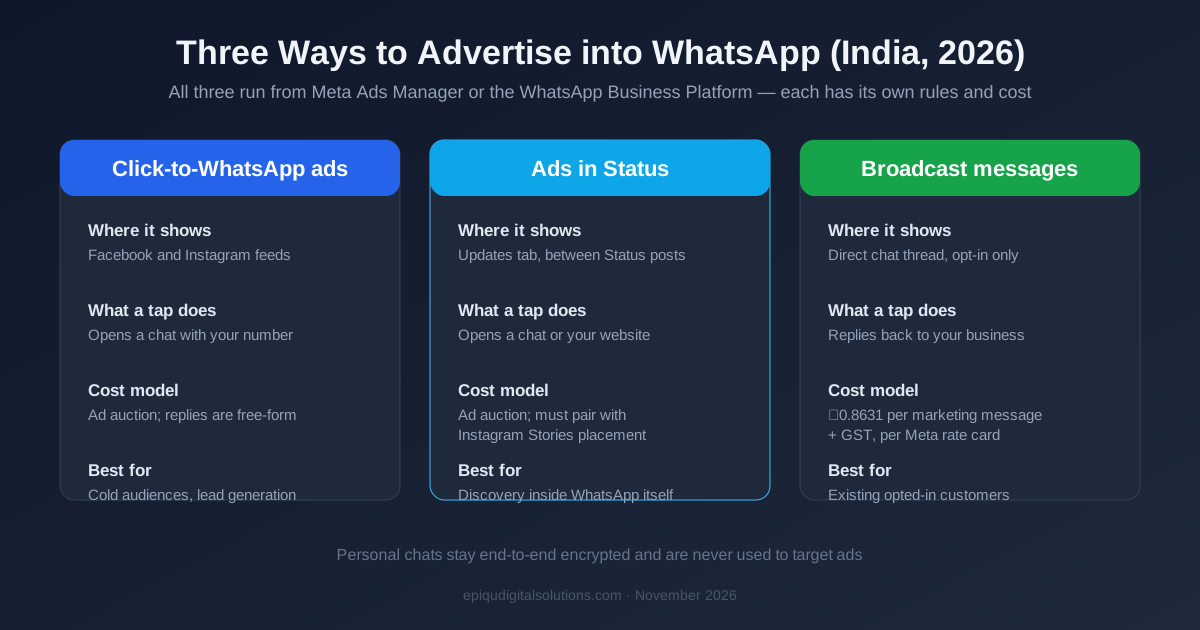
WhatsApp Status ads are auction-priced Meta ads shown in the Updates tab between Status posts, bought in Ads Manager and paired with Instagram Stories. A tap opens a chat with your business or your website. They suit discovery in front of people who do not have your number; they are not a broadcast tool. Start with a small daily budget, judge cost per conversation, and keep click-to-WhatsApp ads as your primary lead channel until Status proves itself.
What changed, and what did not
Meta announced ads in Status and promoted channels for India in September 2025. Maruti Suzuki, Air India and Flipkart were named as early Status advertisers, and Meta said the Updates tab — where Status and Channels live — is used by 1.5 billion people a day worldwide. In February 2026 the company rolled both features out globally. As of November 2026, Indian advertisers can buy Status placements through Ads Manager like any other Meta campaign.
Two things did not change, and they matter for how you pitch this internally. Personal chats, calls and statuses stay end-to-end encrypted and are not used for ad targeting. And the ads sit in the Updates tab, next to Status posts and channels, labelled as ads. Nobody opens a customer's chat thread and finds a promotion inside it.
Targeting is deliberately limited. Meta says Status ads draw on coarse signals: country or city, language, the channels a person follows, and how they have interacted with ads. If the user has linked WhatsApp to Meta's Accounts Center, preferences from their Facebook and Instagram accounts can come in. What you do not get is the granular interest targeting you are used to on Instagram. Plan around that, because it changes what creative will work (more on that below).
Are Status ads live for your account?
Meta describes the rollout as gradual, so before anyone plans a budget, check your own Ads Manager rather than trusting a headline. It takes two minutes:
- Open Ads Manager and start a new campaign with a Traffic, Engagement or Sales objective.
- In the ad set, under Placements, switch from Advantage+ placements to Manual placements.
- Look under Stories, status and reels. If WhatsApp status appears as a tickable placement, your account can run them.
- Note the platform: WhatsApp status can only be selected together with Instagram Stories. A Status-only campaign is not supported.
One trap to check while you are there: if your ad account used brand safety and suitability controls on Facebook, Instagram or Threads in the past 12 months, Meta opts you out of the WhatsApp status placement automatically. You have to go back in and re-enable it manually.
What you need before you can run one
The setup bar is low, which is exactly why it is worth walking through before you click publish:
- A Facebook Page for your business. Required for both destination types.
- A WhatsApp Business account connected to the Page if the ad's tap destination is a chat. The free WhatsApp Business app works; you do not need the API. If you later want automated replies or broadcasts behind that chat, that is where the WhatsApp Business app vs API decision comes in.
- A website URL if you would rather the tap go to your site instead of a chat.
- Vertical creative. Status is a fast, thumb-driven viewing environment. One image, one video, or a carousel of up to 10 cards. Your first frame has to earn the pause in about a second, because that is all a Status viewer gives you before swiping.
Exclusions worth knowing before you brief anyone: campaigns in special ad categories — finance, employment, housing, social issues, elections and politics — cannot use Status, and pharma and healthcare ads are not delivered there. If you run a clinic or a finance-adjacent business, that alone rules the placement out for now.
What they cost, and the metric that matters
There is no rate card for Status ads. They run through the same auction as every Meta placement, so your cost depends on how many other advertisers want your audience, your bid strategy, and how people react to the creative. Anyone quoting you a fixed "Status ads price in India" is guessing.
The honest way to budget: pick a daily number you are comfortable losing for a week, run it, and read the results per conversation started — not per click. A tap that opens a WhatsApp chat is worth something only if the chat goes somewhere. This is the same discipline we recommend for click-to-WhatsApp ads in India, where the cost-per-qualified-chat matters far more than the cost-per-lead headline.
And keep the numbers in perspective. A Status ad that opens 50 chats costs you auction money and nothing per chat. A broadcast message to 50 opted-in customers costs 50 × ₹0.8631 plus GST at Meta's rate card — roughly ₹51 — plus your platform fee. The two tools do different jobs; the comparison in the next section is about jobs, not just price.
Status ads vs click-to-WhatsApp ads vs broadcasts
| Ads in Status | Click-to-WhatsApp ads | Broadcast messages | |
|---|---|---|---|
| Audience | Strangers browsing the Updates tab | Strangers on Facebook and Instagram | People who already opted in |
| Needs opt-in? | No — it is paid ad inventory | No — the tap and first message are the opt-in | Yes, documented, per Meta policy and DPDP Act |
| Creative | Vertical image, video or carousel | Feed or story formats | Pre-approved template |
| Targeting depth | Limited: location, age, language; Advantage+ recommended | Full Meta targeting, custom and lookalike audiences | Your own list segments |
| Cost model | Ad auction; must pair with Instagram Stories | Ad auction | ₹0.8631 per marketing message + GST, per Meta's rate card |
| Job it does | Discovery inside WhatsApp itself | Lead generation at scale | Reactivation and offers to existing customers |
Read the table as a funnel, not a ranking. Status ads and click-to-WhatsApp ads both put you in front of strangers; broadcasts talk to people who already know you. The broadcast side has its own rulebook — consent records, template approval, quality rating — which we covered in the WhatsApp broadcast marketing rules for India. If you are starting from zero leads, Status ads will not out-earn CTWA ads this quarter. Their edge is different: WhatsApp itself becomes a discovery surface, and the person who taps is already inside the app where your follow-up happens.
The targeting limits, and what they mean for your creative
Here is the part most coverage skips. Because Status ad targeting leans on coarse signals — location, language, age, channels followed — your creative has to do the qualifying work that interest targeting normally does. A jewellery studio in Chennai cannot rely on Meta finding "people interested in jewellery". The ad itself has to filter: show the product clearly, name the price band or the city, and give one obvious tap action.
Custom audiences and lookalikes are technically available, but Meta warns they may reduce or restrict delivery in Status unless you use the Advantage+ versions. In practice: let Advantage+ audience run, feed it your existing customer list as a signal, and let the placement learn rather than hand-building narrow audiences that never exit learning phase.
Language matters more here than on Instagram. WhatsApp's Indian user base is heavily regional-language first. If your customers think in Tamil, Telugu or Hindi, test the Status ad in that language before English. We have seen this pattern on the messaging side for years — regional-language templates get better engagement on broadcast lists, and there is no reason the Status surface behaves differently.
Common mistakes we see businesses make with Status ads
We run WhatsApp and ad setups for clinics, D2C brands and service businesses across India, so these come from live accounts rather than theory:
- Treating Status like Instagram Stories. Same format, completely different targeting depth and viewer intent. Porting an Instagram creative unchanged usually wastes the first week of learning.
- Measuring cost per tap. A cheap tap into a dead chat is expensive. Track conversations that turn into replies, and then bookings or orders.
- Skipping the free Status first. Your free Status posts reach only contacts who have your number saved — but they cost nothing and tell you which offers make people reply. A month of free Status rhythm is the cheapest creative research you will ever do.
- Running the ad without anybody watching the inbox. The tap opens a chat. If replies take four hours, the money is gone. This is the same inbox-readiness problem we flag for every click-to-WhatsApp campaign.
- Expecting broadcast economics. A Status ad reaches people who do not have your number. Once they message you, the 24-hour service window and (from October 2026) the 1,000 free service messages per number per month apply — the billing rules live in our WhatsApp Business API pricing guide for India.
A sensible first test, in ₹
We would not hand a Status campaign a Diwali-scale budget on day one, and you should not either. The structure that makes sense:
- Week 1–2: ₹300–500/day, Traffic or Engagement objective, WhatsApp status + Instagram Stories placements, two or three creatives. Success bar: cost per conversation and reply rate, nothing else.
- Week 3–4: keep only the creative that produced chats with replies. Add the winning one to your click-to-WhatsApp campaigns as a comparison point.
- Month 2: only scale if cost per qualified conversation beats your CTWA benchmark. If it does not, Status was a £0 lesson about your audience — you learned your buyers need intent targeting, which is fine.
One more lever, separate from ads: promoted channels. If you already run a WhatsApp Channel for product drops or clinic updates, you can pay to boost it in the channel directory. That builds an owned subscriber list you can later reach through the Updates tab for free — a different asset from a chat list, and worth considering if your publishing rhythm can sustain weekly content.
So should your business run WhatsApp Status ads?
Run them if: you already have CTWA campaigns working and want incremental reach inside WhatsApp, your product is visual, and someone owns the inbox during ad hours. Wait if: you are in an excluded category (finance, housing, employment, pharma, politics), your WhatsApp inbox is unmanned, or you have not yet made the basic broadcast-and-response flow work with existing customers — paid discovery on top of an unmanned funnel just buys faster disappointment.
For most Indian small businesses we work with, the honest verdict is: Status ads are a test-and-learn placement for late 2026, not a primary channel. The primary job — getting strangers into a chat — is still done better by click-to-WhatsApp ads with full targeting. Status is where you build the next six months' advantage: channel subscribers, creative learnings, and early-auction experience while the placement is young and less contested.
Getting into WhatsApp ads is easy. Getting replies out of them is the work.
Epiqu builds the WhatsApp side of the funnel for businesses across India: click-to-WhatsApp and Status campaigns in Ads Manager, inboxes with automated first replies, broadcast flows that stay compliant, and the website behind it all that converts the visit. If you want the pieces to work together, that is our daily work.
Talk to us about your WhatsApp funnel See our digital marketing servicesSources: Meta newsroom, "Bringing new tools to help businesses boost engagement, customer support and discoverability" (September 2025); Meta Business Help Center and WhatsApp Business developer documentation on ads in Status and Channels (updated 2026); India Today coverage of the global rollout (February 2026). Rates and rules re-checked 19 November 2026.
Are WhatsApp Status ads available in India?
Yes. Meta confirmed ads in Status and promoted channels for India in September 2025, with brands like Maruti Suzuki, Air India and Flipkart among early users, and rolled them out globally in February 2026. Availability is gradual, so check whether the WhatsApp status placement appears in your Ads Manager placement settings.
How much do WhatsApp Status ads cost in India?
There is no fixed rate. Status ads run through the same Meta ad auction as Facebook and Instagram, so cost depends on your audience, bid and ad quality. Judge them on cost per conversation started, not cost per click, and start with a small daily budget for the first week.
Do I need the WhatsApp Business API to receive chats from a Status ad?
No. The tap destination can be a WhatsApp Business account created in the free WhatsApp Business app or on the Business Platform (API), connected to your Facebook Page. You only need the API if you want automated replies or broadcasts after the chat starts.
Can I run a WhatsApp Status-only campaign?
No. Meta requires the WhatsApp status placement to be selected together with Instagram Stories. You cannot buy Status inventory on its own, and special ad categories such as finance, employment, housing and politics, plus pharma and healthcare ads, are excluded from Status delivery.
Do WhatsApp Status ads read my customers' private chats?
No. Personal messages, calls and statuses stay end-to-end encrypted and are not used to target ads. Meta says Status ad targeting uses limited signals such as country or city, language, channels a person follows and how they interact with ads.
What are promoted channels on WhatsApp?
Promoted channels let businesses and creators pay to boost their WhatsApp channel in the channel directory so new people can find it. It is separate from Status ads and suits brands that plan to publish regular updates to a subscriber list inside WhatsApp.