For a simple brochure site, an AI website builder is cheaper: roughly ₹3,000 to ₹20,000 per year on published Indian plans. Once you need payments with GST invoices, WhatsApp flows, booking logic or rankings that bring enquiries, a one-time custom build from about ₹15,000 to ₹50,000 usually becomes the cheaper option within two years, and you own the site outright.
Every few weeks a founder or clinic owner calls us with the same opening line: "I already tried one of those AI website builders, so why am I talking to you?" The honest answer is usually that the builder did exactly what it promised. It produced a decent-looking site in an afternoon. What it could not do is the part of the business that makes money.
This guide compares the two routes the way a business decision should be compared: what you pay in year one, what you pay by year three, what each option quietly cannot do, and which route fits which situation. The numbers below reflect published Indian plan prices and typical Indian build ranges we checked in November 2026. Verify prices at checkout, because builders change them often.
What You Are Actually Buying With an AI Builder
An AI website builder (Wix ADI, GoDaddy Airo, Hostinger's builder, Durable, Framer and the rest) takes a short description of your business and generates a page structure, draft copy and a theme. You edit it in a browser. Nothing is wrong with that. For what it does, it is fast.
But understand the deal: you are renting. You do not get files, you do not get hosting you control, and you do not get a database you can query. If you stop paying, the site goes offline. The AI part gets you from blank page to first draft quickly; the subscription is the part you will still be paying in 2029.
Where AI Builders Genuinely Win
We are not going to pretend the custom route always wins, because it doesn't.
| Situation | Builder or custom? | Why |
|---|---|---|
| Testing a new idea before investing | Builder | Live in a day for a few thousand rupees. If nobody buys, you have lost a weekend, not a budget |
| A simple 4-6 page brochure site | Builder | Services, photos, contact form, map. Builders handle this fine |
| Temporary event or campaign page | Builder | Short life, no integrations needed |
| Zero budget, some spare evenings | Builder | Your time is the currency. Count the hours honestly |
| Payments, GST invoices, bookings | Custom | Builders hit a wall or charge clunky add-ons per feature |
| You need Google enquiries, not just a URL | Custom | Speed, structure and schema are yours to control |
| The website runs real operations | Custom | Owner-controlled logic, no per-order platform fees |
The Three Walls We Keep Hitting on Client Builder Sites
Most of what follows comes from actual projects, not theory. When businesses outgrow builders, they outgrow them in the same three places, almost every time.
Wall one: the money path. A clinic wants Razorpay payments with proper GST invoices. A D2C food brand needs the checkout to talk to its shipping partner and its billing software. On a builder, each of these becomes an add-on, a higher plan, or a compromise. On one project, the owner had spent three evenings trying to make a builder's booking widget send WhatsApp confirmations; it simply could not. That flow took us days to build properly on an owned site, and it now runs without anyone touching it.
Wall two: being found. Builders generate reasonably fast pages now, but you do not control the rendering, the schema, the sitemap, or how cleanly the HTML comes out. If your growth plan depends on ranking for searches like "dentist in Anna Nagar" or "almond oil online India", those details decide whether Google shows you. We covered the ranking mechanics separately in our website development cost guide for India, because speed and structure are part of what you are paying for.
Wall three: ownership. Builders do not let you export clean code. When you eventually move, your content and images come with you; the site itself gets rebuilt. Plan for that from day one instead of being surprised in year two.
The Real Cost Comparison in India
Here is what the money actually looks like. Builder figures are entry plans on the vendors' published Indian price lists as of November 2026, billed yearly; custom figures are typical Indian ranges for a 5-10 page small-business site.
| Route | First year | Year 2 onwards | You own | Fits |
|---|---|---|---|---|
| Wix Light (builder) | about ₹3,000, domain included in year 1 | similar plus domain renewal | nothing | simple brochure |
| Squarespace Basic (builder) | about ₹7,600 billed yearly | similar | nothing | portfolio, brochure |
| GoDaddy Starter (builder) | about ₹8,400 (₹699/month) | similar | nothing | simple brochure |
| Hostinger builder | about ₹6,700, but prepaid 48 months | renews around ₹449/month | nothing | budget brochure |
| Shopify Basic (store) | about ₹18,000 plus domain | similar, plus apps and transaction fees | nothing | online store |
| Freelancer (custom) | ₹10,000 to ₹40,000 one-time | ₹3,000 to ₹8,000 hosting and domain | everything | small service business |
| Small agency (custom) | ₹25,000 to ₹1,20,000 one-time | ₹3,000 to ₹8,000 hosting and domain | everything | growing business, stores |
Two things to add on top of every line: 18% GST (foreign builders bill it as tax on imported services, Indian vendors add it at checkout), and your own hours. A builder is never really free once you count the evenings you spend fighting a template instead of running your business.
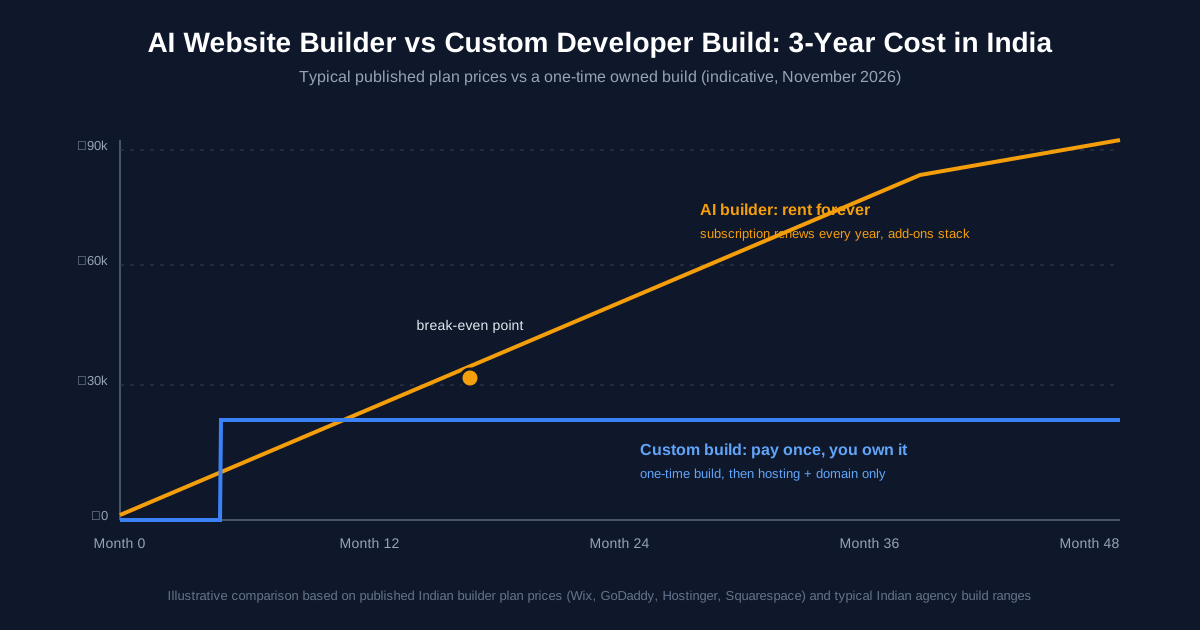
The pattern in the chart above is the whole argument. The builder line never flattens; it climbs every year and climbs faster once you add features. The custom line steps up once and then sits near the floor. Where those lines cross depends on your plan price, but with typical Indian numbers it lands somewhere in year two.
Hidden Costs That Never Show in the Ad
- Premium add-ons: booking, payments and forms often sit behind higher tiers
- Domain renewal from year 2, often at a higher rate than the bundled year 1
- 18% GST on top of every subscription payment
- Transaction or platform fees on stores, per order, forever
- Your own hours: content, layout fixes, SEO basics, months of them
- The eventual rebuild, because there is no clean export from most builders
None of these are hidden from the vendor. They are just never in the ad.
When a Builder Is the Right Call
Fairness matters here, so plainly: if you are validating an idea, building a temporary event page, or you genuinely cannot spend anything upfront, take the builder. A live imperfect site beats a perfect site that does not exist. Our custom vs WordPress comparison covers a related middle ground if you want an owned site without full custom pricing.
Switch to a custom build when two or more of these are true: you take payments, you need bookings or WhatsApp flows, enquiries from Google are part of your growth plan, or the website has started running real operations. At that point the builder is not saving money; it is charging rent on a ceiling.
Moving Off a Builder Later: Rebuild, Do Not Migrate
People ask whether we can "convert" their Wix or GoDaddy site to an owned build. We can carry over the content, images, URL structure and domain, but the site itself is rebuilt, because there is nothing exportable underneath. That is not a sales trick; it is how these platforms are designed.
The practical consequence: if you start on a builder, treat it as a test phase with a planned end date. Budget for the rebuild before you need it, and pick the builder's custom-domain option so your address never changes. We did exactly this sequence for the dental foundation project in our clinic website case study: start simple, prove demand, then build the owned version properly.
Common Mistakes Indian Founders Make With This Decision
Comparing month one instead of year three. ₹250 a month feels cheaper than ₹30,000 upfront until you do the multiplication and add the rebuild.
Choosing on looks. Both routes produce good-looking sites now. Appearance stopped being the differentiator years ago; what the site can do is the differentiator.
Underestimating DIY hours. Fifteen to thirty hours is a normal first-build range on a builder. For a founder billing ₹2,000 an hour of real work, that is the expensive option.
Picking the store plan too early. Shopify's ₹1,499 a month buys capabilities a brand selling ten products on WhatsApp does not need yet.
Ignoring who answers the leads. The site is half the system. Our guide to choosing a web development agency in India covers how to judge the whole package, not just the homepage mockup.
Where the Money Argument Ends
One more thing, because the cost table is not the whole story. A D2C brand we work with in the edible-oil space, covered in our D2C case study, sells through its own site because it needs the customer data, the GST-compliant invoicing and the margins that platform fees would eat. That is a business case, not a preference. If your equivalent case exists, the builder question answers itself; if it does not, save the money and start small.
If you want a straight opinion on which side of the line your business falls on, send us your current setup and what the site needs to do. We will tell you if a builder is enough. Our web design services page explains what we build, our work spans clients across India, and you can talk to us directly.
Frequently Asked Questions
Is an AI website builder enough for a small business in India?
For a simple brochure site with a contact form, yes. For anything involving payments, GST invoices, bookings, WhatsApp automation or ranking for competitive searches, builders become the constraint. Judge it by what the site must do, not by what it looks like.
How much does an AI website builder cost per year in India?
Published entry plans we checked in November 2026 run from about ₹3,000 per year (Wix Light) to about ₹8,400 (GoDaddy Starter), with Shopify Basic around ₹18,000 for stores. Add 18% GST, domain renewal from year 2, and paid add-ons. Verify current prices at checkout, as builders revise them frequently.
How much does a custom website cost in India?
A 5-10 page small-business site typically runs ₹10,000 to ₹40,000 from a freelancer and ₹25,000 to ₹1,20,000 from a small agency, one-time. Yearly costs afterwards are usually just hosting and domain, around ₹3,000 to ₹8,000. Full breakdowns by site type are in our website cost guide.
Can I move my site from Wix or GoDaddy to my own hosting later?
You can move your domain, content and images, but not the site itself. Builders do not export clean code, so the site gets rebuilt on the new platform. Keep your custom domain from the start so your address, Google history and printed materials survive the move.
Do I still need a developer if AI can write websites?
AI has changed how developers work, not whether the work exists. The parts AI drafts quickly are structure and copy. The parts that still need a professional are integrations with payment and billing systems, performance and SEO structure, security, and owning what gets deployed. Good agencies use AI daily and pass the speed savings on.
Can a builder site rank well on Google in India?
Builder sites can rank for low-competition local searches, and a complete Google Business Profile often matters more than the site for local enquiries. But for competitive terms, control of page speed, HTML structure, schema and internal linking decides outcomes, and that control lives on an owned site.
Builder Enough, or Time to Own?
Send us your current setup and what the site needs to do. We will tell you honestly whether a builder is fine or a custom build pays for itself. We build owned, fast, SEO-ready websites for clinics, D2C brands and service businesses across India. See our web design services or browse our service locations.
Get a Straight Recommendation →