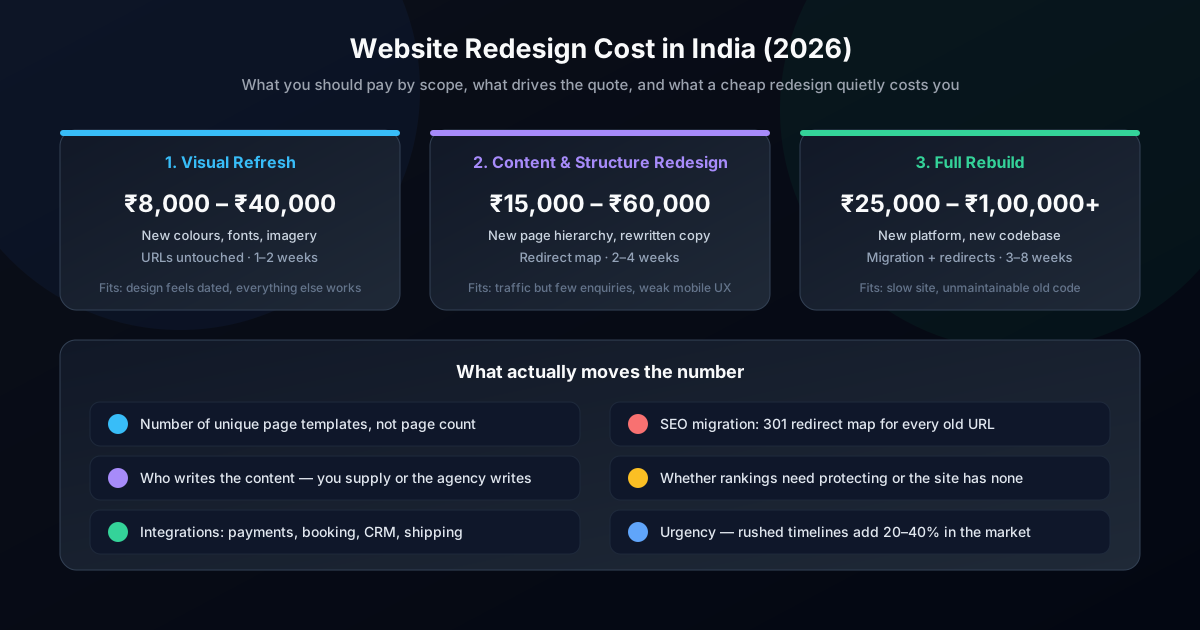
A website redesign in India costs ₹8,000–₹40,000 for a visual refresh, ₹15,000–₹60,000 for a content-and-structure redesign, and ₹25,000–₹1,00,000+ for a full platform rebuild at typical market rates. Small business rebuilds start from ₹5,999 with lean studios like Epiqu. The price is driven by scope, content, integrations, and the SEO migration work — not just design hours.
Somebody emailed us last month with a simple question: their site is five years old, it works, but it looks tired on a phone and nobody fills in the enquiry form anymore. What will a redesign cost them? The honest answer is "somewhere between ₹8,000 and ₹3,00,000," which is useless until you know which of three very different jobs you are actually buying. This guide breaks those jobs apart, shows real market price bands for each, and covers the part most quotes quietly skip — protecting whatever Google rankings your old site has earned.
How Much Does a Website Redesign Cost in India in 2026?
The first thing to understand: "redesign" means three different projects, and vendors quote them as one word. Get the scope wrong and every comparison you make is meaningless.
| Scope | What changes | Typical market price | Timeline |
|---|---|---|---|
| Visual refresh | Colours, fonts, imagery, small layout fixes. URLs and structure untouched. | ₹8,000 – ₹40,000 | 1–2 weeks |
| Content & structure redesign | New page hierarchy, rewritten copy, better mobile flow, redirect map for changed URLs. | ₹15,000 – ₹60,000 | 2–4 weeks |
| Full rebuild | New platform or codebase, migration of content and data, new templates, full SEO migration. | ₹25,000 – ₹1,00,000+ | 3–8 weeks |
Two honest notes on those numbers. First, they are market bands — freelancer quotes sit at the bottom, larger agencies at the top, and the same brief can legitimately differ by 5x between them. Second, a rebuild costs what a new site costs. Our own published pricing for a small business site starts at ₹5,999 as covered in our website development cost guide, and many lean studios price similarly. The ₹1,00,000+ quotes you see online usually buy you discovery workshops, account managers and office overhead — worth it for some companies, pure overhead for a 10-page clinic or D2C brand.
Redesign or Rebuild? How to Tell What You Actually Need
At first I used to treat every redesign enquiry the same. Turns out the cheapest service is frequently the wrong one, and the diagnosis matters more than the quote.
| Your symptom | What it usually needs |
|---|---|
| Looks dated but enquiries still come in and pages load fine | Visual refresh. Cheapest option, lowest risk, done in days. |
| Decent traffic, almost nobody converts; navigation confuses people on mobile | Content & structure redesign. The problem is the journey, not the paint. |
| Pages take 5+ seconds to load, codebase nobody can edit, plugin warnings everywhere | Full rebuild. Patching a rotten foundation costs more over two years. |
| You cannot update a price or add a page without paying the original developer | Rebuild on a platform you control. Lock-in is the real product you were sold. |
That last row deserves emphasis. A surprising share of "redesign" requests we see are really escape requests — the owner is trapped in a builder or a proprietary CMS where every small edit needs a support ticket. If that is you, compare quotes against a clean rebuild rather than a refresh. Our custom website vs WordPress comparison covers that trade-off in detail.
What Actually Drives the Quote
Design hours are rarely the biggest line. When we scope redesigns, these five things move the number far more:
- Unique templates, not page count. A 40-page site built from six templates is cheaper than a 15-page site where every page is bespoke. Ask vendors to price templates and tell them how many pages sit under each.
- Who writes the content. Rewriting 12 pages of service copy is real work and often 20–30% of the project. Supply polished copy and the quote drops sharply; expect "content included" claims to mean one polish pass, not writing from scratch.
- Integrations. Payment gateway, appointment booking, WhatsApp flows, CRM sync, shipping APIs — each one adds setup and testing time. A redesign that must preserve these is a different project from a brochure site.
- SEO migration. Building a redirect map for every changed URL, preserving titles and metadata, and re-verifying after launch is careful, unglamorous work. Skip it and you will pay for it in lost traffic instead.
- Urgency. In the Indian market, compressed timelines typically add 20–40% because the team reshuffles other client work to fit you in. If the deadline is self-imposed, relaxing it is the cheapest discount available.
Will a Redesign Hurt Your Google Rankings?
It can, and the mechanism is boring: URLs. Google ranks individual addresses. When a redesign moves or deletes pages, every address that vanishes without a redirect throws away whatever trust that page earned. Google's own documentation on redirects is blunt about this — permanent 301 redirects are the way to tell both users and crawlers that a page moved. New URLs with no redirect start from zero.
Before any redesign we run, this is the migration checklist:
- Crawl the old site first. Export every indexed URL from Search Console and a crawler. You cannot map what you have not listed.
- Build a 1:1 redirect map. Every old URL gets a closest-match new URL, even if the answer is the homepage. 404s are how rankings quietly die.
- Keep what works. Pages that rank should keep their URL and their core content. Change design around them, not the address itself.
- Staging first, then launch. Preview the full site on a staging domain, check it on a real phone, then cut over.
- Re-verify the week after launch. Search Console coverage, sitemap resubmission, and a spot-check that key pages still render and load fast — our INP optimization guide covers the speed side.
Handled this way, a redesign usually finishes stronger than it started, because new builds are faster and better structured for mobile and for AI search. There is one more angle worth knowing: search is shifting toward AI answers, and an old site's thin, unstructured pages rarely get cited. Our AI search visibility guide explains what to build in while the site is already open on the operating table.
The Costs Nobody Puts in the Quote
Comparing two quotes on the headline number is how budget surprises happen. These items get billed separately more often than not:
- Content and photography. Rewritten copy, new product photos, icon sets and stock licences.
- Premium plugins and themes. Common on WordPress rebuilds; annual licences renew every year.
- Ongoing maintenance. Updates, backups, and small changes are usually a separate annual plan.
- GST. Indian quotes are normally exclusive of 18% GST. An inclusive and exclusive quote can look 18% apart while being identical — always ask which way it is stated.
- Ownership. Ask who owns the design files and code at the end, in writing. Some budget builds hold your site hostage on their hosting.
How We Handle Redesigns at Epiqu
We are a small studio, so our redesigns start with an audit, not a mood board: pull the Search Console data, crawl the old URLs, check what actually ranks and what converts, and only then talk design. If the audit says a visual refresh solves it, we say so and quote the refresh — a rebuild we did not need is not a favour to anyone.
When a rebuild is the right call, the work looks like what we did for the photography studio in our Aura Cinematic case study: a clean, fast, mobile-first site with WhatsApp contact baked in, structured so the owner can update work galleries without touching code. For clinics the same pattern applies with appointment intent front and centre — our clinic website cost guide walks through that budget specifically.
One thing we do differently from the market's cheapest tier: every rebuild ships with the redirect map, the sitemap update, and a post-launch verification pass included, because leaving those out just converts a design problem into a traffic problem. If you are weighing vendors, our guide to choosing a web development agency in India lists the questions that separate the two.
When You Should Not Redesign at All
Occasionally the right answer is to keep your money. If the site loads fine, converts acceptably, and the only complaint is aesthetics, spend the budget where the returns are measurable instead: a properly built Google Business Profile, review generation, or the ongoing work described in our SEO cost guide. And if you are tempted by an AI site builder's ₹500-a-month pitch, read our AI website builder vs web developer comparison first — for some businesses it genuinely fits, for most it trades a one-time cost for a permanent subscription and a ceiling on what the site can do.
Not Sure Which Redesign You Need?
Send us your current URL. We will audit it, tell you plainly whether you need a refresh, a content redesign or a rebuild, and quote only that. We redesign and rebuild websites for clinics, D2C brands, photographers and service businesses across India — see our web design services or the work in our case studies.
Get a Redesign Audit →How much does a website redesign cost in India in 2026?
A visual refresh on an existing site typically costs ₹8,000 to ₹40,000 in the Indian market. A redesign that changes page structure and content runs ₹15,000 to ₹60,000, and a full rebuild on a new platform costs roughly what a new site costs — for small business sites that starts around ₹5,999 at studios like Epiqu and ₹25,000 to ₹3,00,000+ with larger agencies.
Will redesigning my website hurt my Google rankings?
It can, if old URLs disappear without 301 redirects. Every dropped URL loses its ranking history. With a complete redirect map, unchanged content on retained pages, and a staging preview before launch, most sites recover within weeks and many finish stronger because the new build loads faster.
How long does a website redesign take in India?
A visual refresh takes 1 to 2 weeks. A content-and-structure redesign of a 5 to 12 page business site takes 2 to 4 weeks. A full rebuild with migration takes 3 to 8 weeks, depending on how much content and how many integrations move across.
Is it cheaper to redesign or build a completely new website?
If your current site sits on clean, maintainable code, a redesign is cheaper because the foundation stays. If the old build is a tangled template nobody can safely edit, rebuilding is often the better value — you pay roughly the same either way, but the rebuild gives you a clean starting point instead of patching someone else's shortcuts.
What is usually not included in a website redesign quote?
Content rewriting, professional photography, product data cleanup, premium plugins or stock assets, ongoing maintenance, and paid tools are commonly billed separately. GST is usually quoted on top. Always ask what happens to your existing content and who owns the final files.
How often should an Indian business redesign its website?
There is no fixed cycle. Redesign when something measurable breaks: mobile experience, loading speed, conversion rate, or the site no longer reflects what you sell. A well-built site needs incremental updates, not a full redesign every two years.