Instagram is where Indian buyers discover you; it is no longer where the sale finishes. Meta moved Shops to website checkout between June and August 2025, so every organic Instagram sale now closes off-app — usually over DMs or on your own site. Keep Instagram for discovery and Reels, and move checkout — payments, invoices, order records — to a website you own with UPI and COD.
If you sell on Instagram in India, you already know the daily routine. A Reel does well, the comments fill up with "price please" and "DM sent", and the evening goes to answering the same five questions, confirming addresses, sending UPI QR screenshots and checking payment confirmations one by one. The product sold well. The paperwork nearly killed you.
In 2025 that routine stopped being a temporary stage and became permanent — because Meta quietly changed the rules. Instagram Shops no longer complete purchases inside the app. Every tag, every "Shop Now" tap now has to land somewhere you control. For sellers, that makes the Instagram-or-website question concrete in a way it never was before: the platform you built your audience on has officially handed the checkout back to you.
We build websites for exactly these businesses — Instagram-first sellers, D2C food brands, clinics and studios — so this piece is not a platform comparison chart. It is what actually breaks when you run a business inside DMs, what a website fixes, what it costs, and how we handle the switch for clients.
What changed with checkout on Instagram Shops?
Here is the sequence, briefly. In February 2023 Instagram removed the Shop tab from its main navigation, and in March 2023 Live Shopping ended. Then, starting in June 2025, Meta began moving all Shops to website checkout — its own Business Help Center says shops would "gradually begin using website checkout instead of checkout on Facebook or Instagram". Most shops completed the switch by the end of August 2025. The Commerce Manager orders tab went quiet. The "Buy Now" button on an organic post stopped finishing a sale.
What remains is real but narrower: product tags still work, the shop still shows on your profile, and Reels still drive discovery. But tapping a product now routes the buyer off the app — to your website link, or to a DM. Digital products, subscriptions and most services cannot be listed in Instagram Shop at all.
And the 2026 twist: Meta is bringing in-app buying back, but only inside paid ads — a one-tap "Buy Now" checkout built with Stripe and PayPal, and in-ad product browsing switched on from 28 October 2026. In other words, checkout inside Instagram is becoming an advertising feature. Organic sellers — the ones who built their audience without ad budgets — still need a destination of their own.
What is Instagram still good for in 2026?
Discovery, and nothing else comes close to it. Reels put your product in front of people who were not searching for it, and that is a genuine advantage no website can replicate — a website waits to be found; Instagram pushes you into feeds. For visual products — clothing, food, jewellery, home decor, handmade anything — the platform's reach in India is the reason most sellers have an audience at all.
So the honest framing is not "Instagram bad, website good". It is that the two do different jobs. Instagram's job: reach, trust-building through content, social proof in comments. The website's job: everything after "I want it". The businesses that struggle are the ones asking Instagram to do both.
Where does selling over DMs actually break?
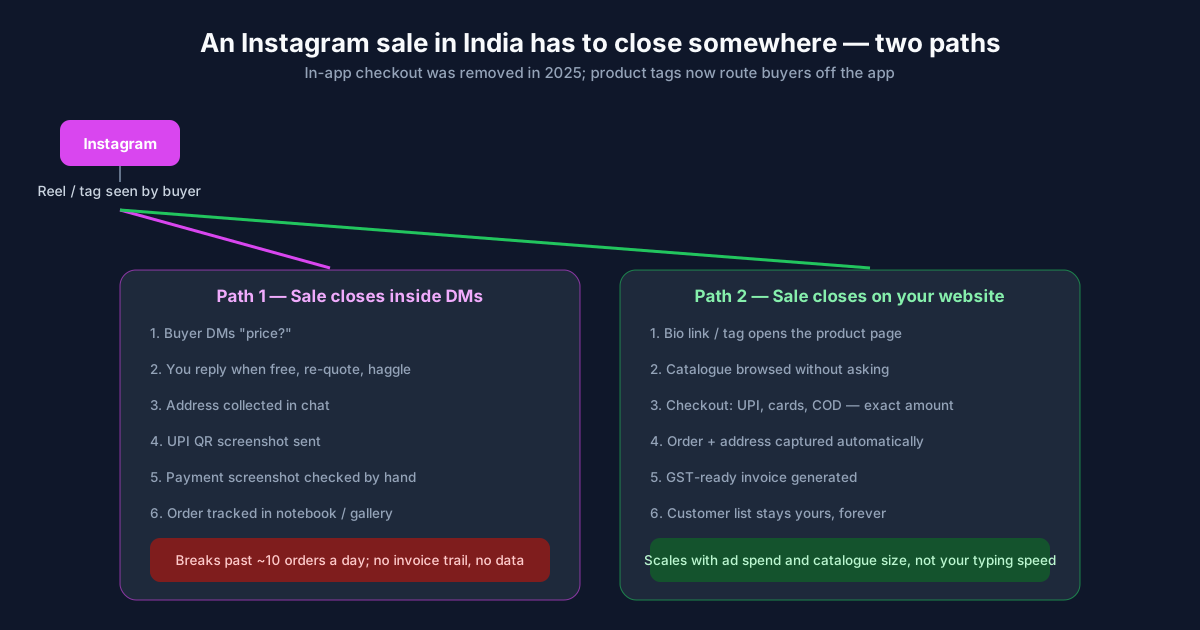
Every founder has a number in their head for when it got too much. For most, it lands somewhere around ten orders a day, or one busy festival weekend. The comparison below is what changes at that point.
| What happens | Sale closed in DMs | Sale closed on your website |
|---|---|---|
| Payment | UPI QR screenshot; buyer types the amount, short payments and "I sent it" disputes are common | UPI, cards, COD at checkout with the exact amount and automatic confirmation |
| Order record | Scattered across chats, screenshots and a notebook | Every order captured in one dashboard with address and payment status |
| GST invoice | Prepared manually, if at all — the trail auditors ask about does not exist | Generated per order, ready for filing |
| Capacity limit | Your typing speed and working hours | Ad spend and catalogue size |
| Customer data | Meta's — no export, no re-marketing list, gone if the account is restricted | Yours — repeat-buyer lists, remarketing, email and WhatsApp follow-ups |
| Google visibility | Zero — Instagram posts do not rank | Product pages can rank for years |
Two of those rows deserve emphasis. The payments row is the hidden tax on DM selling: a customer paying a personal UPI QR pays nothing extra, but you pay in reconciliation time — matching every screenshot to an order, chasing underpayments. And the data row is the strategic one. After two years of selling in DMs you can have thousands of followers and no idea who your actual repeat customers are.
What does a website add that DMs cannot?
A checkout that closes the sale without you in the room. That is the core of it — the buyer taps your bio link, browses the catalogue, pays the exact amount by UPI or chooses cash on delivery, and the order, address and invoice all exist before you have opened the chat. Payments ride on India's rails: UPI processed 25.47 billion transactions in October 2026 alone, with merchant payments making up nearly two-thirds of volume, so the plumbing at checkout is something every Indian buyer already uses daily.
Beyond checkout, the quieter additions matter just as much to a growing seller. A catalogue that answers "how much is it?" without a DM. Policy pages that make high-value buyers comfortable enough to pay a stranger on the internet. Discount codes for the festival sale instead of manually tracking who "used the code". And a customer list you can message again — which is where repeat revenue actually comes from, whether that list lives in your email tool or your WhatsApp broadcasts.
How much does a website cost an Instagram-first seller?
Less than most sellers expect, and far less than the revenue one lost festival weekend costs. Broad ranges for India, as of late 2026:
| Setup | Typical one-time cost | What you get | Fits when |
|---|---|---|---|
| Catalogue site with payment links | ₹15,000–₹25,000 | Product pages, bio-link checkout via UPI/COD links, WhatsApp deep links, basic SEO | Under ~50 SKUs, orders still partly manual |
| Proper store with order dashboard | ₹25,000–₹50,000 | Automated checkout, order dashboard, courier integration, GST-ready invoices, discount codes | 10+ orders a day, growing repeat business |
| Full custom build | ₹50,000–₹1,00,000+ | Custom design, integrations with inventory or accounting tools, performance work | Established D2C brand, multi-channel selling |
Ongoing costs are hosting, domain and maintenance — usually a few thousand rupees a month all-in. Our website development cost guide for India breaks these ranges down by business type and platform, including what changes if you compare a custom build against Shopify or WooCommerce.
One caution on timing costs against returns: a website does not bring traffic by itself. Instagram stays your traffic source — the site converts it. Sellers who expect a website to replace their Reels are the ones who end up with a beautiful page and four orders a month, a pattern we also saw when comparing quick commerce marketplaces against a D2C website for Indian brands. The channel that brought buyers before will keep bringing them; the site just stops leaking them.
Which businesses should add a website now?
- You regularly lose orders because a DM went unanswered for hours — checkout answers "price?" and "available?" without you.
- You are above roughly ten orders a day, or one person now spends their evening matching payment screenshots to orders.
- You sell anything above ₹2,000–₹3,000, where buyers hesitate to pay a DM with no website behind it.
- You need GST-ready invoices per order — manual invoicing does not survive a filing deadline.
- You want festival-season remarketing: a customer list you can message in November is worth more than a follower count.
- Your account has ever been restricted or flagged — if your only storefront can vanish overnight, the website is insurance.
- You are under five orders a day with a small catalogue: hold off. A WhatsApp ordering flow first, and revisit the website when volume justifies it.
That last line matters as much as the rest. We have built WhatsApp ordering flows for small food businesses in India, and for a home baker or a single-kitchen brand at low volume, that is the better first step. The mistake is not building a website too early — it is building it two years too late, after three festival seasons of orders that left no trace.
How we move Instagram sellers to a real checkout
For the sellers we work with, the migration is deliberately boring. Keep posting on Instagram exactly as before — nothing about the content changes. Add the website link to the bio and to every story highlight. Point the product tags at the site. Run both in parallel for a month: DM orders still get answered, but every reply now includes the product page link, so buyers who are ready can just pay. Then watch which orders still arrive as DMs — the remainder is usually bulk queries, negotiation and COD confirmations, which stay in chat where they belong.
The design decisions come from watching real buyers, not templates. COD stays prominent for fashion and Tier-2/Tier-3 audiences even though UPI dominates nationally — a checkout that hides COD loses those orders. Payment steps stay under three taps. And every product page carries the price visibly, because the single biggest time-saver is never answering "price please?" again. If you want this applied to your setup, see our web design services or browse our work across India.
Common mistakes when adding a website to an Instagram shop
The first is switching the bio link before the checkout works. One broken payment weekend costs more trust than six months of posting builds. Test the full flow yourself — order, pay, refund — before the Reels point at it.
The second is abandoning the DMs entirely on day one. Buyers who spent two years buying through chat will not all click a link immediately; run both routes in parallel and let the convenience of instant checkout do the migrating.
The third is pricing on the website that does not match what the DMs quote — nothing kills a checkout faster than a buyer discovering the price changed when they finally clicked. And the fourth is forgetting about payment costs: gateway checkout carries a per-transaction fee (typically around 2% plus 18% GST), and the MDR framework rolling out on select higher-value UPI merchant transactions — our UPI MDR guide for Indian merchants covers what that means — so the ₹0-reconciliation benefit of structured checkout comes with small, known fees attached. Budget for them; they are almost always cheaper than the hours they replace.
Your Reels Deserve a Real Checkout
We build catalogue websites and WhatsApp-first stores for Instagram sellers, D2C brands and service businesses across India — sized to your order volume, priced honestly. Browse our web design services and service locations, or see our India website cost guide first.
Turn Followers Into Orders →Sources: Meta Business Help Center, "About Changes to Shops and Checkout on Facebook and Instagram" (website-checkout migration from June 2025); SellFlow, "Instagram Checkout Is Gone: Where Your Sales Go Now" (September 2026 timeline of Shop tab removal, Live Shopping end, and the October 2026 in-ad checkout test); NPCI UPI product statistics for October 2026 (25.47 billion transactions, merchant payments ~63% of volume) as reported by MediaNama and Business Standard (November 2026). Cost ranges are typical Indian market rates, not quotes — get a specific estimate for your catalogue before budgeting. Re-checked 20 November 2026.
Can I still sell inside Instagram in India in 2026?
You can still be discovered there. Product tags and the shop on your profile work, but Meta moved Shops to website checkout between June and August 2025, so an organic post, Reel or tag can no longer complete a payment inside the app. The buyer finishes the purchase on the page you send them to.
Is taking orders over Instagram DMs okay for a small business?
It is how most Indian Instagram sellers start, and it works at low volume. It breaks down somewhere around ten orders a day: every order needs manual replies, address collection, a UPI QR screenshot and hand-checked payment confirmations, with no invoice trail and no record of who bought what.
How much does a website for an Instagram shop cost in India?
A clean catalogue website with UPI and COD checkout typically starts around ₹15,000–₹25,000 for a small range and ₹25,000–₹50,000 with courier integration, order dashboards and custom design. Ongoing costs are hosting, domain and maintenance. Our website development cost guide for India breaks the ranges down by business type.
Do I have to stop selling on Instagram once I build a website?
No, and you should not. Instagram stays your discovery engine — Reels, tags and Stories keep bringing new buyers. The website takes over the part Instagram no longer does: checkout, payments, invoices and customer records. The bio link simply gives every Reel somewhere to land.
Can I run orders through WhatsApp instead of a full website?
WhatsApp ordering is a strong middle step for food businesses and local sellers, and we have written about it in detail. It solves reply speed, but not the catalogue, GST-ready invoices, order records or Google visibility. Most businesses that outgrow DMs eventually add a website and keep WhatsApp for conversation.