For six years, every rupee a customer sent you over UPI arrived free. That ended this festive season: the government notified a Merchant Discount Rate of 0.4% on merchant UPI payments above ₹2,000, and every business collecting digital payments in India — clinics, D2C brands, coaching centres, B2B suppliers — needs to know what it will cost and who is exempt. Here is the full picture, including a detail most coverage missed: the start date has moved.
Merchants pay a 0.4% MDR on UPI payments above ₹2,000, capped at ₹300 for payments of ₹75,000 or more. Customers pay nothing, payments up to ₹2,000 stay free, and small merchants receiving up to ₹1 lakh a month through UPI are fully exempt. The original 15 October start was pushed to "immediately after Diwali, date to be notified" — as of mid-November 2026 that date is still pending.
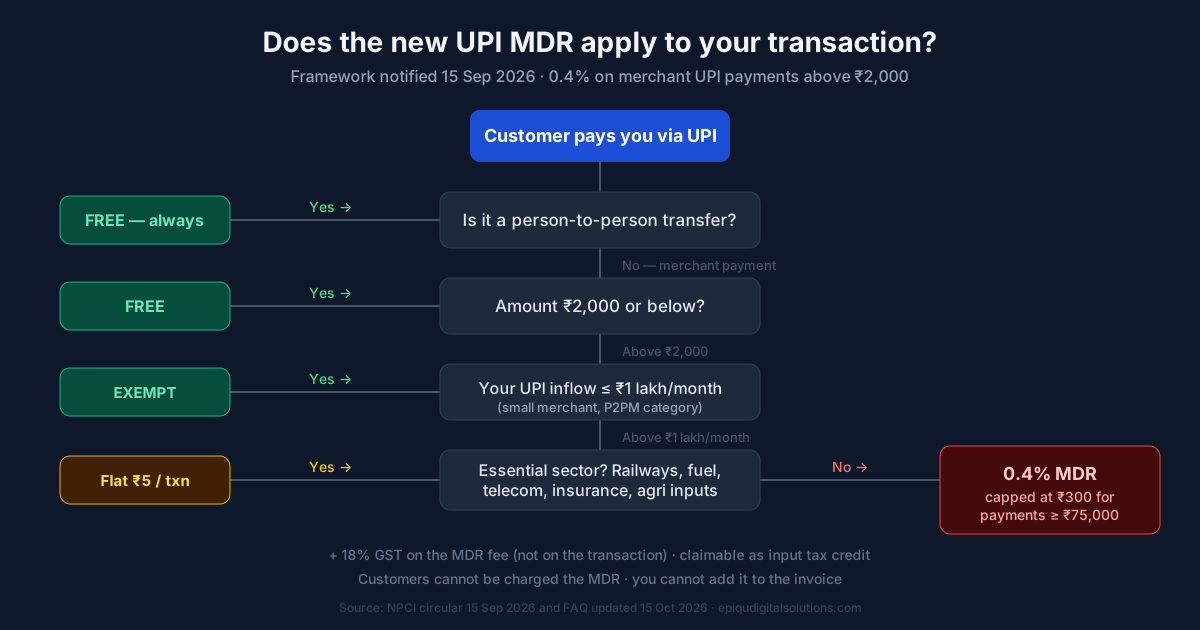
What is the new UPI MDR, and why was it brought in?
MDR stands for Merchant Discount Rate — the fee a merchant pays for accepting a digital payment. UPI has run at zero MDR for merchants since January 2020, which is a big part of why a street vendor and a ₹40-crore D2C brand both take payments the same way. That subsidy was paid for by banks and the government; the ecosystem argued it could not keep funding acceptance infrastructure indefinitely.
Parliament amended Section 10A of the Payment and Settlement Systems Act through the Taxation and Other Laws (Amendment) Act, 2026, a gazette notification followed on 14 September, and NPCI issued its revised framework the next day. The structure:
| Transaction type | MDR from the notified date | Notes |
|---|---|---|
| Person-to-person (any amount) | Free | Paying friends, family, rent — never charged. |
| Merchant payments up to ₹2,000 | Free | Includes RuPay debit. Covers over 95% of P2M transaction volume. |
| Merchant payments above ₹2,000 | 0.4%, capped at ₹300 | The cap kicks in at ₹75,000 and above. |
| Small merchants (P2PM, ≤ ₹1 lakh/month UPI inflow) | Exempt entirely | Kirana stores, auto drivers, small clinics on QR codes. |
| Essential sectors (railways, fuel, telecom, insurance, agri inputs) | Flat ₹5 above ₹2,000 | Fixed fee for cost stability in thin-margin services. |
| Capital markets (mutual funds, stockbrokers) | 0.02%, capped at ₹300 | Concession to encourage retail investing. |
NPCI's own affidavit to the Supreme Court says only about 4% of merchant transactions will actually attract the charge — everything else is either below ₹2,000 or exempt. But that 4% is the high-value end: big retail bills, insurance premiums, school fees, B2B invoices. That is exactly where margins get decided.
When does the UPI MDR actually start?
This is where most articles you have read are already out of date. The framework was announced with an effective date of 15 October 2026. On 13 October, NPCI's press releases revised that: implementation would happen "immediately post Diwali at a date to be notified separately". Diwali has now passed, and as of mid-November 2026 that notification has still not been issued — CNBC-TV18 reported on 11 November that the date is pending, along with an NPCI scheme to fund QR codes and soundboxes for small merchants using 5% of future MDR collections.
Practically, that means two things. First, do not treat any specific date as final until NPCI announces it — including the 15 October date still floating around news archives. Second, treat this as prep time, not a reprieve. Banks and payment aggregators are building the billing plumbing now, and when the date lands, it will apply immediately. The framework itself is settled: rates, caps and exemptions will not change between now and go-live.
Who is exempt from the UPI MDR?
Run your own situation against this list before you budget anything:
- You only receive P2P transfers: customers paying "to a person" UPI ID instead of a merchant QR — free, any amount. (We would not recommend building a business on that distinction, but it is the rule.)
- Your average ticket is under ₹2,000: a salon, a café, most clinic consultations — effectively unaffected.
- Your total UPI inflow is under ₹1 lakh a month: the P2PM small-merchant exemption removes the charge regardless of individual ticket size. This is the single most important line for micro-businesses.
- You sell into essential sectors: flat ₹5 per transaction above ₹2,000 instead of a percentage — better for you at high values.
- You invoice over ₹75,000 per transaction: the ₹300 cap means a ₹5 lakh payment costs the same as a ₹75,000 one. High-value B2B sellers benefit disproportionately.
The exemption worth double-checking is the ₹1 lakh monthly threshold. It applies per merchant under the P2PM classification, and if your UPI collections cross it in a month, the standard rates apply. A clinic doing ₹90,000 a month through UPI is exempt today; a clinic doing ₹1.4 lakh is not. Track it monthly, not annually.
What will the MDR actually cost your business?
At 0.4%, the arithmetic is small per transaction. On an eligible payment:
| Payment value | MDR at 0.4% | 18% GST on MDR | Total deduction |
|---|---|---|---|
| ₹3,000 | ₹12 | ₹2.16 | ₹14.16 |
| ₹10,000 | ₹40 | ₹7.20 | ₹47.20 |
| ₹50,000 | ₹200 | ₹36 | ₹236 |
| ₹1,00,000 | ₹300 (capped) | ₹54 | ₹354 |
Two things about the GST line. It is charged on the MDR fee, not on your sale — the Finance Ministry clarified this before implementation, precisely to stop rumours of a "UPI tax". And if you are GST-registered, that GST component is generally claimable as input tax credit, which shaves the effective cost back down.
To size it for your business, take your monthly UPI collections, subtract everything at or below ₹2,000, multiply the remainder by 0.4%. A store collecting ₹5 lakh a month in UPI payments above ₹2,000 would budget around ₹2,000 plus GST. For most merchants that is less than the cost of one missed delivery or a single day of card-only checkout — real, but not existential.
How does MDR change the total cost of a website payment?
Here is the part nobody's headline mentions: if you collect UPI through a website or app, you were already paying a fee on those payments. UPI's zero-MDR rule stopped the bank-side charge, but payment aggregators charge their own platform fee. Razorpay's published standard rate is 2% per successful transaction plus GST, and Cashfree lists 1.95% on UPI — both checked against their November 2026 pricing pages.
So the honest cost stack for a ₹10,000 website order paid by UPI looks like this:
| Cost component | QR / direct UPI | Website checkout (gateway) |
|---|---|---|
| MDR (new, from notified date) | ₹40 + GST | ₹40 + GST |
| Gateway platform fee | ₹0 | ₹195–200 + GST |
| Approximate total on ₹10,000 | ₹47 | ₹270–280 |
The takeaway is counterintuitive: the MDR is the smaller line for anyone selling online. A D2C brand losing sleep over 0.4% has bigger fish in its gateway contract — negotiated rates at scale routinely beat the published ones, and it is worth a call to your account manager before you optimise anything else. Our payment gateway charges comparison for India breaks the published rates down in detail.
Can you pass the UPI MDR on to customers?
No, and do not try. When the framework was challenged in the Supreme Court in late September, NPCI filed an affidavit on 3 November stating that merchants cannot pass MDR charges to customers, that UPI apps cannot add their own platform fees on payments, and that violations invite compliance action — up to termination of a provider's UPI membership. The government is also monitoring implementation daily specifically to catch any pass-through.
The legal challenge is still pending, so a future ruling could change something. But the operating assumption for every business right now should be: the MDR is your cost, it comes off the settlement, and adding a "UPI charge" line to an invoice is the kind of shortcut that gets a payment provider to freeze your account.
How we are preparing client checkouts for MDR
We build payment-enabled websites and booking flows for clinics, D2C brands and service businesses across India, and the MDR prep has turned out to be mostly boring accounting work — which is exactly what it should be. What we are actually doing for clients:
- Classifying each client against the exemptions first. Most clinic and small-service clients sit under the ₹1 lakh/month P2PM threshold or under ₹2,000 tickets, which means their checkout needs zero changes. Knowing that early stops a lot of unnecessary panic.
- Separating UPI inflow from gateway volume. The ₹1 lakh exemption is measured on UPI QR inflow, not total gateway turnover. A client taking ₹2 lakh through cards but ₹80,000 through UPI may still be exempt on the UPI side. This needs a per-instrument report from the gateway dashboard, not a glance at the monthly total.
- Auditing the gateway fee before worrying about the MDR. As the table above shows, the platform fee is usually 4–5× the MDR for online sellers. Fixing that (renegotiating, or moving high volume to a better-priced provider) pays more than any MDR workaround.
- Keeping instrument choice visible at checkout. We are not hiding UPI or nudging customers to cards to dodge the fee — beyond being against the spirit of the pass-through prohibition, it damages conversion. Cards already cost the gateway 2%+; UPI at 0.4% remains the cheapest instrument you can offer.
One honest limitation: until NPCI notifies the implementation date, no provider can show you exactly how the MDR will appear on your settlement reports — as a separate line, netted off, or bundled. Budget for it, reconcile one month carefully after go-live, and expect the first statement to need a human read.
What should you do this week?
If you take UPI payments in any form, three actions cover you:
- Pull your last 3 months of UPI collections and check them against the ₹2,000 ticket and ₹1 lakh/month thresholds. If you are under both, you are exempt — file the numbers somewhere you can re-check monthly.
- Read your gateway's pricing page and your actual settlement statements side by side. Work out what a ₹10,000 order really costs you today, so the MDR lands as a known line, not a surprise.
- Brief whoever reconciles settlements that from the notified date, UPI amounts received will be net of 0.4% + GST on eligible transactions, and that the GST part may be claimable as input credit.
Nothing here requires rebuilding your checkout. For most Indian businesses the change is a rounding error on the P&L — the ones who get burned are those who discover it from their first short-settled payout instead of from a plan.
Collecting payments through your website?
We build and maintain payment-enabled websites and booking flows for clinics, D2C brands and service businesses across India — including gateway setup, settlement reconciliation and UPI cost planning.
Talk to us about your payment setup See our development servicesSources: NPCI's official MDR FAQ (updated 15 October 2026), The Hindu's report on the 15 September 2026 circular, and Mint's coverage of the GST treatment and daily monitoring. Gateway rates are each provider's published standard pricing, checked November 2026.
For related reading: how UPI AutoPay recurring payments work for Indian businesses (mandates stay free under the new framework), and how D2C brands are choosing between quick commerce platforms and their own website when every rupee of margin is being counted.