Indian service exporters, SaaS companies, and D2C brands lose thousands of dollars each month to hidden foreign exchange markups, payment gateway cuts, and manual banking paperwork. Choosing the right payment channel in 2026 cuts transaction leakage from 10% down to under 1.5% while automating mandatory Reserve Bank of India (RBI) export compliance.
To accept international payments in India in 2026: use virtual export accounts (Razorpay MoneySaver, Skydo, or Wise Business) for B2B invoices over $1,000 to keep transaction costs under 1.5% via local ACH and SWIFT. For website checkout and D2C carts, use Razorpay International or Cashfree (3% to 4% + forex markup). Always file a GST LUT and ensure your gateway provides automated digital e-FIRA downloads to keep export earnings zero-rated.
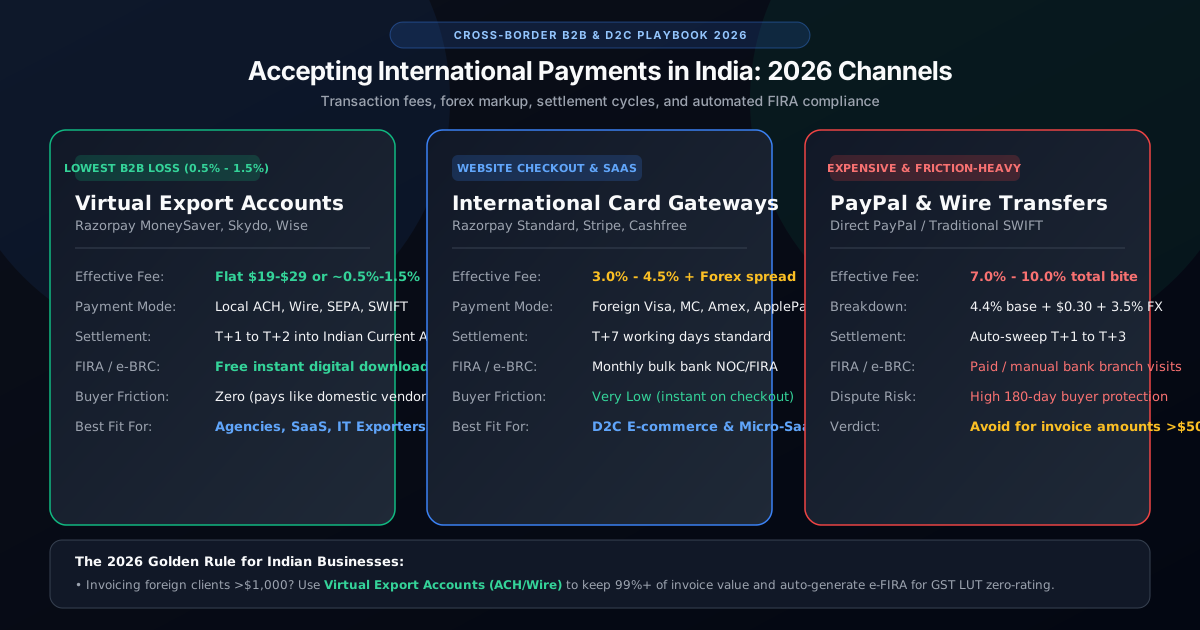
Where Indian Exporters Lose Money: The 3 Hidden Costs of Foreign Payments
Most founders look only at the headline transaction rate quoted on a gateway pricing page. If an aggregator advertises 3%, they assume a $5,000 invoice will cost $150 to process. When the money lands in their Indian current account, they find only $4,550. That missing $300 vanished into three separate financial layers:
| Cost Layer | What You See | What You Actually Pay | How It Hits Your Margin |
|---|---|---|---|
| Base Gateway Processing Fee | 2.5% to 4.4% | Stated fee + 18% GST on the fee | Deducted immediately at checkout or settlement. |
| Forex Conversion Markup | "Zero FX fees" or not disclosed | 2% to 4% above interbank mid-market rate | The provider converts USD to INR at Rs 84 when interbank shows Rs 86.5. That 3% difference is pure provider margin. |
| Correspondent / Intermediary Bank Cuts | "$0 outward fee" | $15 to $45 flat per SWIFT hop | Intermediary foreign banks skim processing tolls off the wire before it reaches your Indian receiving bank. |
| Manual FIRA / NOC Bank Charges | Not mentioned during onboarding | Rs 250 to Rs 1,500 per transaction | Traditional banks charge a fee to stamp a physical Foreign Inward Remittance Certificate (FIRC) needed for GST audits. |
On a $5,000 client project, using PayPal burns roughly $420 in cumulative fees and currency conversion markdown. The exact same payment routed through an Indian virtual export account costs around $29 flat, keeping an extra Rs 32,000 in your business bank account.
2026 Comparison: Top Payment Channels for Indian Businesses
Indian companies handle international money through four distinct channels. Selecting the correct rail depends on whether you run an agency sending monthly invoices, an e-commerce store with a public shopping cart, or a B2B SaaS platform.
| Solution | Best Use Case | Effective All-In Cost | Settlement Timeline | e-FIRA Handling |
|---|---|---|---|---|
| Razorpay MoneySaver (Export) | B2B Agencies, IT Services, SaaS | Flat $19 to $29 per incoming ACH/Wire or ~0.5% | T+1 to T+2 into Indian bank | Free instant digital download in dashboard |
| Skydo / Wise Business | Freelancers, Tech Consultants, MSMEs | Flat $19 to $29 per invoice (zero FX markup) | 24 to 48 hours | Free automated digital FIRA |
| Razorpay International / Cashfree | D2C E-commerce, Courses, Digital Products | 3.0% to 3.5% + forex spread (~5% total) | T+7 business days | Monthly consolidated bank certificate |
| Stripe India (Invite-Only) | SaaS Billing, International Subscriptions | 3.0% + Rs 3 per transaction + 2% FX fee | Rolling 5 to 7 days | Automated digital delivery via partner bank |
| Legacy PayPal India | Small transactions (<$200) where buyer insists | 4.4% + $0.30 fixed + 3.5% currency markup (~8-10%) | T+1 auto-sweep to domestic bank | Manual request or portal download |
| Direct Bank SWIFT Wire | Enterprise contracts (>$20,000) | $25-$50 intermediary fee + bank FX spread (1.5-2.5%) | 2 to 5 banking days | Manual request at home branch (Rs 500+ fee) |
B2B Invoicing: Why Virtual Export Accounts Beat Card Gateways
If you bill corporate clients in the United States, Europe, the United Kingdom, or Australia, asking them to pay via credit card is a costly mistake. Foreign enterprise finance teams dislike paying five-figure invoices by card because of card limits, foreign transaction surcharges on corporate accounts, and audit policies. They prefer standard domestic bank transfers: ACH in the US, SEPA in Europe, Faster Payments in the UK, and EFT in Canada.
Virtual export accounts solve this by giving your Indian business local bank account details in foreign jurisdictions:
- Local Receiving Rails: Your invoice displays a US routing and account number (or an EU IBAN). The client makes a routine domestic transfer through their existing bank portal with zero wire fees.
- Transparent Forex Margins: Instead of taking a 4% currency cut, modern providers charge the live interbank exchange rate plus a transparent flat fee ($19 to $29) or a capped markup below 0.8%.
- Zero Chargeback Vulnerability: Credit card processing allows buyers up to 120 or 180 days to dispute payments. Bank-to-bank ACH and wire transfers are irreversible once cleared.
- Direct Current Account Credit: The funds convert into Indian Rupees and land in your HDFC, ICICI, Axis, or SBI current account within 24 to 48 hours.
D2C E-commerce & Micro-SaaS: Optimizing International Checkout
For online retailers and software companies selling directly through a website, self-serve credit and debit card processing is mandatory. You cannot send a manual invoice to a customer buying a $45 physical product or a $20 monthly subscription.
Converting international buyers on an Indian website requires eliminating specific checkout obstacles:
Key Rules for High-Converting International Checkout
- 1. Present Local Currencies: Never force an American, British, or European customer to calculate INR exchange rates in their head. Display clean prices in USD, EUR, or GBP. Our development team sets up dynamic geo-IP currency switching on custom business websites to present the buyer home currency instantly.
- 2. Prepare for 3DS Behavioral Differences: While Indian domestic cards require two-factor SMS OTP or app prompts for every rupee spent, international cards often skip 3DS for low-risk transactions. Your payment gateway must correctly configure risk-based 3DS fallback so foreign cards process without failing OTP screens.
- 3. Activate Alternative Wallets: Over 60% of US mobile shoppers prefer Apple Pay or Google Pay over entering 16-digit card numbers. Use payment gateways that support native digital wallet sheets on iOS and Android browsers.
- 4. Provide Upfront Shipping and Delivery Timelines: International buyers immediately abandon carts if cross-border courier timelines, duties, and return terms are unclear.
Mandatory Compliance: RBI Norms, e-FIRA, and GST LUT
Accepting foreign currency into India requires strict adherence to regulatory rules. Failing to set up your compliance pipeline correctly can trigger tax penalties and freeze your payment gateway settlements.
| Requirement | Authority | Why It Matters | Action Required |
|---|---|---|---|
| GST Letter of Undertaking (LUT) | GST Portal (CBIC) | Allows exporting services at 0% tax instead of paying 18% IGST upfront and waiting months for refunds. | File Form GST RFD-11 annually online before April 1st. Takes under 10 minutes with your DSC or EVC. |
| Import Export Code (IEC) | DGFT | Primary identifier for all foreign trade entities recognized by the Reserve Bank of India. | Mandatory for goods exporters and recommended for service exporters billing international clients. |
| e-FIRA / Digital NOC | Authorised Dealer (AD-1) Banks | Statutory proof that your invoice payment was received in convertible foreign currency. | Essential during GST audits to defend zero-rated export status. Choose gateways that generate this automatically. |
| Purpose Code Declaration | Reserve Bank of India | Categorizes the exact nature of your service export (e.g., P0802 for software, P0803 for data processing, P1007 for advertising). | Set your default RBI purpose code correctly in your payment gateway dashboard during initial setup. |
Step-by-Step Setup: From Zero to Receiving Global Revenue
Setting up a cross-border payment funnel for your business takes four logical steps:
- Register for GST and File Your LUT: Obtain your GSTIN and file Form GST RFD-11 on the official GST portal. This ensures that every foreign invoice you generate is treated as a zero-rated export of service.
- Open a B2B Virtual Collection Account: Create an account with a platform like Razorpay MoneySaver or Skydo. Complete company KYC with your Certificate of Incorporation, company PAN, cancelled cheque, and an active business website.
- Configure Multi-Currency Checkout on Your Site: For automated sales, connect payment APIs to your custom website. Display native pricing in foreign currencies, configure webhooks for automated receipt generation, and ensure real-time inventory locking.
- Automate Remittance Advice Reconciliations: At the close of every month, download the electronic FIRAs for every incoming foreign batch. Store them in your accounting archive alongside matching client invoices for your quarterly GST filings.
Our Recommended Stack for Indian Businesses
At Epiqu, we build digital infrastructure for companies across India. Based on actual transaction data and operational overhead, here is our standard payment architecture recommendation:
- For B2B Agencies & Software Firms: Use Razorpay MoneySaver or Skydo for invoices over $1,000. You get ACH/wire receiving details, lose less than 1% to fees, and receive free automated digital FIRAs within 48 hours.
- For D2C Brands & Digital Products: Integrate Razorpay International or Cashfree on your website checkout. Pair with dynamic currency conversion and automated email order updates.
- For Cross-Border SaaS: If your company has a foreign subsidiary (US Delaware or Singapore entity), run global billing through Stripe. If operating strictly as an Indian entity, use Razorpay Subscriptions with international recurring billing enabled.
A reliable payment channel is only the final link in your sales pipeline. What drives international revenue is a fast, high-converting digital presence. Learn how we build high-performance business websites and custom application workflows that turn global visitors into paying customers. See our methodology in action in our healthcare digital infrastructure case study, or discover our service locations across India.
Frequently Asked Questions
What is the cheapest way to receive international B2B payments in India?
Virtual export accounts like Razorpay MoneySaver or Skydo are the cheapest for invoices above $1,000. They charge flat fees ($19 to $29) or low spreads (around 0.5% to 1.5%) using local ACH/wire rails, compared to 7% to 10% lost on PayPal or international credit cards.
Why are Indian founders finding it hard to get onboarded onto Stripe in 2026?
Stripe India operates under an invite-only model due to strict Reserve Bank of India Payment Aggregator Cross-Border (PA-CB) regulations and onboarding compliance. Most Indian businesses use Razorpay International, Cashfree, or specialized cross-border accounts instead.
What is an e-FIRA and why is it mandatory for Indian exporters?
An electronic Foreign Inward Remittance Advice (e-FIRA) proves that foreign currency entered India through authorized banking channels. It is required by tax authorities to zero-rate your export of services under a GST Letter of Undertaking (LUT) and avoid paying 18% IGST.
Can Indian D2C stores accept international credit cards without huge drop-offs?
Yes, by enabling 3D Secure fallback and multi-currency pricing in USD, EUR, or GBP via Razorpay International, Cashfree, or PayU. Pricing in the customer home currency prevents surprise foreign transaction fees on their bank statement, reducing checkout abandonment.
How does GST LUT work when receiving foreign client payments?
Under GST Rule 96A, filing a Letter of Undertaking (LUT) allows registered Indian businesses to export services at zero tax without paying 18% IGST upfront. You must receive payments in convertible foreign exchange within one year and retain the e-FIRA for every inward transaction.
Build a Global Business Infrastructure That Converts
International payment rails work best when paired with fast websites and frictionless user journeys. Epiqu builds custom digital solutions that help Indian businesses scale worldwide. Explore our web design and development services, review our custom software development offerings, or get in touch with Epiqu today.
Get a Free Consultation →