From 1 October 2026, the WhatsApp Business Platform charges ₹0.115 per delivered service message in India — the free-form replies your team or chatbot sends inside the 24-hour support window. The first 1,000 service messages per number each month are free; after that it is ₹0.115 + 18% GST per message, with no volume discount. Consolidating replies and deflecting repeat questions keeps the bill small.
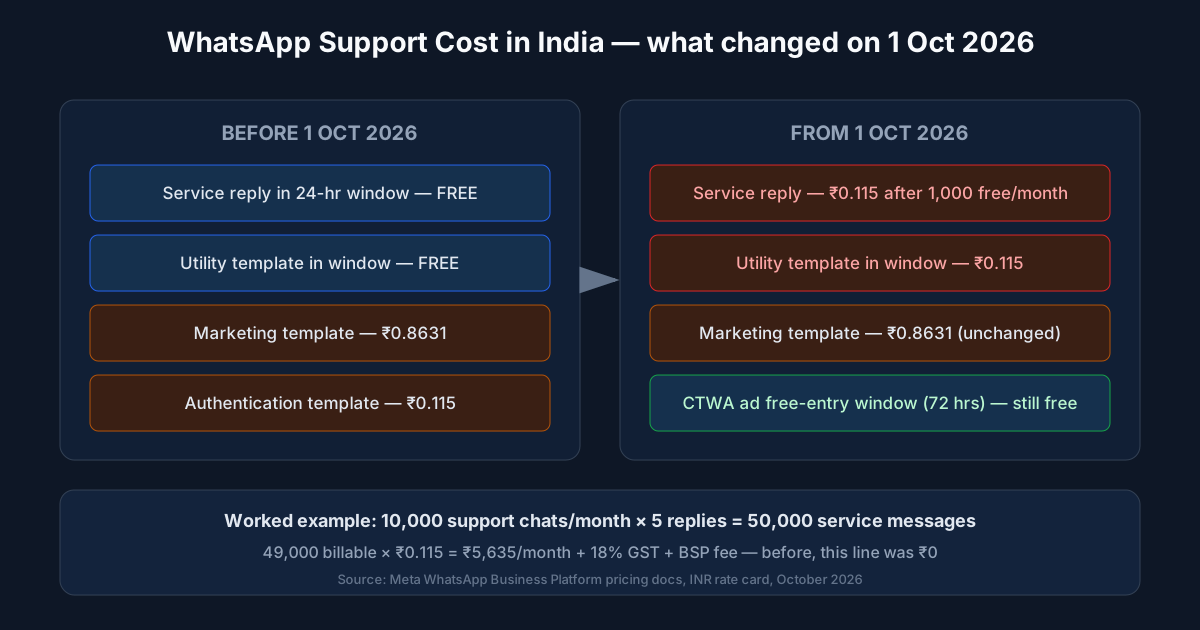
For almost two years, answering a customer on WhatsApp cost an Indian business nothing. A customer messaged, your team replied inside the 24-hour window, and Meta sent the invoice with a zero on that line. That ended on 1 October 2026, and most owners we speak to had no idea until they opened the month's invoice. This guide walks through exactly what is charged now, what is still free, what the new bill looks like at realistic volumes, and the seven changes we make when a client's WhatsApp support bill starts climbing.
We build WhatsApp automation and AI support agents for businesses across India — clinics, D2C brands, coaching institutes, manufacturers — so this change sits squarely in our lane. Everything below is based on Meta's published pricing documentation and what we see on real accounts, not guesswork. For the full rate card across all four message categories, see our WhatsApp Business API pricing guide for India.
What Changed on 1 October 2026?
Two message types moved from free to charged on the same day, and both landed at the same rate as utility messages in India: ₹0.115 per delivered message.
| Message type | What it is | Before 1 Oct | From 1 Oct |
|---|---|---|---|
| Service message | Any free-form reply your team or third-party AI sends inside the open 24-hour window | Free | ₹0.115 after 1,000 free/month |
| Utility template in window | Order updates and reminders sent while a conversation is already open | Free | ₹0.115 |
| Marketing template | Offers, broadcasts, abandoned-cart nudges | ₹0.8631 | ₹0.8631 (unchanged) |
| Authentication template | OTPs and login codes | ₹0.115 | ₹0.115 (unchanged) |
Three details matter as much as the rates. Meta charges on delivery, not on sending, so a failed message costs nothing. There are no volume tiers for service messages — your 100,000th reply costs the same as your 1,001st. And the free tier of 1,000 service messages resets monthly per phone number, with no rollover. Meta's own documentation confirms all three on its WhatsApp Business Platform pricing page.
What Is Still Free?
The headline makes it sound like everything costs money now. It does not. Four things remain free:
- Incoming messages. Meta charges businesses, never customers. A customer can message you a hundred times and your Meta bill does not move.
- The first 1,000 service replies per number each month. A small clinic or shop answering a few hundred conversations rarely crosses this line.
- Replies inside the free entry-point window. When a customer messages you from a Click-to-WhatsApp ad, a free window opens in which your replies — including marketing templates — draw no Meta charge. If you run CTWA ads, this is still your cheapest conversation channel. We covered the economics in our Click-to-WhatsApp ads cost guide.
- Failed deliveries. Opt-outs, invalid numbers and undelivered template sends do not draw a Meta charge.
What Your Support Bill Looks Like Now
Per-message rates sound trivial at ₹0.115. The bill comes from multiplication: every conversation, every reply, every month. These worked examples use the India rate card plus 18% GST and treat the platform fee separately because it varies by provider:
| Business profile | Monthly replies | Meta charge (est.) | With 18% GST |
|---|---|---|---|
| Small clinic — 400 chats × 2 replies | 800 | ₹0 (within free tier) | ₹0 |
| Growing D2C brand — 2,000 chats × 3 replies | 6,000 | ₹575 | ₹679 |
| Busy support desk — 10,000 chats × 5 replies | 50,000 | ₹5,635 | ₹6,649 |
| Marketplace-scale seller — 40,000 chats × 6 replies | 2,40,000 | ₹27,485 | ₹32,432 |
Read that table twice, because it cuts both ways. If you are in the top two rows, the change is a rounding error — do not let a BSP's sales pitch scare you into an expensive overhaul. If you are in the bottom rows, the Meta charge is still a fraction of what those same conversations cost in staff hours; one agent handling 1,000 chats a month costs far more than ₹6,649. But it is now a line item that grows with your success, and it rewards businesses that reply efficiently. The quick formula for your own numbers: (monthly replies − 1,000) × ₹0.115 × 1.18.
Seven Ways to Keep the Bill Down
Nothing here requires a developer. Every item is a workflow or a settings change, ordered by the size of the saving we typically see.
1. Stop sending reply bursts
Indian support teams love splitting one answer into four messages: a greeting, the answer, a follow-up link, a closing line. Each one is a separate ₹0.115 charge now. Train agents — and configure bots — to send one complete reply. Four messages per conversation down to two halves the service line on high-volume accounts.
2. Answer the question fully the first time
Half of all support replies exist because the first reply was a holding message: "checking sir, one moment." A reply that includes the tracking link, the price list or the available slots ends the conversation. One that says "we will update you" guarantees a second reply, and often a third. On the accounts we manage, killing holding messages is the single biggest saving.
3. Deflect the repeat questions
Every business has the same twenty questions: timings, prices, delivery area, refund policy. Put the answers where customers find them without a human — a WhatsApp catalogue, an auto-reply with links, or WhatsApp Flows for things like slot booking. Fewer conversations opened means fewer service messages at all. This is also where an AI support agent earns its keep, which we cover in the comparison below.
4. Route paid traffic through Click-to-WhatsApp ads
A customer who messages from a CTWA ad opens a free entry-point window. Replies inside it, including marketing templates, draw no Meta charge. If your sales conversations start from Instagram or Facebook anyway, move the entry point from a landing page to a CTWA ad. Same customer, cheaper conversation.
5. Cap bot conversations
AI agents occasionally loop — repeating a question, retrying a failed action, or answering "I didn't understand" ten times. Each reply is a charge. Most platforms let you set a daily reply limit per customer and a human-handoff trigger after two failed attempts. Turn both on. A runaway bot is the worst-case bill scenario, and it is one checkbox away from prevention.
6. Merge your transactional updates
If you send an order confirmation, then a packed update, then a shipped update, then a delivered update, that is four utility charges per order. Two do the job: confirmation with the summary, and shipped with the tracking link. Utility messages are cheap, but at marketplace volumes the pattern adds real money.
7. Audit your numbers
The 1,000 free messages are per number per month. Some businesses run two or three numbers where one would do, often a legacy of old campaigns. Consolidating concentrates your free tier and trims per-number platform fees. The exception is genuinely separate teams with separate volumes, where separate numbers each get their own free 1,000.
Human Agents vs Third-Party AI vs Meta Business Agent
Since the pricing change, owners keep asking whether they should just switch support to Meta's own AI. Here is how the three options actually bill:
| Option | What Meta charges | Other costs | Best for |
|---|---|---|---|
| Human team | ₹0.115 per reply after the free tier | Salaries, inbox seats via your BSP | High-value sales and negotiation chats |
| Third-party AI agent | ₹0.115 per reply (service message, same as human) | AI token cost (₹1–₹2 typical) + platform fee | FAQs, order status, after-hours coverage |
| Meta Business Agent | ~4–5 US cents per reply, token-based, worldwide | None beyond the token charge | Zero-setup triage; no custom control |
The detail that surprises people: a third-party AI reply is billed as a service message, exactly like a human reply. AI does not make the Meta charge disappear — it makes your staff time disappear. At roughly ₹1.3 to ₹2.5 all-in per reply (Meta charge plus AI tokens), it still beats a human for the repetitive 70% of questions. Meta Business Agent costs roughly double per reply and gives you no control over tone or answers, so we recommend it only as a fallback, not as the front line. Our Meta Business Agent cost breakdown covers the token maths, and our AI agents for Indian businesses piece shows what a well-built agent handles versus what it should not touch.
Common Mistakes We See After the Change
First, panic switching. We have spoken to owners who moved from a ₹2,000/month BSP to a ₹25,000/year enterprise contract because a sales rep showed them a scary projected bill. Run your own numbers from the table above first. Second, confusing the free WhatsApp Business app with the API. If you answer customers from one phone using the free app, none of this applies to you — the charges only reach businesses on the platform through a provider or direct integration. Third, cutting support volume to save ₹0.115 messages. WhatsApp converts because it is responsive; a slower reply costs more in lost sales than a hundred messages ever will. The Economic Times covered the change when it landed in India, and the practical takeaway from every business it spoke to was the same: the channel still pays for itself (Economic Times, October 2026).
One more thing worth checking this week: whether your provider moved your account to INR billing. Meta requires every India-billed account to move to rupee invoices by 31 December 2026, and accounts still billed in other currencies stop delivering messages from 1 January 2027. If your BSP has not mentioned this, ask them directly.
Frequently Asked Questions
Are all my WhatsApp replies charged now?
No. Incoming customer messages are always free. The first 1,000 service messages per business phone number each month are free, replies inside the free entry-point window from Click-to-WhatsApp ads stay free, and you are charged only for delivered messages. Billing starts from the 1,001st delivered service reply in a month.
How much does a WhatsApp service message cost in India?
₹0.115 per delivered message — the same as utility and authentication rates in India. There are no volume tiers for service messages, so the rate never falls with volume. Add 18% GST and your provider's platform fee to get the real landed cost.
Do AI chatbot replies count as service messages?
Yes. Meta's documentation says a service message can be written by a person or a third-party AI solution, and both draw the same ₹0.115 service charge. Replies from Meta's own Business Agent are the exception — they are billed separately per token, roughly 4 to 5 US cents per message since August 2026.
Does this affect the free WhatsApp Business app?
No. The October 2026 charges apply only to the WhatsApp Business Platform (API), used directly or through providers like Wati, AiSensy, Interakt or MSG91. The free WhatsApp Business app on a single phone has no per-message billing at all.
How do I calculate my new monthly WhatsApp bill?
Take your monthly business replies (your BSP dashboard shows this), subtract 1,000 free per number, multiply by ₹0.115, then add 18% GST. Example: 20,000 replies on one number → 19,000 billable × ₹0.115 = ₹2,185, or about ₹2,578 with GST, before your platform subscription.
Is WhatsApp still worth it for customer support?
Yes. Even at 50,000 replies a month the Meta charge is around ₹6,649 with GST — a fraction of one agent's monthly salary, for a channel that consistently outperforms email and phone follow-ups in India. The right response to the pricing change is efficiency, not abandonment.
Want your WhatsApp bill modelled on real numbers?
We build AI WhatsApp support agents and automation for clinics, D2C brands and service businesses across India — priced per project, with the message-cost maths done before you commit. Serving clients pan-India, remotely or on-site.
Get a quote for WhatsApp automation See our AI solutionsWhatsApp support in India just gained a price tag, but a well-run setup still costs less per conversation than any other channel you have. Reply in one message, deflect what repeats, route ads through CTWA, and check your invoice once a month. That is the whole playbook — and it is the one we run for our own clients.