Standard payment gateway charges in India average 2.0% plus 18% GST per transaction on domestic credit cards, net banking, and commercial wallets, creating an effective deduction of 2.36%. Standard UPI transactions and RuPay debit cards incur 0% transaction fees under statutory guidelines. Setup fees and annual maintenance charges are zero across top gateways like Razorpay, Cashfree, and PhonePe in 2026.
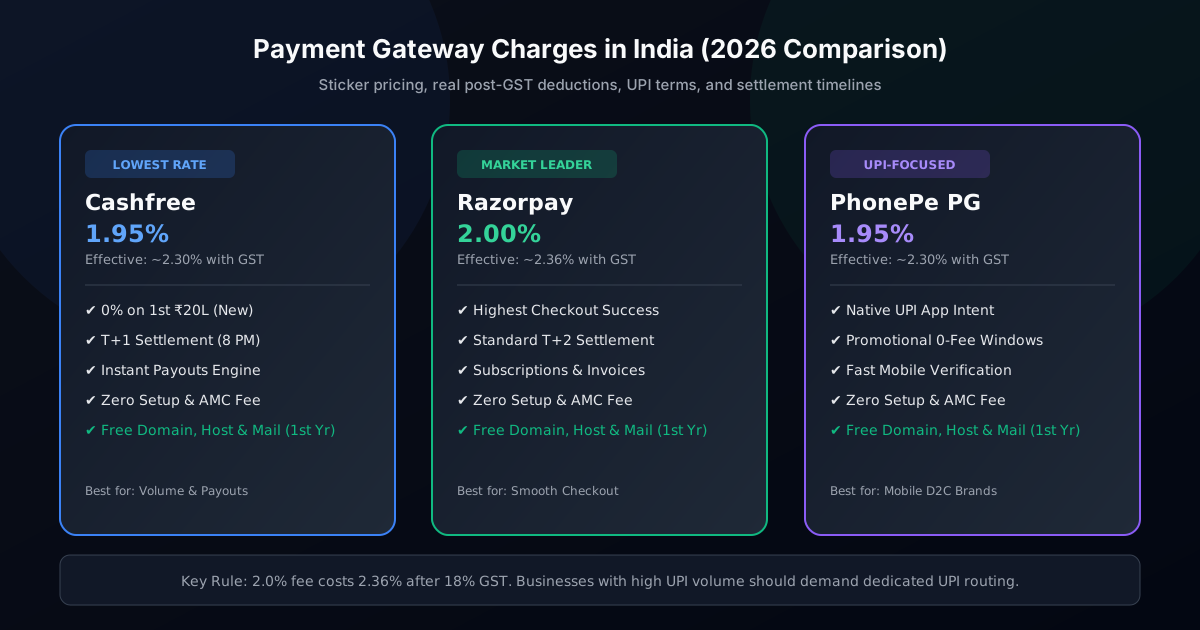
The True Cost of Accepting Online Payments in India
Most Indian business owners evaluate payment gateways solely on sticker pricing. When an account manager pitches flat 2% per transaction, it sounds straightforward. But that 2% is a base Merchant Discount Rate (MDR) subject to statutory taxes and specific instrument rules that shift your actual net realization.
Every commercial transaction processed through an Indian payment gateway carries an automatic 18% Goods and Services Tax (GST) levied on the gateway fee, not on the total invoice amount. If a customer buys a ₹10,000 product on your website using an HDFC credit card:
- Transaction Value: ₹10,000.00
- Base Gateway MDR (2.0%): ₹200.00
- 18% GST on MDR (18% of ₹200): ₹36.00
- Total Gateway Deduction: ₹236.00 (2.36% effective rate)
- Net Settlement to Your Bank Account: ₹9,764.00
If your business operates with a registered GSTIN, you can claim that ₹36.00 as Input Tax Credit (ITC) on GSTR-2B when filing monthly returns. But if you run an unregistered enterprise or composite scheme business, that 0.36% represents a permanent operational cost. Across ₹50,00,000 in annual credit card sales, the difference between 2.0% and 2.36% equals ₹18,000 in unrecoverable margin.
Payment Gateway Charges in India: 2026 Comparison Table
The Reserve Bank of India (RBI) Payment Aggregator (PA) licensing framework has standardized operations across major fintech providers. Setup charges, annual maintenance fees (AMC), and software integration fees are now zero across standard merchant plans. Providers earn exclusively through transaction processing fees.
| Payment Gateway | UPI (Standard / P2M) | Domestic Cards & Net Banking | International Cards | Standard Settlement | Key Strengths |
|---|---|---|---|---|---|
| Razorpay | 0% (Standard) 1.95% (Corporate) |
2.00% + 18% GST (2.36% effective) |
3.00%–3.50% + ₹7 flat + 18% GST | T+2 Working Days (T+1 for select accounts) |
Highest checkout success rates, automated subscriptions, Magic Checkout for D2C addresses. |
| Cashfree Payments | 0% (Standard) 1.80% (Corporate) |
1.95% + 18% GST (2.30% effective) |
3.50% + ₹7 flat + 18% GST | T+1 Working Day (Daily batch settlement at 8 PM) |
Superior bulk payout APIs, automated vendor split payments, competitive high-volume card rates. |
| PhonePe Payment Gateway | 0% (Free promotional tier) 1.90% (Custom) |
1.90%–1.95% + 18% GST (2.24%–2.30% effective) |
Not supported / Limited pilot | T+1 Working Day | Direct switch to 500M+ PhonePe app users, fast mobile intent checkout, zero onboarding friction. |
| Paytm Payment Gateway | 0% (Standard UPI) 1.99% (Postpaid/Corporate) |
1.99% + 18% GST (2.35% effective) |
2.99%–3.50% + 18% GST | T+1 to T+2 Working Days | Large consumer base, QR reconciliation, unified offline soundbox and online reporting. |
| CCAvenue | 0% (UPI) 1.90%–2.00% (Wallets) |
2.00% + 18% GST (2.36% effective) |
4.00%–4.99% + 18% GST | Weekly to T+2 Working Days | 200+ payment options, deep public sector and enterprise ERP support, multi-currency processing. |
The Zero-MDR UPI Mandate: How It Actually Works for Merchants
UPI accounts for over 80% of all digital transaction volume on Indian consumer websites. Government mandates enforce zero MDR on Unified Payments Interface (UPI) transactions conducted through standard bank accounts and RuPay debit cards. For most small business websites, customer payments via Google Pay, PhonePe, Paytm UPI, or BHIM incur ₹0 in transaction processing fees.
However, specific transaction categories trigger fees that founders frequently overlook:
Prepaid Payment Instruments (PPI) on UPI
When a buyer completes a transaction above ₹2,000 using a wallet-funded UPI handle (such as Paytm Wallet or PhonePe Wallet linked through UPI), an interchange fee of 1.1% applies at the network switch. Some gateways absorb this fee on small accounts, while others pass 1.1% + GST through to your monthly statement.
RuPay Credit Cards on UPI
Linking RuPay credit cards to UPI handles enables credit-line purchases via QR and app intent. For merchant transactions above ₹2,000 processed via RuPay credit cards, gateways deduct an MDR of 1.80% to 2.00% + GST. Transactions under ₹2,000 remain exempt.
UPI AutoPay and Recurring Mandates
Setting up recurring subscription collections via UPI AutoPay incurs an initial e-mandate registration charge of ₹1 to ₹5 per tokenized setup, followed by standard per-debit processing fees depending on your contractual tier.
Settlement Timelines and Working Capital Realities
Processing transactions is only half the operational equation. The speed at which collected capital hits your current bank account dictates your working capital health, inventory reordering cycle, and vendor payments.
| Settlement Mode | Standard Timeline | Weekend / Bank Holiday Impact | Additional Fee | Ideal Business Profile |
|---|---|---|---|---|
| Standard Batch (T+2) | 48 business hours after capture | Settlements pause until next active banking day | ₹0 (Default) | Consultancies, B2B services, and low-velocity merchants. |
| Next-Day Batch (T+1) | 24 business hours (Cashfree/PhonePe default) | Saturday transactions settle on Monday | ₹0 to 0.10% optional | E-commerce retail brands and healthcare clinics. |
| Same-Day Settlement | Credited same evening (by 7 PM to 11 PM) | Runs 365 days via IMPS/NEFT rails | 0.15% to 0.25% surcharge | High-velocity D2C food brands and daily ticket services. |
| Instant On-Demand | Credited within 15 to 30 minutes of request | Runs 24x7x365 | 0.20% to 0.30% per payout | Emergency liquidity, ad spend funding, urgent vendor settlements. |
For high-volume retail stores, leaving two days of cash flow locked in transit can choke inventory cycles. When negotiating custom gateway terms, prioritizing T+1 settlement often delivers greater operational value than haggling over a 5-basis-point card MDR cut.
Payment Gateway Integration Types: Conversion vs Compliance
How you connect the payment gateway to your website directly influences two critical metrics: customer drop-off during checkout and your corporate PCI-DSS compliance liability.
1. Standard Hosted Checkout Modal (Recommended for 95% of MSMEs)
With a hosted modal (such as Razorpay Standard Checkout or Cashfree Drop Checkout), the customer clicks Pay Now and a secure overlay opens directly on top of your webpage. The customer enters their card details or selects their UPI app inside an iframe hosted securely on the gateway's servers.
Benefits: Your business falls under PCI-DSS SAQ-A scope (the simplest self-assessment questionnaire). Your web servers never touch, process, or store raw card numbers. Implementation takes hours, and security patches happen upstream on the gateway infrastructure.
2. Direct Server Checkout via Custom APIs
Enterprises running bespoke mobile applications sometimes seek complete control over the visual checkout interface, capturing cardholder numbers in custom input fields before sending encrypted payloads to the gateway endpoint.
Trade-offs: Direct API collection triggers full PCI-DSS SAQ A-EP or SAQ D audit requirements. Your hosting infrastructure requires quarterly vulnerability scans, annual penetration tests, and expensive network segmentation. Unless your business processes upwards of ₹5 Crore per month, the conversion uplift rarely justifies the compliance overhead.
3. Mobile Intent Flow for UPI (Crucial for Indian Mobile Shoppers)
Over 75% of Indian e-commerce transactions occur on mobile phones. If a mobile user has to manually type their UPI ID (e.g., name@okhdfcbank) and switch apps to approve a notification, conversion rates drop by 22% to 30%. Modern gateways offer UPI Intent flow: tapping UPI on the checkout page automatically opens installed apps (Google Pay, PhonePe, Paytm) with payment details pre-filled. Confirming that your website design implements native intent flow is the fastest way to lift checkout conversions.
International Payments and RBI Regulatory Compliance
Accepting foreign currencies (USD, EUR, GBP, AED, SGD) introduces strict Reserve Bank of India foreign exchange regulations under FEMA (Foreign Exchange Management Act). Many Indian agencies, software firms, and export merchants make the mistake of assuming standard domestic gateways automatically handle cross-border trade.
Mandatory Purpose Codes (P-Codes)
Every inward foreign remittance requires an RBI Purpose Code categorizing the export (e.g., P0802 for software consultancy, P0104 for goods exports, P1006 for digital advertising). If your gateway does not capture purpose codes at checkout, acquiring banks will hold funds indefinitely pending manual compliance declarations.
Foreign Inward Remittance Certificate (FIRC / FIRA)
When foreign funds convert to INR and credit your current account, your chartered accountant requires an Electronic FIRC (e-BRC or FIRA advice) to prove foreign revenue and claim 0% GST export treatment. Razorpay and Cashfree generate monthly digital FIRAs automatically for standard export transactions, saving dozens of manual bank branch visits.
International Card Conversion Surcharges
International credit card transactions carry a base MDR of 3.0% to 3.5% + 18% GST. Additionally, if the customer pays in USD and your gateway settles in INR, acquiring banks levy a 1.5% to 2.5% foreign exchange conversion markup. On a $1,000 USD overseas project fee, total transaction and currency conversion deductions often exceed 5.5%.
Hidden Gateway Fees and Margin Leaks to Audit
Beyond base MDR and GST, specific operational triggers generate non-obvious line items on your monthly settlement statement:
- Refund Processing Fees: When you issue a customer refund, Indian gateways return the principal product amount to the customer's bank account. However, the original 2.0% merchant fee plus 18% GST deducted during the sale is retained by the payment gateway and banking switch. If your e-commerce return rate sits at 8%, you absorb transaction fees on revenue you never kept.
- Chargeback Dispute Fees: If a customer files a chargeback claiming unauthorized usage or non-delivery, gateways freeze the disputed transaction amount from your current settlement pool. If you fail to present valid proof of dispatch within 5 to 7 working days, gateways assess a non-refundable chargeback fee ranging from ₹250 to ₹500 per incident.
- Security Reserve Holds: New accounts operating in high-risk categories (travel bookings, drop-shipping, digital courses, astrology consultations) often face rolling reserve mandates where gateways withhold 10% to 20% of gross settlements for 90 to 180 days to cover potential chargeback claims.
- Payout API Charges: If you use gateway banking APIs (such as Cashfree Payouts or RazorpayX) to automate vendor payments or affiliate commissions, charges run from ₹1.50 to ₹6.00 per IMPS transfer, depending on transaction slabs.
Multi-Gateway Redundancy: Eliminating Payment Downtime
Bank payment switches experience frequent planned maintenance and unplanned server outages. When an acquiring bank like HDFC, ICICI, or SBI undergoes maintenance on a Saturday evening, transaction failure rates on single-gateway integrations can spike from 4% to over 35%.
For brands generating more than ₹20,000 in daily orders, payment downtime directly destroys paid ad budgets (Google Ads and Meta Ads continue sending traffic while checkouts fail). Implementing a multi-gateway strategy prevents this revenue leakage:
- Primary and Secondary Routing: Route 85% of traffic through your primary gateway (e.g., Cashfree for lower card fees and fast T+1 payouts) and 15% through a secondary gateway (e.g., Razorpay or PhonePe). This keeps both merchant accounts active and warm with consistent transaction history.
- Automated Health Checks and Fallback: If webhook timeouts on the primary gateway exceed 5% over a rolling 10-minute window, the checkout switch automatically re-routes subsequent buyers to the backup gateway. The buyer never sees an error screen.
- Reconciliation Hygiene: When operating multiple gateways, maintain unified accounting software tags. Tag each order in your database with the gateway name, unique transaction ID, and bank settlement reference to avoid confusion during quarterly GST audits.
Annual Fee Impact Across Different Business Volumes
To quantify how gateway choices impact actual bottom-line profits, consider the real annual cost breakdown across three common business tiers in India:
| Annual Digital Sales | Payment Instrument Mix | Estimated Blended Fee | Total Annual Processing Cost | GST ITC Reclaimable | Net Unrecovered Cost |
|---|---|---|---|---|---|
| ₹12,00,000 (₹1L/month) Boutique Clinic / Service Studio |
85% UPI (0%) 15% Domestic Cards (2.36%) |
0.35% blended | ₹4,248 per year | ₹648 (if GST registered) | ₹3,600 to ₹4,248 |
| ₹60,00,000 (₹5L/month) Growing D2C Retail Brand |
65% UPI (0%) 30% Cards/NetBanking (2.36%) 5% EMI/Wallets (2.48%) |
0.83% blended | ₹49,920 per year | ₹7,615 (via GSTR-2B) | ₹42,305 |
| ₹2,40,00,000 (₹20L/month) Multi-Location Brand / B2B Wholesaler |
45% UPI (0%) 45% Cards/NetBanking (2.36%) 10% Special/Intl (3.80%) |
1.44% blended | ₹3,46,080 per year | ₹52,792 (via GSTR-2B) | ₹2,93,288 |
KYC Onboarding Checklist for Indian Businesses
The RBI has mandated strict merchant onboarding audits. Submitting complete, verifiable corporate documentation prevents account freezing or settlement caps during your initial 30 days of operation.
Entity Registration Proof
Certificate of Incorporation (Pvt Ltd / LLP), Partnership Deed, or GST Registration Certificate. Sole proprietorships without GST must provide MSME Udyam Registration plus Shop & Establishment license.
Banking Verification
Pre-printed cancelled cheque showing the legal business entity name, current account number, and IFSC code matching your registration documents.
Director / Signatory KYC
PAN card copy and Aadhaar verification of authorized signatories and key shareholders holding more than 25% equity ownership.
Website Compliance Audit
Your live website must feature clear navigation to Terms & Conditions, Privacy Policy, Pricing Policy, Refund/Cancellation Policy, and Contact Us page with a valid Indian physical operating address and corporate email.
Selecting the Right Payment Gateway for Your Business Model
Different business models require distinct gateway capabilities. Choosing based solely on brand familiarity can impair checkout conversion rates or financial operations:
- D2C E-Commerce Brands: Razorpay or Cashfree are standard choices. Razorpay address pre-fill (Magic Checkout) cuts checkout friction for mobile shoppers who have purchased from other Indian Shopify or WooCommerce stores. If you operate custom e-commerce infrastructure, Cashfree automated COD-to-prepaid conversion hooks reduce return-to-origin (RTO) expenses.
- Clinics, Salons, and Professional Services: PhonePe PG or Razorpay Payment Links work exceptionally well. They enable sending instantaneous WhatsApp payment links for consultations, treatment packages, or diagnostic tests with zero customer hesitation and instant UPI app launching.
- B2B Distributors and Manufacturers: Cashfree excels in high-value NEFT/RTGS virtual account reconciliations. It assigns unique virtual accounts to each dealer, automatically matching large incoming wire transfers against specific ERP invoices.
- Subscription and SaaS Businesses: Razorpay Subscriptions offers mature recurring mandate management supporting recurring cards, UPI AutoPay, and automated invoice delivery with dunning logic for failed charges.
Frequently Asked Questions
Do Indian payment gateways charge monthly maintenance or setup fees?
No. Standard business accounts on Razorpay, Cashfree, and PhonePe PG carry ₹0 setup fees and ₹0 annual maintenance charges (AMC) in 2026. You are charged strictly on a per-transaction basis when sales occur.
Can I claim Input Tax Credit (ITC) on payment gateway GST charges?
Yes. If your business holds a valid GST registration and you add your GSTIN to your payment gateway profile during onboarding, the gateway will issue a monthly tax invoice. You can claim the full 18% GST paid on gateway fees as ITC in your monthly GSTR-3B filings.
Why is UPI free on some payment gateways while others charge for it?
Standard UPI payments made from bank accounts via app intent or QR codes carry zero MDR under Indian regulatory mandates. However, UPI transactions funded via digital wallets (PPI) or RuPay credit cards above ₹2,000 carry an MDR of 1.1% to 2.0%. Gateways charge fees only when these credit or wallet rails are engaged.
How do payment gateways handle refunds and customer disputes?
When you refund a customer, the customer receives 100% of their money back within 5 to 7 banking days. However, the payment gateway retains the original 2.0% merchant fee plus 18% GST charged on the initial purchase. For chargeback disputes, gateways give merchants 5 to 7 days to submit evidence before adjudicating the claim.
What documents are required to activate a payment gateway in India?
You need your company PAN, Certificate of Incorporation or GST registration, a pre-printed cancelled cheque of your corporate current account, and authorized signatory identity proof. Your live website must also display working links to your Terms of Service, Privacy Policy, and Refund Policy.
Planning to launch or modernize your company website with direct payment collection? Discover our high-performance business web design services, explore our custom software development and API integration capabilities, review our verified work in our client case studies, check out our regional footprint across Tamil Nadu digital service hubs, or contact our technical team for a tailored implementation plan.