Hiring a web development agency in India is one of the highest-friction procurement decisions a founder or business head makes. The market is saturated with conflicting quotes ranging from ₹12,000 to ₹15,00,000 for what sounds like the exact same website. Without an engineering background, evaluating agencies based on sales pitches almost always leads to delayed launches, broken code, or vendor lock-in.
Direct Answer: How Do You Choose the Right Web Development Agency in India?
To choose the right web development agency in India, vet candidates across four strict criteria: audit live client websites on mobile devices for speed scores above 85, verify complete intellectual property and GitHub code ownership in writing, demand a detailed scope of work breaking down custom code versus pre-made templates, and tie milestone payments (30/30/25/15) to working staging demos rather than calendar dates.
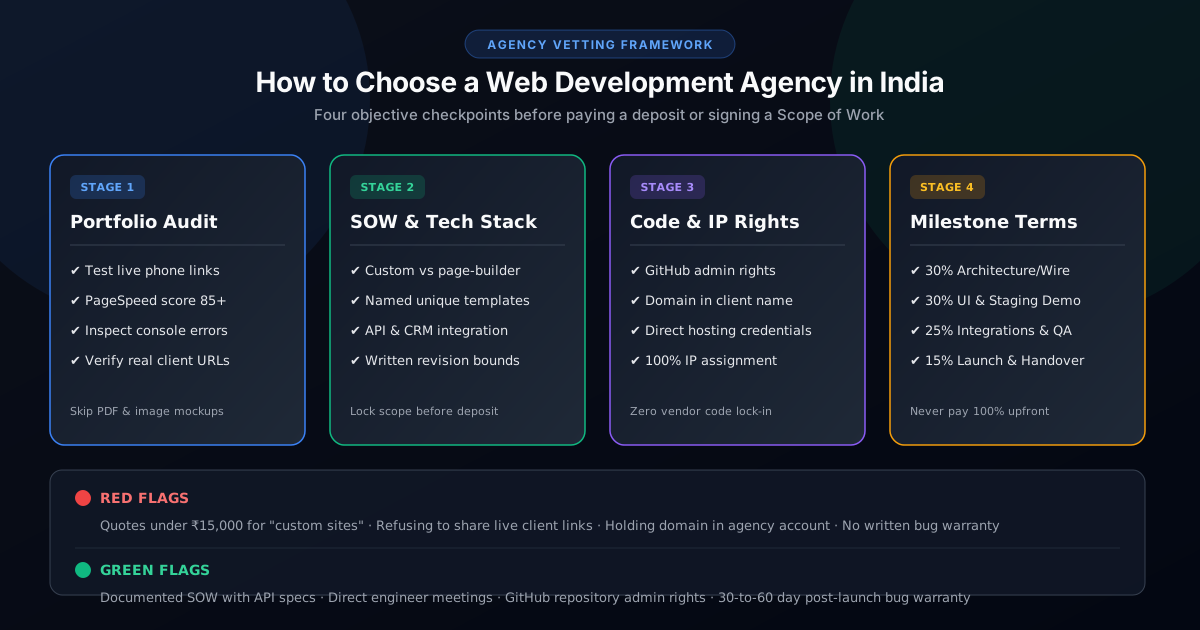
The Four Red Flags You Should Catch on the First Call
When you speak with agency sales teams across India, initial conversations often look polished. Yet 70% of business owners who contact us for rebuilds experienced the exact same early warning signals before their projects derailed.
- The Instant Fixed Quote: If an agency quotes ₹25,000 within ten minutes of hearing your requirements without asking about your database structure, payment workflows, or third-party CRM0integrations, they are selling a pre-purchased WordPress theme. They will fit your business into their template, not build what you need.
- The Static Image Portfolio: Agencies that share screenshots or PDF case studies instead of live production URLs often do not have active client relationships. When you ask for live links, test whether the site loads under 2.5 seconds on a real 4G/5G mobile connection.
- Domain and Hosting Bundling: Never allow an external vendor to purchase your primary domain name or host your application inside their private shared server account. If a dispute arises over invoices or deliverables, you lose access to your company domain and email infrastructure overnight.
- Ambiguous Revision Windows: Contracts that say "unlimited revisions" sound generous, but they indicate lack of process. When requirements are loose, timelines drag from six weeks to nine months because neither party defined what "completed" means.
Stage 1: Stress-Testing the Agency Portfolio
Most buyers skim a portfolio page, look at visual styling on a desktop monitor, and assume the agency is competent. That tells you whether their graphic designer can place stock photos. It tells you nothing about their software engineering or mobile performance.
Run these four objective tests on every live portfolio link the agency provides:
- Mobile Performance Audit: Open Google PageSpeed Insights and(run the client's home and service pages. If an agency cannot score above 80 on mobile for their featured clients, your site will suffer from the same technical debt.
- Console and Network Inspection: Right-click on their client's website, open Chrome DevTools, and look at the Console tab. Red errors indicate unhandled JavaScript exceptions, dead analytics tags, or security certificate warnings.
- Inquiry Workflow Test: Submit a dummy lead or click the WhatsApp action button. Does the message carry UTM tracking parameters? Does the confirmation email arrive within two minutes? If their client funnels leak leads, your funnels will leak too.
- Asset Attribution and Hosting Check: Check who hosts the site. If five different client sites are hosted on one low-cost shared cPanel server, the agency cuts corners on infrastructure resilience.
When we built the direct inquiry system for Adharva Oil, testing mobile order completions on entry-level Android smartphones was our primary technical metric. High desktop scores mean little when 84% of Indian commercial traffic originates on mobile handsets.
Stage 2: Scope of Work and Technical Architecture
Before transferring any initial booking deposit, demand a written Scope of Work (SOW) that documents technology choices and architectural boundaries. Vague SOWs are the primary root cause of scope creep and surprise billing.
| Vendor Category | Typical Price (INR + 18% GST) | Tech Stack Used | Best Suited For | Critical Trade-Off |
|---|---|---|---|---|
| Solo Freelancer | ₹15,000 – ₹45,000 | WordPress, Elementor, Wix | Early concept validation, basic 3-page brochure | Single point of failure; zero availability during illness |
| Volume Template Agency | ₹25,000 – ₹75,000 | Pre-built PHP / Theme builders | Local service shops needing basic Google presence | Slow load times; bloated code; generic design patterns |
| Custom Engineering Studio | ₹80,000 – ₹3,50,000 | Modern PHP, Node.js, Custom CSS, Tailwind | MSMEs, D2C brands, clinics, B2B exporters | Requires clear founder input during sprint reviews |
| Enterprise IT Consultancies | ₹6,00,000 – ₹25,00,000+ | Java, .NET, Enterprise headless stacks | Public limited firms, funded tech startups, banks | High overhead costs; extensive bureaucratic change orders |
Review the exact technical platform before signing. If your business requires fast lead capture or dynamic catalog filtering, compare our custom web development services with off-the-shelf alternatives. Custom engineering eliminates plugin subscription fees and security vulnerabilities that plague template sites.
Stage 3: Intellectual Property, GitHub, and Asset Rights
Legal ownership of your digital assets is non-negotiable. Hundreds of Indian business owners discover too late that their agency owns the code repository, the Webflow workspace, or the server environment.
- Codebase Assignment: All custom code, HTML, CSS, JavaScript, database schemas, and documentation produced must be assigned to your company upon milestone settlement.
- Direct GitHub / Git Repository Access: The agency must push daily or weekly commits to a Git repository where your company account holds Administrator status.
- Domain Registration: Domains must be registered directly under your corporate account with ICANN-accredited registrars, using your official company GSTIN and contact details.
- Post-Launch Warranty: Insist on a minimum 30-day bug warranty period following production deployment, covering browser compatibility fixes and broken links without additional billing.
When our team delivered the patient scheduling system for Coimbatore Dental Foundation, full source code ownership and independent hosting handover were established on day one. A business must retain the freedom to maintain its website internally or switch technical partners whenever needed.
Stage 4: Milestone Payments and Accountability Structure
Never agree to pay 50% upfront and 50% upon project completion. Two-part payments eliminate your bargaining power when delivery delays occur midway through development. Instead, link disbursements to demonstrable working features on an active staging server.
- Milestone 1 (30% Deposit): Wireframes, user journeys, responsive visual prototypes, and finalized database architecture approved in writing.
- Milestone 2 (30% Staging Demo): Core pages built, responsive layouts verified across mobile devices, and primary CMS or database operations working on staging URLs.
- Milestone 3 (25% Integrations & QA): Third-party integrations (payment gateways, CRM webhooks, WhatsApp Business automation) connected and tested under staging load.
- Milestone 4 (15% Final Handover): Production launch, SSL installation, Google Search Console sitemap submission, source code repository handover, and admin training completed.
This 30/30/25/15 distribution keeps both parties aligned. The agency covers its initial engineering hours, while your business pays remaining funds only as tangible functionality passes acceptance testing.
Comparing Custom Code vs Page Builders for Indian MSMEs
One of the first questions an agency should address is whether your use case requires custom web engineering or an off-the-shelf site builder. Agencies that push one solution for every client are often limited by their in-house skill set.
| Factor | Custom Engineered Stack | WordPress / Elementor | Shopify / SaaS Builders |
|---|---|---|---|
| Core Web Vitals | Consistently 90–100 on mobile | Frequently 40–65 due to script bloat | Typically 60–80 depending on app installs |
| Annual Software Fees | Zero recurring plugin license fees | ₹15,000 – ₹45,000 in commercial plugins | ₹35,000 – ₹1,20,000+ |
| Security Maintenance | No theme exploits; minimal attack surface | Requires weekly patch updates and monitoring | Managed platform security included |
| Custom ERP/API Fit | Native integration with Indian payment/SMS APIs | Requires third-party connector plugins | Bound by platform app ecosystem limitations |
For high-intent service businesses, speed directly dictates lead cost. For example, our work across
Frequently Asked Questions
How much should a professional business website cost in India?
For an established Indian business or MSME, a professionally engineered custom website typically costs between ₹60,000 and ₹2,50,000 plus 18% GST depending on dynamic requirements, payment gateway setup, and CRM integrations. Basic template sites may cost ₹20,000 to ₹45,000, while complex custom web applications range upwards of ₹4,00,000.
Should I hire a local agency or an agency in another Indian metro?
Technical competence, engineering quality, and clear communication matter far more than physical office proximity. Modern agencies collaborate through video sprint reviews, staging links, and direct messaging channels. Prioritize agencies with verifiable live projects, fast response times, and clear contracts over a nearby agency that lacks technical depth.
How long does a custom business website take to build?
A standard 8-to-15 page corporate website with custom design and mobile optimization takes between 4 and 8 weeks from kickoff to launch. More extensive platforms featuring custom calculators, booking engines, or B2B customer portals usually require 8 to 14 weeks across structured development milestones.
What happens if the agency fails to deliver on time?
Your contract must define a delivery schedule with clear review windows for each milestone. If you tie payments to working staging demos rather than calendar dates, your financial exposure remains strictly limited. Include a clause permitting termination with full handover of completed code if deliverables are delayed beyond agreed grace periods.
Who should purchase the web hosting and domain name?
You must always purchase your domain name and hosting account directly using your company email, credit card, and GST credentials. You then grant developer access to your agency through user permissions. Never permit an agency to hold your primary domain or server credentials inside their private account.
Do web development agencies provide post-launch maintenance?
Reputable agencies offer dedicated Annual Maintenance Contracts (AMC) covering server monitoring, security patches, regular backups, and minor content updates. Standard AMC plans in India range from ₹18,000 to ₹60,000 annually depending on update frequency and platform complexity.
Ready to plan your next web project with transparent milestones, custom engineering, and full intellectual property ownership? Explore our regional technology centers across India or contact our engineering team today to review your project scope.