Cashfree is running the most aggressive “free payment gateway” offer India has seen: a 0% platform fee for new merchants on their first ₹20 lakh of sales, valid until 31 March 2027. Sounds too good. Partly. The platform fee genuinely disappears. The GST does not. This guide walks through who qualifies, what a real ₹1,00,000 sale costs during and after the offer, and when switching from Razorpay or your current gateway is worth the work.
Cashfree’s festive offer gives new merchants — those who signed up on or after 21 July 2026 — a 0% platform fee on domestic UPI, card, net banking and wallet payments up to ₹20 lakh in cumulative sales, until 31 March 2027. GST at 18% is still deducted on the standard 1.95% basis, and EMI, Pay Later, Amex, prepaid cards and international payments stay chargeable.
We build payment flows for clinics and small D2C brands across India, and this offer comes up in client conversations weekly now. Most owners have seen the 0% banner. Very few have read the terms page. That gap matters, because the offer is genuinely valuable for one kind of business and quietly disappointing for another. Here is what the terms actually say, checked against Cashfree’s published documentation in November 2026.
What the Cashfree 0% Offer Actually Says, and Who Gets It
Cashfree’s own documentation spells out the mechanics. The offer applies to new merchants who sign up on or after 21 July 2026, get their KYC approved, and activate during the campaign period. It is applied automatically — no promo code, no support ticket. From that point, eligible domestic payment gateway transactions carry no Cashfree platform fee until the merchant crosses ₹20 lakh in cumulative GMV or the campaign ends on 31 March 2027, whichever happens first.
| Offer term | What it means for your business |
|---|---|
| Who qualifies | New merchants signed up on or after 21 July 2026, KYC approved and activated during the campaign. Merchants who transacted before that date, partner-referral signups and custom-priced accounts are excluded. |
| Fee waived | Cashfree’s platform fee on eligible domestic payment gateway transactions — UPI, debit and credit cards, net banking, wallets. |
| Volume cap | ₹20 lakh cumulative GMV. One-time cap, not a monthly allowance. |
| End date | 31 March 2027, or the cap, or disqualification for misuse — whichever comes first. Unused volume lapses. |
| Settlement | T+1 by 8 PM IST under the campaign terms. Instant settlement is a paid add-on starting at 0.30%. |
| Fixed costs | No setup fee, no annual maintenance charge on the standard plan. |
One more condition deserves its own paragraph: the credit-card share rule. Once a merchant’s processed GMV crosses ₹1 lakh, Cashfree may review whether credit card transactions make up 60% or more of the volume. If they do, Cashfree reserves the right to withdraw the offer for subsequent transactions. A B2B services firm whose clients pay by card — not UPI — should not plan an entire year of economics around this offer.
What Does 0% Actually Cost You? The GST Catch
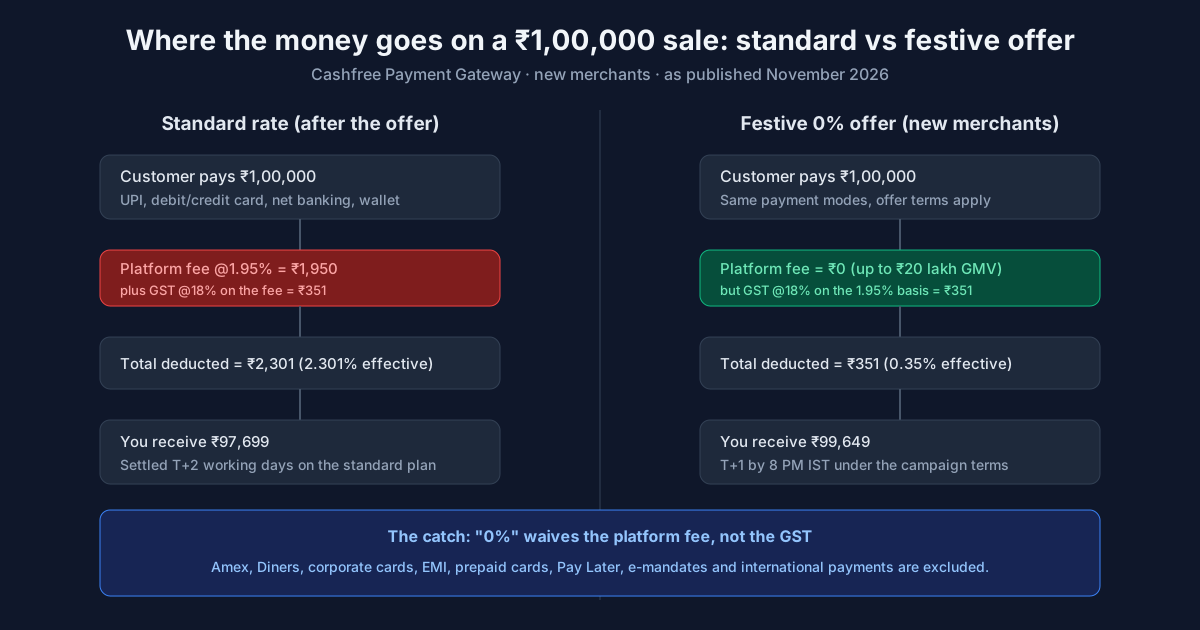
Here is the part the banner does not say. The offer waives Cashfree’s platform fee. GST is still charged, and per Cashfree’s terms it is calculated on the standard 1.95% fee basis even while that fee itself is waived. So a ₹1,00,000 sale during the offer carries ₹351 in GST. Not zero. Not free. Just much cheaper than the standard rate.
| Line item (₹1,00,000 sale) | Standard 1.95% rate | During festive offer |
|---|---|---|
| Platform fee | ₹1,950 | ₹0 |
| GST at 18% | ₹351 | ₹351 (on the 1.95% basis) |
| Total deducted | ₹2,301 | ₹351 |
| You receive | ₹97,699 | ₹99,649 |
| Effective cost | 2.301% | 0.35% |
0.35% effective is excellent — better than any published standard rate in India right now. But it is not 0%, and the business that budgets “payments cost nothing until March” gets a small, unpleasant surprise on its first settlement statement. Multiply it out: over the full ₹20 lakh cap, expect roughly ₹7,020 in GST while the platform fee is waived. Your accountant should also confirm whether GST on payment gateway fees carries input credit for your setup.
UPI deserves a separate note. UPI person-to-merchant payments carry zero MDR at the bank level, and the offer waives Cashfree’s platform fee on eligible UPI transactions too. But since September 2026, NPCI’s 0.4% merchant fee on UPI payments above ₹2,000 applies no matter which gateway processes the payment (small merchants are exempt). We broke down who pays what in our UPI MDR guide for merchants.
Which Payment Methods Sit Outside the Offer?
The exclusion list is where businesses with mixed payment mixes get burned. These methods are always charged at standard rates, offer or no offer:
- American Express and Diners Club cards — 1.95% at Cashfree’s listed domestic rate.
- EMI options — credit card EMI 2.2%, debit card EMI 1.5% (HDFC), cardless EMI 1.90%.
- Pay Later instruments (LazyPay, Simpl) — 2.20%.
- Prepaid cards and corporate credit cards — standard rates apply.
- Subscriptions and e-mandates — recurring payments via AutoPay are excluded. Our UPI AutoPay guide covers how recurring billing is charged.
- International cards — 2.99% for Visa and Mastercard through the international gateway, 2.95% for Amex. If you sell abroad, see our guide on accepting international payments from India.
For a clinic taking appointment advances or a food brand on UPI-heavy retail orders, none of this matters much — your transactions sit squarely inside the covered set. For a coaching institute selling EMI plans or a B2B supplier billing on corporate cards, most of your volume may sit outside the offer entirely.
Should You Switch Gateways for a 0% Offer?
Verdict first. Switch if you are a new business without a gateway yet, or a young D2C or services brand that expects to cross ₹20 lakh in sales before 31 March 2027 and mostly collects through UPI and regular debit/credit cards. Stay put if your current gateway gives you negotiated rates below 1.95%, or if your customers pay heavily through EMI, corporate cards or international methods. The comparison below uses published standard rates as of November 2026:
| Gateway | Standard domestic fee | Settlement | Setup / AMC |
|---|---|---|---|
| Cashfree | 1.95% + GST; 0% offer for new merchants till 31 Mar 2027 | T+1 by 8 PM during the campaign | ₹0 / ₹0 |
| Razorpay | 2% + GST (per its published pricing) | T+2 typical; same-day and instant at extra cost | ₹0 / ₹0 |
| PayU | 2% + GST | T+2 standard | ₹0 / ₹0 |
| PhonePe PG | 1.99% + GST; limited-period zero-fee offer | T+1 | ₹0 / ₹0 |
The full published rate card for every major gateway sits in our payment gateway charges comparison for India.
Now the honest part about switching. A gateway migration is not a settings toggle. It means a fresh KYC cycle, reconfiguring your Shopify or WooCommerce plugin, or — if you have a custom-built checkout like most of our clients do — rewriting webhooks, settlement account mapping and refund flows, then retesting the entire payment journey before you dare take a live order. That is a day or two of real work, sometimes more.
Is that work worth it? Run the numbers. At the standard rates, Cashfree’s 1.95% against Razorpay’s 2% saves a business doing ₹10 lakh a year all of ₹500 annually. Nobody switches gateways for ₹500. The offer is the actual prize: 0% platform fee on up to ₹20 lakh saves roughly ₹39,000 in fees you would otherwise pay — assuming your mix stays inside the covered methods and under the 60% credit-card condition. If that math lands, the migration is worth a weekend. If not, it is not.
What Happens When the Offer Ends?
31 March 2027 arrives, or your ₹20 lakh runs out, and the standard rate applies automatically: 1.95% plus GST, about 2.301% effective. There is no grace negotiation email, no automatic downgrade to a better slab. Two things are worth doing before that date. First, set a calendar reminder for early March to review your volume and re-run the cost math. Second, once you are processing steady monthly volume, ask for custom pricing — at meaningful scale, published rates are a starting point, not a ceiling, and this applies at every gateway, not just Cashfree.
And resist the temptation to build your pricing model on free processing. A 0% window that ends in March 2027 should inform your cash flow, never your margins. If your product only works financially when the gateway charges nothing, the gateway is not the problem.
How to Get the Offer Applied to Your Account
- Sign up on cashfree.com after 21 July 2026 with your business KYC documents — GSTIN, PAN, bank details — ready. The offer triggers only for accounts activated during the campaign.
- Complete KYC and account activation. The 0% terms apply automatically once approval lands; confirm you see the offer in your dashboard rather than assuming it.
- Check your expected payment mix against the exclusion list above. If EMI, Amex or international cards dominate your sales, the offer covers little of your volume.
- Confirm your settlement cycle. Campaign terms give T+1 by 8 PM IST; instant settlement costs extra from 0.30% and is rarely worth it for small businesses.
- Set two reminders: one for ₹18 lakh GMV (so the cap doesn’t ambush you mid-month) and one for 1 March 2027 to plan the return to standard rates.
Common Mistakes Businesses Make With “Free” Gateway Offers
- Treating 0% as ₹0 cost. GST still applies. Effective cost during the offer is about 0.35%, not zero.
- Signing up through a partner or reseller. Partner-referred accounts are excluded from the offer. Sign up direct.
- Ignoring the credit-card share condition. Cross 60% credit card GMV after ₹1 lakh and Cashfree can withdraw the offer.
- Assuming the offer renews. It does not. The ₹20 lakh is a one-time cap and unused volume lapses on 31 March 2027.
- Migrating an existing stable checkout for the post-offer rate alone. 1.95% versus your current 2% is a rounding error at small volumes. Switch for the 0% window or don’t switch.
Frequently Asked Questions
Is Cashfree really 0% for new merchants?
On the platform fee, yes, within limits. Merchants who signed up on or after 21 July 2026 pay no Cashfree platform fee on eligible domestic payments — UPI, cards, net banking, wallets — up to ₹20 lakh in cumulative GMV or until 31 March 2027, whichever comes first. GST is still deducted on the standard 1.95% basis, and methods like EMI, Pay Later, Amex, prepaid cards and international cards are charged at normal rates.
I signed up before 21 July 2026. Can I get the offer?
No. Cashfree’s terms exclude merchants who processed any transaction before 21 July 2026, along with accounts referred through partners or resellers and accounts on custom pricing. The offer is applied automatically after KYC approval — there is no promo code to enter.
What is the effective cost during the offer?
About 0.35% of each eligible sale. Cashfree still charges 18% GST calculated on its standard 1.95% platform-fee basis, so a ₹1,00,000 sale carries ₹351 in GST even with the platform fee waived, against ₹2,301 at the standard rate.
What happens after the ₹20 lakh cap or 31 March 2027?
The standard rate applies automatically: 1.95% plus GST, which works out to about 2.301% of each sale. There is no carry-forward of unused offer volume. Businesses with steady monthly volume can ask for custom pricing once they are off the offer.
Does the 0% offer cover UPI payments?
The offer waives Cashfree’s platform fee on eligible domestic payments, which includes UPI. But the separate NPCI merchant fee of 0.4% on UPI payments above ₹2,000 applies regardless of which gateway you use, with small merchants exempt. Check our UPI MDR guide for who pays that.
Is switching gateways worth the work for this offer?
For a business with no gateway yet, yes — you get months of near-free processing. For an existing checkout with negotiated rates below 1.95%, usually not. A switch means a new KYC cycle, plugin or webhook changes, and retesting your whole payment flow; compute the savings against that effort before moving.
Setting up or migrating a payment checkout?
We build and maintain custom payment flows for clinics, D2C brands and service businesses across India — gateways, subscriptions, refunds and settlement reporting. We will tell you plainly whether a switch is worth your time.
Talk to us about your checkout See our software development servicesSources: Cashfree’s pricing documentation and payment gateway charges page, plus Razorpay’s published pricing page, all checked in November 2026. Offer terms change without notice — confirm on the provider’s current terms page before making decisions.
Related reading: the full payment gateway charges comparison for India, who pays the new UPI MDR in 2026, how UPI AutoPay handles recurring billing, and our guide to accepting international payments in India.