Every Indian small business owner eventually types "best GST billing software" into Google, reads two app-store listings, picks the one with more stars, and discovers three months later that it cannot do the one thing their CA needs. The 2026 e-invoicing rules have made this choice a compliance decision, not just a convenience one. Here is how to pick correctly the first time, whether you run a shop in Coimbatore, a clinic in Pune or a D2C brand selling pan-India.
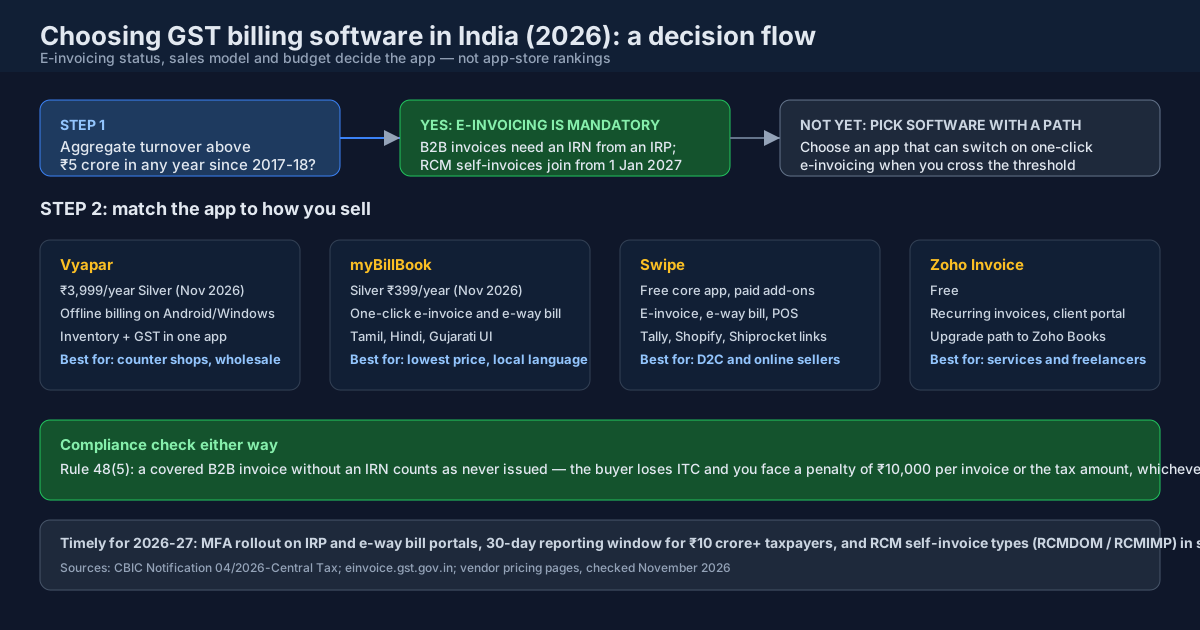
For most Indian small businesses in 2026: pick Vyapar (₹3,999/year Silver) if you bill from a counter and need offline billing with inventory, myBillBook (₹399/year Silver) if budget and a Tamil/Hindi/Gujarati interface matter most, Swipe (free core) if you sell online and want Shopify and Shiprocket integrations, and Zoho Invoice (free) if you invoice clients for services. If your turnover has ever crossed ₹5 crore, e-invoicing support is non-negotiable.
Why billing software became a compliance question in 2026
For years, choosing a billing app was about convenience: nicer invoices, faster counter billing, fewer calculation mistakes. That changed with the e-invoicing mandate, and it keeps tightening.
The current position, unchanged since 1 August 2023: if your aggregate turnover crossed ₹5 crore in any financial year from 2017-18 onwards, every B2B invoice, export invoice and SEZ supply needs an Invoice Reference Number (IRN) generated through an Invoice Registration Portal. Two details catch owners out. The test runs at PAN level, so three GSTINs in three states add up. And it looks backwards: cross ₹5 crore once, drop to ₹1 crore next year, and the mandate stays on.
Then there is the part almost nobody pricing a billing app thinks to ask about. CBIC Notification 04/2026-Central Tax, dated 26 October 2026, extends e-invoicing from 1 January 2027 to two inward transaction types for ₹5 crore-plus taxpayers: self-invoices for supplies received from unregistered persons under reverse charge (RCMDOM) and for imported services (RCMIMP). If you buy raw material from small unregistered suppliers, this lands directly in your accounts workflow.
What happens if you ignore it? Rule 48(5) treats a covered invoice issued without an IRN as never issued. Your buyer cannot claim input tax credit, which means your B2B customer pushes back before paying you. You also carry a penalty of ₹10,000 per invoice or the tax amount involved, whichever is higher.
| Situation | E-invoice (IRN) required? |
|---|---|
| B2B supply to a GST-registered buyer, turnover above ₹5 crore | Yes |
| Exports and supplies to SEZ units, above ₹5 crore | Yes |
| RCM supplies from unregistered persons / import of services (₹5 crore+) | Yes, from 1 January 2027 |
| B2C retail sale to a consumer | No |
| Turnover below ₹5 crore in every year since 2017-18 | No, normal GST invoice is valid |
| Banks, NBFCs, insurers, GTA, passenger transport, multiplex cinema | Exempt class |
The four apps actually worth shortlisting
Search results will offer you twenty options. After cutting the ones that are reskins of the same template, four deserve a real look for a small Indian business. We picked them on the criteria that matter in practice: GST and e-invoicing support, offline behaviour, price honesty, and whether the company behind them will still exist in five years.
Vyapar — best for counter billing with unreliable internet
Vyapar lists its Silver plan at ₹3,999 per year (shown as a discount from ₹6,799 on its pricing page, November 2026). What you are paying for is offline billing that works on Android and Windows, with inventory, GST invoices and e-invoicing in the same app. Wholesale distributors and retail shops in markets where connectivity drops during the day are the natural fit. The per-month framing ("₹333 per month") is marketing arithmetic; treat it as a ₹3,999 annual purchase.
myBillBook — best for the lowest annual price
myBillBook advertises its Silver plan at ₹399 per year on its Play Store listing, which is roughly one-tenth of Vyapar. You get GST and non-GST billing, inventory with batch and barcode support, one-click e-invoice and e-way bill generation, and a multilingual interface that includes Tamil, Hindi, Hinglish and Gujarati. For a shop that bills modest volumes and wants compliance features without a big annual outlay, it is hard to beat on value. Read the plan limits before committing: entry tiers usually cap users, businesses or document volumes.
Swipe — best free option for online sellers
Swipe is free at its core and supports e-invoices and e-way bills, POS billing, and integrations with Tally, Shopify and Shiprocket. If you are a D2C seller already juggling an online store and a courier platform, that integration list matters more than any invoice template. Free software earns money from paid tiers and add-ons, so expect the useful edge features (multi-warehouse, advanced reports) to sit behind a plan.
Zoho Invoice — best for service businesses and freelancers
Zoho Invoice is free and is built for people who invoice clients rather than ring up counter sales: recurring invoices, expense tracking, estimates, a client portal, and GSTR-1 data export. It is the odd one out in this list because it is an invoicing tool, not a full inventory-and-accounting system. If e-invoicing becomes mandatory for you, check whether your requirement is covered inside Zoho Invoice or needs the upgrade to Zoho Books — Books is where Zoho puts the heavier compliance machinery.
| App | Entry price (Nov 2026) | E-invoice support | Offline billing | Best for |
|---|---|---|---|---|
| Vyapar | ₹3,999/year (Silver) | Yes | Android, Windows | Counter shops, wholesale, stock-heavy |
| myBillBook | ₹399/year (Silver) | Yes, one-click | Mobile app | Tight budgets, regional language UI |
| Swipe | Free core, paid tiers | Yes | Mobile app | D2C, online sellers, integrations |
| Zoho Invoice | Free | Via Zoho ecosystem; verify | Web and mobile | Services, freelancers, agencies |
Five questions to answer before you pay for anything
The comparison table gets you close. These five questions finish the job. We use the same list when a client asks us which invoicing stack should sit behind the website and payment flow we build for them.
- Have you crossed ₹5 crore turnover in any year since 2017-18? If yes, e-invoicing is mandatory today and the app must generate IRNs, not just printable invoices. If no, buy the cheap option but confirm the upgrade path exists.
- Where do you physically bill? Counter billing with weak internet demands offline capability (Vyapar). Client invoicing from a laptop makes a free web tool (Zoho Invoice) the obvious start.
- Does your CA use Tally or Zoho Books? Your accountant's workflow decides the export format you need. Swipe and several others export to Tally; fighting your CA every month costs more than any subscription.
- How do customers pay you? If you collect through UPI links or payment gateways, check the app connects to them. Pair this with our comparison of payment gateway charges in India so the billing app and the collection stack agree.
- What does the second year cost? First-year discounts are the norm. Vyapar prices Silver at ₹6,799 before the promotional ₹3,999; assume renewal at the higher figure when you calculate ROI.
The Vyapar vs myBillBook question, answered plainly
This is the comparison half the search traffic actually wants, so here is our position. Choose Vyapar if billing happens at a counter, stock accuracy matters daily, and you want one Windows or Android app doing GST, inventory and e-invoicing together. It costs ten times more than myBillBook's entry plan. You are paying for offline reliability and a mature inventory module, and for a shop doing meaningful B2B volume, that is money well spent.
Choose myBillBook if your volumes are modest, budget is genuinely tight, or a Tamil, Hindi or Gujarati interface will decide whether your staff actually use the software. An app nobody on the floor opens is free software that costs you everything. One caution: at ₹399/year, entry-tier limits on documents, users or businesses will eventually push growing shops up the plan ladder, so read the caps now, not at renewal time.
Neither is wrong. The mistake is buying the "better" app instead of the right one for how your business physically works.
Where free billing apps stop being enough
A free invoicing tool handles invoices. It does not do full double-entry accounting, e-way bill workflow at scale, multi-branch consolidation, or inventory valuation the way an accounting system does. When your CA starts asking for ledgers rather than invoice lists, that is the signal to graduate. The usual next steps in India are Zoho Books or Tally Prime; we compared them in detail in our Zoho Books vs Tally Prime comparison, including which one fits a growing MSME versus a CA-managed ledger.
If you collect recurring payments from customers — maintenance contracts, subscriptions, instalments — also check whether your billing app connects to a UPI Autopay mandate system. We explain that setup in our guide to UPI Autopay recurring payments.
Common mistakes when switching billing software
Migrations go wrong in predictable ways. Export a complete backup from the old app before you touch anything, including historical invoices and party ledgers. Start the new app from the first day of a month or quarter so your returns have a clean boundary. Import item and customer lists from Excel rather than retyping them, and get your CA to verify opening balances before the first GST filing from the new system. And do not run two systems in parallel for months; parallel runs breed duplicate entries, and duplicate entries are what GST notices are made of.
FAQs: GST billing software in India
Which is the cheapest GST billing software in India?
Zoho Invoice and Swipe are free at the core. myBillBook starts at ₹399 per year on its Silver plan and Vyapar Silver lists at ₹3,999 per year, both as shown on their pages in November 2026. Always re-check vendor pricing before you buy, because plans change several times a year.
Do I need e-invoicing if my turnover is below ₹5 crore?
No. The mandate under Rule 48(4) applies to businesses with aggregate turnover above ₹5 crore in any financial year since 2017-18, tested at PAN level across all your GSTINs. Below that threshold a normal GST invoice is valid. Pick software that can switch e-invoicing on later without a migration.
What changes on 1 January 2027 for e-invoicing?
CBIC Notification 04/2026-Central Tax extends e-invoicing to reverse-charge self-invoices from 1 January 2027 for taxpayers above ₹5 crore: supplies received from unregistered persons under RCM (RCMDOM) and import of services (RCMIMP). The two new supply types are already in sandbox at all six IRPs.
Can I file GSTR-1 directly from these billing apps?
All four apps generate GSTR-1-ready reports. Swipe and myBillBook advertise direct filing support with the GST portal, Zoho Invoice exports GSTR-1 data, and Vyapar prepares return-ready reports for your accountant. The legal filing still happens on the GST portal, whether you do it or your CA does.
Vyapar vs myBillBook: which is better for a small shop?
Vyapar if you bill from a counter with patchy internet, need offline billing on Android or Windows, and want inventory in the same app. myBillBook if the lowest yearly price matters and you want a Tamil, Hindi or Gujarati interface with one-click e-invoice generation.
Can I move my old invoices into a new billing app?
Item and customer lists import from Excel in all four apps. Opening balances and full ledger history are harder: budget for a day of CA-assisted data cleanup, export a complete backup from the old tool first, and start the new app from the first day of a month or quarter.
Billing software is one layer. The website, payments and WhatsApp flow around it are the other.
We help small businesses across India pick the right tools and connect them: order forms that push into your billing stack, UPI collection on the website, and WhatsApp confirmations that customers actually read. If you want the pieces to talk to each other, that is our daily work.
Talk to us about your setup See our software servicesSources: CBIC Notification 04/2026-Central Tax analysis (original at taxinformation.cbic.gov.in), the official GST e-invoice portal news page, and vendor pricing pages for Vyapar, myBillBook and Zoho Invoice, all checked November 2026. This article is general information, not tax advice — confirm applicability with your CA before acting.
Related reading: our Zoho Books vs Tally Prime comparison, payment gateway charges in India, the UPI Autopay guide for recurring payments, and how website development cost in India fits the same budget conversation.