Yes — Indian customers can now complete a purchase without leaving WhatsApp. On 17 November 2026 Razorpay and Cashfree both went live on Meta Business Agent, so the AI agent answering your chats can drop a payment link (UPI, cards, net banking) into the same conversation. If you are not on the agent yet, a UPI QR code inside the free WhatsApp Business app or a gateway payment link pasted into a chat does the same job manually.
For most Indian businesses, WhatsApp is already the shop counter. Customers browse, ask for sizes, negotiate, send voice notes at 11 pm — and until now, the sale died right at the money step. The owner had to send a UPI QR screenshot or a payment link, check whether it actually got paid, and follow up when it did not. Meta has been closing that gap piece by piece: bill payments through Bharat Connect in September, and now the final step, in-chat checkout.
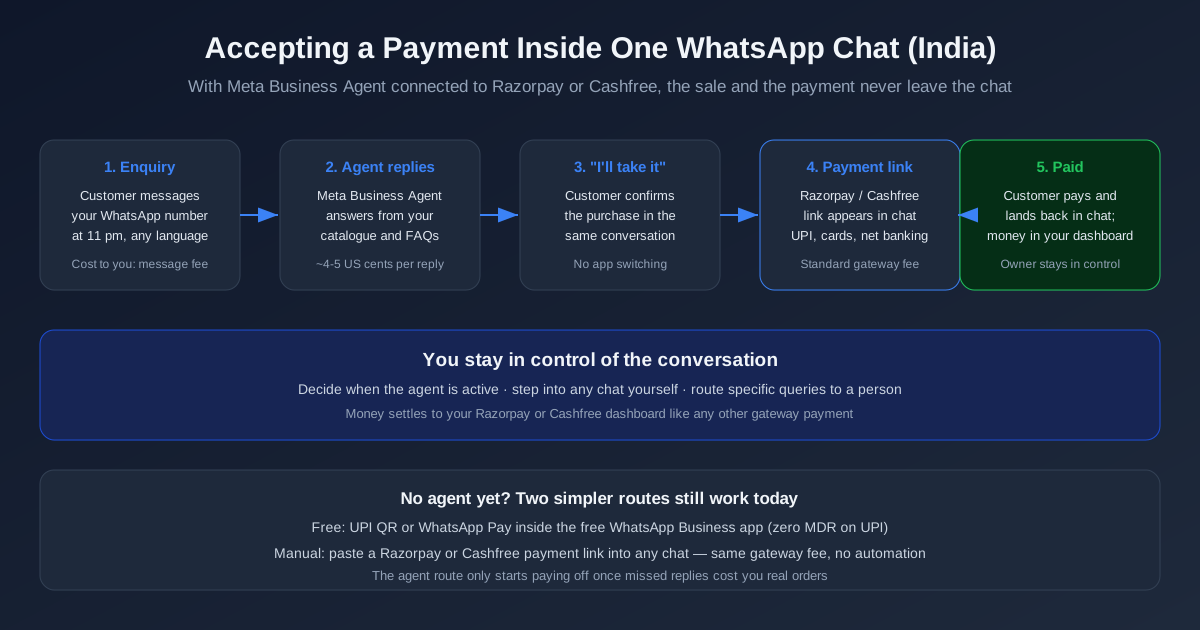
On 17 November 2026, Razorpay announced it went live on Meta Business Agent in India, and Cashfree shipped the same integration the same week. Both do the same thing: when the customer says "I'll take it", the agent raises a payment request right there in the chat, the customer taps and pays, and the money lands in your gateway dashboard. No app switching, no screenshots, no lost sales between "interested" and "paid".
This guide walks through the three realistic routes — free QR, manual payment links, and the agent-powered flow — what each costs, and which business each one actually fits. We build WhatsApp-first websites and support flows for clinics and D2C brands, so the practical notes below come from setups we have worked on, not from a press release.
Can customers really pay inside a WhatsApp chat in India?
Yes, and it is live today on three levels. The free WhatsApp Business app supports UPI payments natively — a customer can tap and pay you through WhatsApp Pay inside the chat, and UPI carries zero MDR, so it costs you nothing. Any chat, agent or not, accepts a payment link from Razorpay or Cashfree pasted in manually. And since mid-November 2026, the automated route exists too: Meta Business Agent, connected to Razorpay or Cashfree, handles the enquiry, confirms the purchase and raises the payment request in one conversation.
The context matters. WhatsApp Pay itself holds under 1% of India's UPI volume — about 0.8% as of September 2026, against PhonePe's 45.6% and Google Pay's 32.2%. Meta knows it will not win by replacing PhonePe on the home screen. Its play is the other side of the table: the business chat. More than a million businesses already use Meta Business Agent to reply to customers, and now those replies can end in a transaction. You do not need customers to change payment apps — you need them to do what they already do: message you.
Three ways to collect money on WhatsApp
Every route below works for an Indian business today. They differ in cost, setup effort, and how much of the conversation a machine handles.
| Route | How it works | What it costs | Setup effort | Best for |
|---|---|---|---|---|
| UPI QR / WhatsApp Pay | Customer pays through WhatsApp Pay or scans your UPI QR in the free WhatsApp Business app | Zero — UPI carries no MDR | Minutes | Walk-in businesses, single-owner shops, anyone starting out |
| Gateway payment link, pasted manually | You create a Razorpay or Cashfree link and send it in the chat | Standard gateway fee, typically around 2% + 18% GST per transaction | An hour — open a gateway account | Custom-priced work: services, bulk orders, anything needing an amount per customer |
| Meta Business Agent + gateway | The AI agent answers, confirms the purchase and raises the payment request by itself | Gateway fee + agent token cost (~₹3.5–₹4.5 per AI reply on the API) | Connecting your gateway account to the agent; catalogue and FAQs must be filled in properly | Businesses losing real orders to unanswered messages — nights, festivals, peak enquiry hours |
One honest note on the middle row: a payment link is the only route that handles variable amounts cleanly. A QR code holds a fixed VPA and the customer types the amount, which invites short payments and "bhaiya, I sent it" disputes. A link carries the exact amount, tracks its own payment status, and gives both sides a receipt. For anything above a couple of thousand rupees, we push clients to links.
What does the agent-powered route actually cost?
Money moves through the gateway, so the main cost is the ordinary one: most Indian gateways charge roughly 1.9–2% plus GST per transaction on UPI, cards and net banking through payment links. Our payment gateway charges comparison for India breaks the per-gateway numbers down in detail.
The new cost line is the agent itself. Meta Business Agent bills at $2 per million tokens on the API — about 4–5 US cents, ₹3.5–₹4.5, per AI reply. We covered the full arithmetic in our Meta Business Agent cost guide; the short version is that a month of heavy automated replies costs a few thousand rupees, which is trivial next to one staff salary, but the bill scales with conversation length, not message count.
What the agent route does not charge for is the sale itself. There is no commission on the transaction beyond the gateway's standard fee — Razorpay and Cashfree are competing to be your connected app precisely because they want the ordinary transaction volume. That is what makes this integration genuinely different from paying a per-conversation fee to a chatbot vendor.
How the flow works for a real enquiry
Take a D2C snack brand doing orders over WhatsApp during a sale week. Before this integration, the sequence was: customer messages, brand replies when someone is free, customer asks for price, brand sends a link, customer pays or does not, brand checks the dashboard and follows up. At 30 orders a day that is a person doing nothing but order confirmation.
With the agent connected, the same chat runs itself: the agent answers from the catalogue in the customer's language, confirms the item and quantity, and when the customer says they want it, a payment request appears in the chat showing the business name, the amount and a Pay button. The customer taps, pays by UPI or card, and lands back in the same thread. Payment status shows in the gateway dashboard like any other payment — refunds run through the same dashboard.
The part most press releases skip: the owner stays in control. You decide when the agent is active, you can join any conversation mid-thread, and you can route specific queries — complaints, refunds, bulk negotiations — straight to a person. For a clinic or a lender, note the flip side: Meta's eligibility list excludes health, finance and government businesses, so the agent route is simply unavailable, and the manual link or a compliant self-built flow remains the answer.
Which route fits which business? A quick checklist
- You take fewer than 10 orders a day and reply yourself: stay on the free app, add a UPI QR, and use payment links for custom amounts. The agent would cost more in setup than it saves.
- You lose orders at night or during festivals because nobody replies: connect a gateway to Meta Business Agent and switch the agent on for off-hours only.
- You sell on a website but take support and custom orders on WhatsApp: keep checkout on the site, use in-chat links for the exceptions — do not split inventory across two systems casually.
- You are a clinic, pharmacy or finance business: the agent route is off the table under Meta's eligibility rules. Build your booking and payment flow on the WhatsApp Business API with your own agent instead.
- You currently use an unofficial "bulk sender" tool: move to official routes before your number gets banned — that risk grows with every broadcast you send outside the API.
The limits, risks and things nobody mentions
First, this is a prepaid-era product. If your customer base still expects cash on delivery — common in Tier-2 and Tier-3 food and fashion — the agent closing a prepaid sale does not remove your RTO problem; our guide to reducing COD RTO for Indian e-commerce covers that side separately.
Second, the agent is only as good as the data behind it. A stale catalogue, outdated prices or missing stock status means the AI confidently quotes the wrong thing and takes payment for it — a refund, an angry customer, and a bad review in one message. Before connecting a gateway, spend a weekend on the catalogue. It is the same lesson from our work on agentic commerce for Indian D2C brands: clean data beats fast adoption.
Third, consent and data. Customer names and numbers now flow through Meta and the gateway, and promotional follow-ups still need consent under the DPDP Act and WhatsApp's commerce policy. A payment completed in chat does not give you permission to broadcast to that number — our WhatsApp broadcast marketing rules guide covers where the line sits.
And fourth, taxes still work the same way. An in-chat payment is a normal gateway settlement: GST invoicing obligations, settlement timelines and reconciliation do not change because the button lives in WhatsApp.
Common mistakes we see when businesses add chat payments
The most common is skipping the QR-to-link upgrade too late. A fixed QR works until the day a customer underpays and you spend twenty minutes sorting it out. The second is turning the agent on full-time from day one: for the first fortnight, run it off-hours only, read every conversation it handled, and fix the answers it got wrong before you let it loose on your peak hours.
The third is treating the payment link as a substitute for confirming the order. The agent handles "yes, I want it" — you still need a clear step for address, size or appointment confirmation before money moves, or your refund rate will do the learning for you. And the fourth is budgeting nothing for replies: at ₹3.5–₹4.5 per automated answer, a chatty agent on a sale weekend can out-cost the plan you made for it.
How we set this up for clients
For the businesses we build for — clinics, D2C food brands, service studios — the order of operations is fixed: WhatsApp Business account and catalogue first, then the payment link route, then automation only once the enquiry volume justifies it. A recent example of that philosophy in practice is our dental foundation website case study, where the booking conversation was designed around how patients actually message, not around what the technology can do. If you want the same thinking applied to your setup, see our AI and automation services or our work across India.
Still Collecting Payments With Screenshots?
We set up WhatsApp-first websites, payment flows and AI support for clinics, D2C brands and service businesses across India — the free routes first, automation only when it pays for itself. See our AI solutions and WhatsApp Business API pricing guide, or browse our service locations.
Set Up In-Chat Payments →Sources: Razorpay newsroom announcement on going live with Meta Business Agent (17 November 2026); Cashfree's connected-app announcement for Meta Business Agent (November 2026); Moneycontrol interview with Meta India head Arun Srinivas on WhatsApp Pay volumes and Bharat Connect (November 2026); Meta WhatsApp Business Platform Payments API documentation for India (updated May 2026). Gateway fee percentages are typical ranges — confirm exact rates on your plan before budgeting. Re-checked 20 November 2026.
Can customers actually pay inside a WhatsApp chat in India?
Yes. Since 17 November 2026, Razorpay and Cashfree both work as connected apps on Meta Business Agent, so the AI agent answering your WhatsApp chats can drop a payment link into the conversation. Customers pay by UPI, card or net banking without leaving the chat. Smaller businesses can always collect with a UPI QR code or a gateway payment link pasted manually.
What does it cost to accept payments on WhatsApp?
The chat itself is free to receive. Costs come from three places: standard payment gateway fees on each transaction (typically around 2% plus 18% GST on a payment link), Meta Business Agent token charges on the API (roughly 4-5 US cents, ₹3.5-₹4.5, per AI reply), and optional platform fees if you route through an intermediary. A plain UPI QR code inside the free WhatsApp Business app costs nothing because UPI carries zero MDR.
Does the AI agent see my customers' payment details or my money?
No. The agent generates a payment link powered by the gateway; the actual payment runs through the gateway and the customer's own UPI or banking app. Money settles to your Razorpay or Cashfree dashboard like any other gateway transaction, and you can step into any conversation yourself or route it to a person.
Do I need the WhatsApp Business API to collect payments in chat?
Not necessarily. The free WhatsApp Business app supports UPI payments directly and you can paste payment links into any chat. You only need the API — and a gateway integration — when you want automation: the agent replying on its own, payment status updates in your systems, or messages sent at scale. The API brings per-message pricing and template rules with it.
Is it safe, and can my WhatsApp number get banned for this?
Using official routes is safe: Meta's agent, a licensed Indian payment gateway, and UPI's two-factor authorisation on the customer's phone. The risk comes from unofficial "bulk WhatsApp sender" tools that promise automation outside the API — Meta bans numbers for those, and a banned business number can take years of customer history with it.