D2C brands in India spent the last two years paying Meta and Google for discovery. Now the discovery surface itself is shifting: shoppers are asking ChatGPT to find and order products, Razorpay has wired ChatGPT into UPI through a partnership with OpenAI and NPCI, and GoKwik and PayU have put Indian D2C brands directly inside the chat. This guide explains what agentic commerce actually is, what works in India today versus what is still pilot-stage, and what a small or mid-sized brand should genuinely do this quarter.
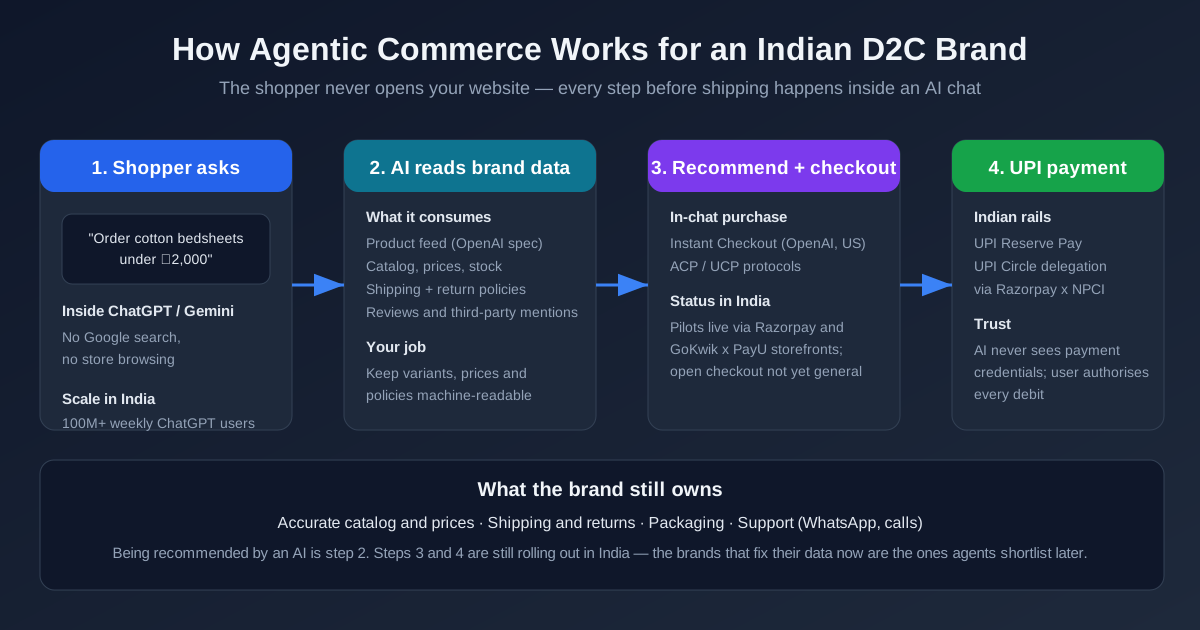
Agentic commerce means an AI assistant like ChatGPT finds, recommends and can order products on a shopper's behalf. In India, checkout runs on UPI rails — Razorpay works with OpenAI and NPCI on UPI Reserve Pay and UPI Circle, and GoKwik with PayU runs a multi-brand ChatGPT storefront. Open checkout is not generally available yet, so the practical job for D2C brands now is fixing catalog data, product feeds and policies so AI assistants shortlist you when it opens.
What is agentic commerce, in plain terms?
Agentic commerce is shopping where an AI agent does the browsing for you. Instead of opening Google, filtering on a marketplace, and reading reviews across six tabs, a shopper types one request into ChatGPT or Gemini: "order cotton bedsheets under ₹2,000 that ship by Friday." The agent reads product data, compares options, picks, and — where checkout exists — completes the purchase inside the conversation.
The part most explanations skip: the agent does not browse your store the way a human does. It reads machine-readable inputs — a product feed, catalog APIs, policy pages, reviews across the web — and it decides between brands based on that data. There is no page two of an AI answer. If your product data is thin or stale, you are not ranked lower; you are often simply not mentioned. That is a different failure mode from SEO, where a weak page still gets impressions.
For the brands we build and optimise sites for, this reframes the work. The website stops being only a conversion surface and becomes the data source an AI reads before it ever shows your product to a customer.
Can Indian shoppers actually buy inside ChatGPT today?
Short answer: in pilots, not at general availability. Here is the honest state of play as of November 2026.
What is real: OpenAI launched Instant Checkout in the United States — Walmart was an early partner — and published a public product feed spec that describes exactly what data merchants should send. Google answered with the Universal Commerce Protocol (UCP), an open spec backed by major payment processors including Visa, Mastercard and Stripe. In India, Razorpay began working with OpenAI and NPCI in late 2025 to enable purchases inside ChatGPT; its stack uses UPI Reserve Pay (blocking funds for a future debit) and UPI Circle (delegated UPI authorisation) so a payment completes without leaving the chat. Razorpay's CEO said the company was working with around 50 brands, with skincare brand Innovist among the first live.
What is also real: GoKwik and PayU launched India's first multi-brand D2C shopping experience inside ChatGPT, with early brands like Hyphen, Beardo and Bombay Shaving Company. GoKwik's co-founder claimed early-cohort brands saw roughly a 25% improvement in ROAS and a 15% drop in CAC — treat those as the vendor's own numbers, not independent benchmarks.
What is not real yet: open, self-serve agentic checkout for any Indian merchant on ChatGPT, Gemini or Perplexity. Economic Times reporting in 2026 noted that OpenAI, Perplexity and Google's agentic commerce offerings had launched in the US but not India, and that brands were building their own connectors in the meantime. If a consultant tells you they can list you on ChatGPT checkout next week for a fee, ask which pilot programme they are actually part of.
The discovery side, though, is already live and measurable. ChatGPT crossed 100 million weekly users in India, NIQ's Agentic Commerce India 2026 study found 92% of consumers in top metros had used AI while shopping, and Adobe's data shows AI-referred traffic to retail sites up more than 1,300% since October 2024, with those visitors converting better than search traffic. Nykaa told investors it had become the top beauty brand on ChatGPT and Gemini through what it calls Answer Engine Optimisation. Indians are already asking AI what to buy. The checkout is catching up.
How does the money move — and who touches the payment data?
This is the first question every founder asks, and rightly so, because "an AI bought something for my customer" sounds like a fraud story waiting to happen. The Indian pilots were designed around that fear.
- The AI never receives payment credentials. Razorpay has stated explicitly that ChatGPT does not get card or UPI details; the checkout hands over to Razorpay's payment infrastructure.
- The customer authorises every debit. Payments run through NPCI's UPI infrastructure with normal two-factor authentication. On UPI Reserve Pay, the user approves a blocked amount for a specific merchant; on UPI Circle, the delegating user controls what the agent may spend.
- Refunds and disputes follow the existing rails. The transaction is a UPI payment to the brand, processed by the gateway, not some new AI escrow. Chargeback logic stays familiar.
One consequence worth planning for: because the purchase happens in-chat, order confirmation, shipping updates and support requests arrive as conversations, not page visits. Brands that already run support on WhatsApp (and most of our clients do) are structurally closer to this future than brands still chasing email support. The pattern is the same one we describe in our guide to WhatsApp AI customer support for Indian businesses: the chat is the session, and the brand answers inside it.
Three ways a D2C brand can get transactable
You do not have to hire a machine-learning team. There are three realistic routes, and they differ mainly in who builds and maintains the plumbing.
| Route | What it involves | Effort and cost signal | Who it suits |
|---|---|---|---|
| Aggregator / pilot partner | Go live through Razorpay's ChatGPT commerce stack or GoKwik's storefront ecosystem. They sync your catalog and submit you to the platform. | Lowest effort — Razorpay pitches near-instant setup for Shopify merchants. Standard gateway fees plus partner charges; pricing not published, so get it in writing. | Most small and mid D2C brands. You want reach without owning infrastructure. |
| Own MCP storefront | Build a Model Context Protocol server exposing your catalog, cart and checkout so any AI agent can transact with you directly. | Razorpay's CEO put a typical custom build at eight to ten weeks of engineering. Real maintenance cost afterwards: stock sync, price sync, version changes. | Brands with in-house engineering or complex catalogs (B2B price lists, custom configurations) and a genuine reason not to sit in an aggregator's queue. |
| Prepare-only | Do nothing transactional yet. Clean the catalog, publish a feed per OpenAI's spec, fix policies and schema, and watch your category. | Costs time, not money. A working week of catalog hygiene for most brands. | Brands under ₹50L annual online revenue, or anyone burned by jumping on an immature channel. This is the honest default for most businesses we advise. |
A note on the do-nothing option, because it is less passive than it sounds. TruCommerce's founder told Inc42 that in their data, 84.6% of products ChatGPT recommends come from its cited sources, and over 95% of those citations are external — editorial coverage, Reddit and Quora threads — not the brand's own pages. The same data put the cheapest option at the top of AI recommendations 67.8% of the time versus 26.9% when priced 20% higher. Preparation, in other words, is partly off-site: being reviewed, compared and discussed in places an AI reads. That overlaps heavily with the work we describe in the AI search visibility guide for small business.
What actually decides whether an AI recommends your product?
Ranking on Google taught everyone to think in keywords and backlinks. Agent ranking rewards different things, and they are mostly boring data problems.
- Catalog accuracy beats everything. Agents hallucinate when data is messy. If your variants are unclear — "Medium / Blue" as one product, sizes as free text — the AI either guesses or skips you. TruCommerce's founder named messy variant data as a leading cause of AI quoting wrong specs and prices, which is worse than being skipped: it generates support tickets.
- Price transparency, and price itself. See the 67.8% figure above. Agents doing a shopper's comparison job favour the cheapest qualifying option. If your brand can only win on story rather than price, your data needs to carry the differentiators in structured form — material, certifications, warranty — not marketing adjectives.
- Reviews and third-party mentions. Agents weigh ratings heavily because they cannot try your product. seeding honest conversations on Reddit and Quora, and getting into comparison articles, does work that no feed submission replaces.
- Policies in plain, findable text. Shipping timelines, COD availability, return windows. An agent asked "will it arrive before the wedding on the 12th?" needs a real answer from your data.
None of this requires new tooling on day one. It requires the discipline that marketplaces always demanded — clean feeds — applied to a new consumer.
What should a D2C brand do this quarter? A practical checklist
Assuming you run a normal D2C store on Shopify, WooCommerce or a custom build, this is the sequence we would actually follow, in order:
- Audit catalog data (week 1). Every product: title a human could parse, variant-level price, live stock status, dimensions where they matter. Fix the worst 20 SKUs by revenue first.
- Publish policies in plain text (week 1). Shipping, returns, COD, warranty — as normal sentences on crawlable pages, not buried in an image or a PDF.
- Check Product schema on every product page (week 2). Price, availability, rating where real. If you are on a custom build rather than Shopify, this is usually the gap; it is a small fix with a large effect on how machines read the page.
- Draft an OpenAI-format product feed (week 2-3). The spec is public and mercifully boring: titles, descriptions, prices, availability, links. Most catalog tools can export 80% of it already.
- Ask your payment gateway the direct question (week 3). If you are on Razorpay or Cashfree: what is your agentic commerce timeline, what does it cost, and what do you need from us? Written answers, not sales calls.
- Start measuring AI-referred traffic (week 4). Filter analytics for chatgpt.com, gemini.google.com, perplexity.ai referrers. Small numbers today; the trend line matters more than the volume.
- Seed honest third-party presence (ongoing). Real comparisons, real customer discussions, category lists you genuinely belong on. Slow, compounding, and exactly what agents cite.
Notice what is missing: paying for an "AI optimisation package." With open checkout not live in India, anyone selling guaranteed ChatGPT placement is selling something that does not exist yet.
Common mistakes we see brands make with AI commerce
- Confusing AI search visibility with agentic commerce. Being mentioned in an answer is step two of four. Brands buy visibility audits and think they are checkout-ready. The feed, the rails and the pilots are separate work.
- Optimising for one assistant. Today it is ChatGPT; Gemini's share grows every quarter, and Google's AI Mode sits in front of far more Indian users than any standalone chatbot. Build for the data layer — feeds, schema, policies — and every assistant reads it. Chase one chatbot and you rebuild the work every model cycle.
- Treating the marketplace play as the AI play. Listing on ONDC or Amazon and assuming agents will find you there. Sometimes yes, but marketplace listings give you marketplace margins and no customer data. The brands pulling ahead, like Nykaa, did the work on their own catalog and their own site.
- Ignoring the support implication. In-chat purchases produce in-chat questions. If nobody owns your WhatsApp inbox or chat support, agentic orders create response-time debt you pay in refunds and bad reviews. We make the same argument in our comparison of quick commerce versus your own D2C website: the channel that wins is the one whose follow-up actually works.
- Early-mover panic spend. Signing a year-long contract for an MCP build before your catalog is clean. Sequence matters: data first, rails second.
Will agentic commerce replace your website?
No, and planning for it to is its own mistake. Three reasons, in order of how fast they bite.
First, someone has to ask. An agent recommends what it is asked about, and demand creation — the launch, the reel, the ad that made someone want bedsheets — still lives on Instagram, Meta and Google. That is the same division of labour that exists between marketplaces and brand sites today, which we covered in the WhatsApp ordering versus online store comparison.
Second, margin lives on your own channels. Bundles, subscriptions, first-party data for re-marketing, the checkout you control — none of that transfers to a chat session routed through a gateway partner. Expect agentic orders to behave like marketplace orders: incremental revenue, thinner control.
Third, the rails are young. Protocols are still settling — OpenAI's Agentic Commerce Protocol on one side, Google's UCP on the other, India's pilots in between. Building deeply on any of them today is building on sand. The website, meanwhile, keeps doing what it has always done: converting the demand the other channels create.
The pragmatic posture: keep investing in the site as your data source and conversion engine, and treat agentic channels as an emerging third distribution lane you prepare for rather than bet on. When open checkout lands in India, the brands that win the first wave will be the ones whose data was already right — not the ones who moved fastest on announcement day.
The AI layer is only as good as the site it reads from.
Epiqu builds and maintains D2C and service-business websites across India: clean catalog data, real Product schema, fast pages, WhatsApp-integrated support flows. If you want your site ready for the agents before your competitors are, that is a conversation worth having.
Talk to us about your store See our AI solutionsSources: Reuters on Razorpay's OpenAI and NPCI partnership (October 2025); Inc42 interviews with Razorpay, TruCommerce and Flash AI (2026); Economic Times on agentic commerce pilots in India (2026); OpenAI Instant Checkout and product feed documentation; Google Universal Commerce Protocol announcement (ucp.dev); NIQ Agentic Commerce India 2026 study via Entrepreneur India; Adobe Digital Insights via Digital Commerce 360; Indian Express on ChatGPT's 100 million weekly users in India. Figures attributed to companies are their own claims. Rates and launch status re-checked 20 November 2026.
Can Indian customers buy products inside ChatGPT right now?
Not through OpenAI's own checkout yet. In India, purchases currently run through pilots built by Razorpay with OpenAI and NPCI (using UPI Reserve Pay and UPI Circle) and through GoKwik and PayU's multi-brand ChatGPT storefront. General-access agentic checkout has not launched in India, so for most shoppers the AI still recommends, and buying happens on your site or app.
What is agentic commerce in simple terms?
It is shopping where an AI assistant does the work of finding, comparing and ordering: you tell it what you want, it reads product data from brand feeds, recommends options, and can complete the purchase inside the chat. The brand still ships the order and owns support; the AI just replaces the browsing journey.
Does the AI see my customers' UPI or card details?
No. In the Indian pilots, payment credentials stay with NPCI's UPI infrastructure and the customer's own app. Razorpay's CEO has said AI models do not receive payment credentials, and every transaction still requires user authorisation through UPI's two-factor flow.
How much does it cost to go live on ChatGPT commerce in India?
There is no published Indian price list yet. Razorpay has positioned its ChatGPT commerce stack as near-instant setup for Shopify merchants, against an eight-to-ten-week custom engineering effort to build your own MCP storefront. Expect standard payment gateway transaction fees plus whatever the pilot partner charges; ask for written pricing before signing.
Will agentic commerce replace my website?
No, not for years. AI-referred traffic is growing fast but is still a small share of visits, someone has to know your brand for an agent to be asked about it, and margin-heavy parts of the business like retention and bundles live on your own channels. Treat ChatGPT as a discovery and checkout channel next to your website, not instead of it.
What is the single most important preparation step for a D2C brand?
Clean, machine-readable product data: accurate titles, variant-level prices, real stock status, shipping and return policies in plain text, and Product schema on every product page. AI assistants recommend brands whose data they can trust, and messy variant data is a leading cause of AI quoting the wrong price or spec.