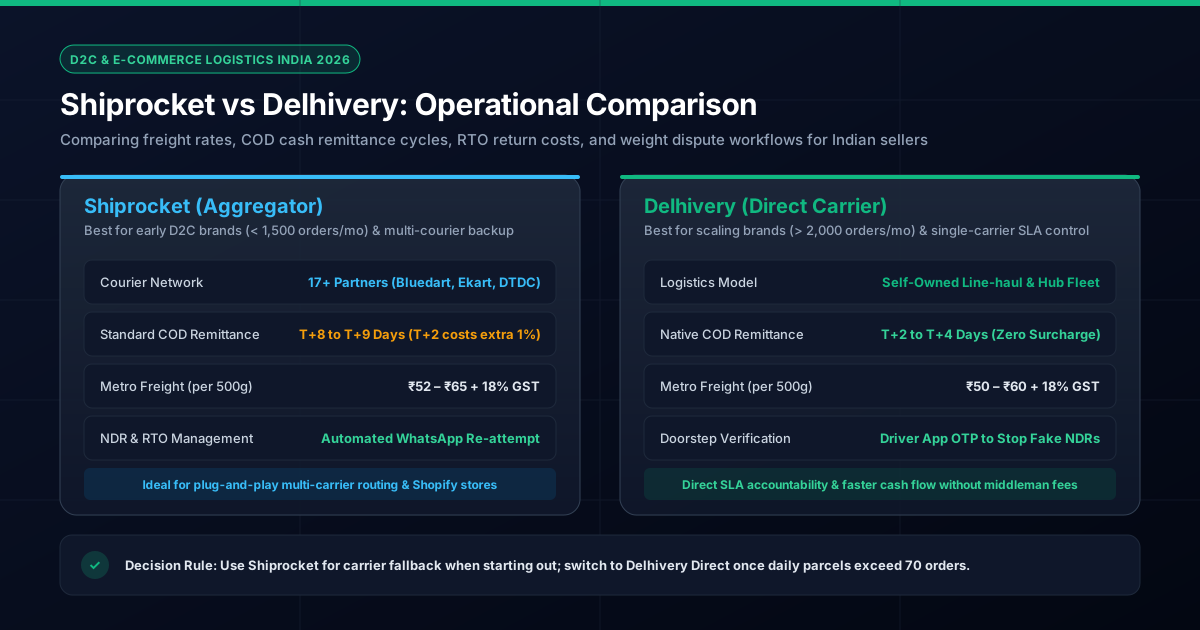
Choose Shiprocket if you ship under 1,500 monthly orders and need multi-courier flexibility across 17+ carrier partners like Bluedart, Ekart, and DTDC to prevent delivery blackouts. Choose Delhivery Direct if you process over 70 daily parcels, require native T+2 COD cash remittance without early-withdrawal fees, and demand direct single-carrier operational accountability.
The E-Commerce Shipping Reality in India
For Indian direct-to-consumer (D2C) brands, shipping is rarely just a delivery line item. It accounts for 12% to 18% of gross merchandise value. When you factor in Return-to-Origin (RTO) rates on Cash on Delivery (COD) orders—which frequently touch 25% to 35% in apparel, cosmetics, and footwear—logistics determines whether your store turns a net profit or burns working capital.
Every founder launching an online store faces an early structural choice: should you use a multi-carrier aggregator like Shiprocket, or sign a direct enterprise agreement with a dedicated logistics carrier like Delhivery? Both platforms move millions of packages across India daily, but they operate on distinct business models.
Shiprocket acts as a shipping broker. It pools parcel volume across tens of thousands of online sellers to negotiate bulk discounted commercial rates with third-party courier companies, including Delhivery, Bluedart, DTDC, Ekart, and Shadowfax. Delhivery Direct is a technology-driven express logistics network with its own automated sortation hubs, line-haul trucks, and last-mile field fleet spanning over 18,500 Indian pin codes.
Understanding which model aligns with your monthly shipment volume, working capital constraints, and average order value determines how effectively your store survives competitive Indian retail cycles.
Rate Card Comparison: Freight Costs per 500 Grams
Shipping rates in India depend on dead weight versus volumetric weight, origin-destination distance zones, and platform subscription tiers. Both Shiprocket and Delhivery charge freight on 500-gram incremental slabs with mandatory 18% GST applied on top.
| Shipping Zone / Parameter | Shiprocket (Aggregator) | Delhivery Direct (Carrier) | Operational Impact |
|---|---|---|---|
| Intra-City / Local (within 50 km) | ₹29 – ₹38 per 500g | ₹32 – ₹42 per 500g | Shiprocket accesses hyper-local riders (Shadowfax, Borzo) at lower entry rates. |
| Regional / State (Zone B) | ₹39 – ₹48 per 500g | ₹38 – ₹45 per 500g | Delhivery offers competitive regional line-haul transit times. |
| Metro to Metro (Zone C) | ₹52 – ₹65 per 500g | ₹49 – ₹58 per 500g | Delhivery provides direct airport hub transfers without third-party handoffs. |
| Rest of India / National (Zone D) | ₹68 – ₹85 per 500g | ₹64 – ₹78 per 500g | Delhivery direct account saves ₹4 to ₹8 per parcel on cross-country lanes. |
| Special Zones (NE, J&K, Islands) | ₹85 – ₹120 per 500g | ₹80 – ₹110 per 500g | Shiprocket allows switching to Bluedart Air or Speed Post if roads close. |
| Monthly Platform Fee | Free base tier; ₹1,900 to ₹4,500/mo for lower rates | Zero SaaS fee; volume-based commercial contracts | Shiprocket locks lowest per-kg rates behind paid monthly subscription plans. |
| Minimum Daily Order Volume | No minimum threshold (1 order/week allowed) | Recommended 50–100+ orders/day for direct pickups | Delhivery hub vans avoid daily visits if your dispatch batch is under 15 packages. |
For early-stage brands shipping 10 to 30 parcels daily, Shiprocket offers an immediate pricing advantage without requiring contract negotiations. However, as your order volume crosses 2,000 monthly shipments, the ₹5 to ₹10 per-order margin difference on Delhivery Direct adds up to thousands of rupees in pure operational savings every month.
Cash on Delivery (COD) Remittance: Managing Cash Flow
Cash on Delivery represents between 50% and 75% of consumer e-commerce transactions across Tier-2 and Tier-3 Indian cities. When buyers pay cash at the doorstep, that money does not land in your bank account immediately. The speed of that remittance defines whether you can restock inventory and run digital ads, or find yourself trapped waiting for cash releases.
| Remittance Feature | Shiprocket | Delhivery Direct |
|---|---|---|
| Standard Remittance Cycle | T+8 to T+9 business days after delivery | T+2 to T+4 business days after delivery |
| Early COD Remittance Option | Available (T+2 / Next-Day / 2-Hour) | Standard agreement includes fast payout |
| Early Remittance Surcharge | 0.5% to 1.2% deduction per transaction | Zero extra percentage fee |
| COD Handling Fee | ₹35 to ₹45 or 1.5% to 2% of parcel value | ₹30 to ₹40 or 1.2% to 1.8% of parcel value |
If you run a bootstrapped business with tight working capital, Shiprocket's standard 8-day payout schedule can choke supply chains. If you opt for their Early COD program to get funds in 48 hours, you surrender roughly 1% of your total revenue. Over ₹10,00,000 in monthly COD collections, that 1% fee amounts to ₹10,000 in unnecessary fees—an expense that Delhivery's native direct bank settlement avoids.
RTO Rates and Fake Non-Delivery Reports (NDR)
Return-to-Origin is the most dangerous margin leak in Indian retail. When an order returns undelivered, you pay forward freight, reverse freight (often 100% of forward cost), and packaging waste, while tying up unsold inventory in transit for two weeks.
A major cause of RTO in India is the fake non-delivery report: a field delivery agent marks a package as "Customer Not Available" or "Address Incomplete" without attempting the doorstep visit, simply to meet end-of-day route quotas.
Here is how both platforms handle NDR verification and recovery:
Shiprocket NDR Workflow
Shiprocket offers an automated communication engine that triggers automated WhatsApp and SMS alerts to the customer the moment a delivery partner flags an issue. The buyer receives a secure link to confirm their address, select a preferred delivery date, or provide alternative phone numbers.
Because Shiprocket acts as an intermediary, it passes this updated instruction to the carrier's API. The limitation: if the underlying courier partner ignores the API update, the parcel can still slip into RTO status. Shiprocket provides the intelligence layer, but not the delivery fleet.
Delhivery Doorstep Verification
Delhivery counters fake delivery attempts at the hardware level. Delivery personnel use the proprietary Delhivery rider application, which enforces geo-fence checks and mandatory customer OTP verification before an address can be marked as unreachable. If a driver claims a buyer was absent, the system flags whether the vehicle actually stopped at the delivery coordinates.
For brands with dedicated Delhivery account managers, you can mandate three consecutive delivery attempts across distinct time windows before reverse transit initiates, cutting preventable RTO by 4% to 7%.
Weight Discrepancy Disputes
Ask any seasoned Indian e-commerce seller about shipping headaches, and weight discrepancy disputes will top the list. This occurs when an automated sortation scanner at a courier hub records a 400-gram package as 1.8 kilograms, instantly deducting an extra ₹120 from your prepaid shipping balance.
Resolving these disputes requires photographic proof, box dimensions, and depot verification:
- Shiprocket Dispute Resolution: Shiprocket acts as an arbitrator between you and the third-party courier. You have 7 days to upload parcel photos on a weighing scale showing length, width, height, and shipping label. Resolution takes between 7 and 14 business days. While Shiprocket automated systems catch obvious scan errors, sellers sometimes face unresolved deductions when courier companies reject disputes.
- Delhivery Direct Resolution: When you hold a direct enterprise account with Delhivery, weight disputes go through a single operations team. You have direct access to automated optical dimensioner logs and CCTV snapshot records from Delhivery sortation hubs, resolving billing anomalies within 3 to 5 business days.
Operational Decision Guide: Which Platform Fits Your Business?
Selecting between Shiprocket and Delhivery is not about which service is universally superior—it is about which operational model matches your monthly dispatch volume and internal team bandwidth.
Choose Shiprocket If:
- • You dispatch fewer than 1,500 packages per month.
- • You run a multi-channel store (Shopify, WooCommerce, Amazon, Quick Commerce) and need 1-click order synchronization.
- • You ship across remote PIN codes where a single courier may lack serviceability or face localized delivery strikes.
- • You want integrated post-purchase tracking pages and automated buyer WhatsApp updates without writing custom code.
- • You require on-demand courier switching if one carrier experiences backlogs during festive peak sales.
Choose Delhivery Direct If:
- • You regularly ship more than 70 orders per day (2,000+ per month).
- • You operate a high-volume COD business and need fast T+2 bank remittance without surrendering 1% in early cash-out charges.
- • You want a dedicated pickup truck and driver assigned directly to your warehouse daily.
- • You require direct SLA accountability and direct escalation paths when packages face transit delays.
- • You sell standardized products where automated box dimensions are consistent and predictable.
The Multi-Carrier Strategy Used by Top Indian Brands
India's fastest-growing D2C companies rarely rely on a single shipping pipe forever. Instead, they implement an evolutionary shipping architecture:
When launching your brand, plug into Shiprocket to access all major domestic carriers instantly with zero upfront deposit. Configure your checkout to prioritize Bluedart for high-value prepaid air shipments, Delhivery for metro surface, and DTDC for Tier-3 pin codes.
As specific logistics lanes mature and your daily parcel dispatch exceeds 100 packages, negotiate a direct contract with Delhivery for your high-volume surface corridors. Keep your Shiprocket account active as an automated fallback system. When regional weather disruptions or state border checkpoints impact one carrier, you can route dispatches to backup carriers in two clicks.
To support this logistics architecture, Indian retailers need fast, reliable e-commerce storefronts that calculate shipping rules accurately at checkout. Explore our custom web design services for high-converting stores, or review our custom software development services to build automated ERP and inventory dispatch workflows. For enterprise distribution, explore our footprint across regional commercial centers throughout India.
Operational Checklist Before Signing Shipping Contracts
Before committing your business to a courier aggregator or direct carrier, audit these five operational requirements:
- Volumetric Weight Box Optimization: Ensure your outer packaging closely matches product dimensions. Incurring volumetric surcharges for empty cardboard air is the fastest way to double freight costs.
- Automated OTP Address Validation: Enable pre-checkout phone validation on your store to eliminate fake phone numbers and incomplete street addresses before shipping labels generate.
- RTO Buffer in Product Pricing: Factor an 8% to 12% reverse freight risk margin into your base retail pricing to ensure COD returns do not push unit economics into negative territory.
- Prepaid Conversion Incentives: Offer a ₹50 instant discount or free gift for UPI prepaid checkouts. Shifting your mix from 70% COD to 50% prepaid immediately cuts RTO and eliminates remittance delays.
- Dedicated Weighing Scale with Barcode Scanner: Record accurate dead weight and package photos at your packing station before courier handover to defend against automatic weight discrepancies.
Frequently Asked Questions
Is Delhivery cheaper than Shiprocket for small e-commerce businesses in India?
For brands shipping under 500 parcels per month, Shiprocket is generally more economical because it gives you access to enterprise bulk rates without minimum monthly commitments. Delhivery Direct offers cheaper per-order rates only once you dispatch more than 1,500 to 2,000 orders monthly and negotiate volume-based pricing.
How does Cash on Delivery (COD) remittance work between Shiprocket and Delhivery?
Shiprocket pays out standard COD funds on a T+8 to T+9 schedule after delivery. To receive funds faster (T+2), you must activate Early COD, which deducts a 0.5% to 1.2% convenience fee. Delhivery Direct processes native COD settlements within T+2 to T+4 days directly into your registered bank account without charging an early payout fee.
Can an Indian brand use both Shiprocket and Delhivery simultaneously?
Yes. Many mature D2C brands use Delhivery Direct as their primary carrier for high-density metro and regional surface lanes to lower per-parcel costs, while keeping Shiprocket connected to handle fallback routing, remote pin codes, and multi-courier coverage during festive peak sales.
What is the average RTO percentage for Indian D2C brands, and how do these platforms reduce it?
Average RTO in India ranges between 15% and 35%, depending on the category (highest in fashion and footwear). Shiprocket reduces RTO through automated WhatsApp customer address confirmations and delivery reschedule links. Delhivery reduces RTO by enforcing rider mobile app OTPs and GPS coordinate checks before a delivery can be logged as failed.
How do weight discrepancy disputes get resolved on each platform?
On Shiprocket, you submit weight disputes via your seller dashboard with photos of the parcel on a digital scale within 7 days. Shiprocket negotiates with the carrier on your behalf. On Delhivery Direct, you raise disputes directly with your account manager and have access to sortation hub dimensioner logs and CCTV images for faster resolution.
Scale Your Online Retail Infrastructure
Need help building a fast, conversion-optimized e-commerce platform with automated shipping integrations, address validation, and ERP workflows? Speak with our engineering team.
Schedule an E-Commerce Consultation →