Sooner or later, almost every business owner we work with asks the same question: should we build an app? The customer just asked for one, a competitor has one, and it feels like the thing serious businesses own. Most of the time the honest answer is no — not because apps are bad, but because the website plus WhatsApp setup they already run does the job at a tenth of the cost. Here is the decision framework we actually walk clients through, with the 2026 numbers in rupees.
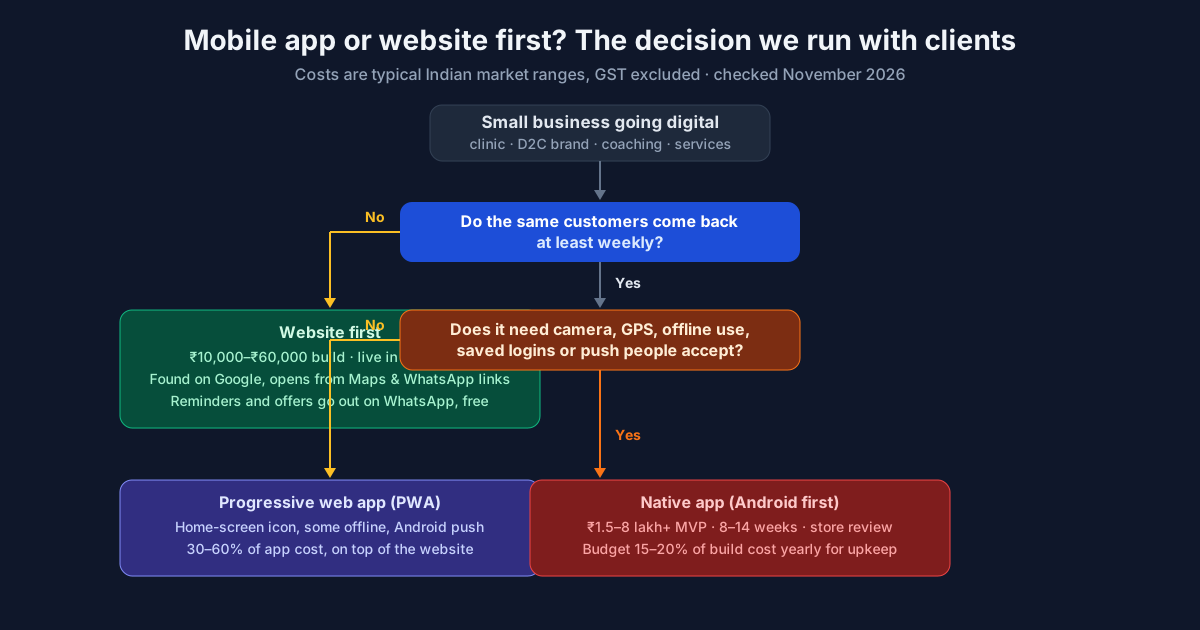
Build the website first. A small business site costs ₹10,000–₹60,000, launches in 1–2 weeks and is where Google, Maps and WhatsApp links land customers. A useful app costs ₹1.5–8 lakh, takes 2–4 months, and only pays off when the same customers transact weekly and need phone features — camera, GPS, offline, saved logins — that a browser cannot do.
What a mobile app actually costs in India
App quotes in India vary more than website quotes, because every screen, login role and integration multiplies the work. These are the bands we see across the Indian market in 2026, GST excluded:
| App type | Typical build cost | Timeline |
|---|---|---|
| Basic utility app (fixed content, no real backend) | ₹50,000 – ₹4,00,000 | 4–8 weeks |
| Ordering / booking app (logins, payments, admin panel) | ₹2,00,000 – ₹12,00,000 | 2–4 months |
| Multi-role platform (customer, vendor, delivery, admin) | ₹12,00,000+ | 4–8 months |
The line that almost never appears in a first quote: upkeep. Apps need OS updates, bug fixes and security patches every year, and most Indian vendors price that at 15–20% of the build cost annually. A ₹4 lakh app is really a ₹4 lakh build plus ₹60,000–₹80,000 every year after, for as long as the app exists. A website's upkeep is hosting and occasional content edits.
What a website costs, and what it does that an app cannot
A professionally built small business website in India runs ₹10,000–₹60,000, and an online store with payments lands between ₹80,000 and ₹4,00,000 depending on customisation. We have broken the full ranges down in our website development cost guide for India, so I will not repeat them here.
The more interesting question is what the website does that the app structurally cannot. When someone searches "dentist near me", taps your Google Business Profile, or clicks a link you sent on WhatsApp, they land on a website. Instantly. No install, no storage prompt, no 60 MB download on a phone with 2 GB free. Search engines index websites; they do not index app screens in any way that matters. Every new customer you will ever win through Google, Maps, or an AI assistant lands on the website first. The app is invisible to all of them until they already know you.
That is the core asymmetry: a website wins new customers. An app serves existing ones. Budgeting app money before the website is done is building the retention layer before the acquisition layer exists.
The costs that only come with an app
Build price is where the comparison usually stops, and it is the wrong place to stop. An app carries recurring costs a website never sees:
| Cost item | Website | Mobile app |
|---|---|---|
| Store accounts | None | $25 one-time (Google Play), $99/year (Apple) |
| Customer logins | Rarely needed | SMS/OTP charges on every verification |
| Updates | Live same day, no approval | Store review on every release, users must update |
| Platform changes | None | Mandatory Play policy updates, yearly OS work |
| Yearly upkeep | ₹3,000–₹15,000 (hosting, domain) | 15–20% of build cost |
| Reaching customers | Google, Maps, WhatsApp links | Push notifications (if users allowed them) |
One of these deserves its own paragraph. Push notifications are the reason most owners want an app — "we'll send offers and reminders". But Indian customers already read one notification channel faster than any other: WhatsApp. Appointment reminders, order updates, payment receipts and offers all run on WhatsApp Business API without asking anyone to install anything, and utility messages cost ₹0.115 each at Meta's list rate, with the first 1,000 service replies per number free each month. If notifications are your reason for wanting an app, you already own the better version of it. Our WhatsApp Business API pricing guide has the full rate card.
When a website is genuinely enough
Run your business against this list. If most of it sounds like you, spend the app budget on making the website excellent instead:
- Customers find you once, then deal with your team. Clinics, consultants, interior designers, wedding photographers — one enquiry, then phone calls and WhatsApp. There is nothing for an app to do between visits.
- People buy a few times a year, not a few times a month. Asking someone to install software they will open twice a year is how you lose the sale, not keep the customer.
- Growth depends on being found. Search, Maps, referrals, AI assistants — all of them lead to websites. None lead to app store listings.
- Your reminders and offers already run on WhatsApp. If that is working, an app adds cost, not reach.
- You are still validating the business. The cheapest test of demand is a fast site plus a ₹10,000 ad budget, not a ₹3 lakh build.
When an app earns its keep
Then there are businesses where the browser genuinely is the wrong tool. Three signals, and two of them need to be true before an app quote makes sense:
- The same customers transact weekly. Grocery reorders, daily tiffin services, gym check-ins, tuition fee payments, pharmacy refills. Frequency is the whole business case for an app — a home-screen icon and saved preferences only pay off when opening it is a weekly habit.
- The product needs the phone itself. Barcode scanning at volume, background GPS for delivery staff, Bluetooth peripherals, offline forms for field teams, biometric login. A browser can fake some of this; an app does it reliably.
- You have a base that will actually install it. Apps get installed by existing customers, not strangers. A few hundred people you can reach today at the counter or on WhatsApp is the minimum seed. Without that, the app launches to 200 installs and a review complaining about the OTP.
If two of the three are true, get quotes. If all three are true, you are probably losing money every month by not having one. If none are, no amount of "our competitor has an app" changes the maths.
What about a progressive web app?
The middle option deserves more attention than it gets. A PWA is a website that can be added to the Android home screen with an icon, open full-screen, work partly offline and send push notifications on Android — no app store, no review delays, one codebase. Flipkart Lite was the early Indian proof that this works at scale.
Cost-wise, adding PWA behaviour to an existing well-built site runs roughly 30–60% of what a native app would cost. Updates go live instantly. Customers get the icon they asked for without a download. What it cannot do well: deep hardware access, background location, Bluetooth, or anything iOS-specific — iPhone push support has improved but stays limited.
For ordering from a local business, customer portals, booking flows and internal staff tools, a PWA on top of a fast website covers most of what people think they need an app for. We recommend it far more often than we recommend a native build.
How we actually decide this with clients
We build websites, WhatsApp flows and apps for clinics, D2C brands and service businesses across India, and the pattern repeats so consistently that we now run it as a fixed sequence. When a clinic asked us for a booking app, the conversation started with where their patients actually were: on WhatsApp. We built a fast website with an enquiry flow and a WhatsApp appointment flow instead — patients message, the flow asks availability questions, and reminders go out the same way. No install, no OTP cost, no store review standing between a fix and the patient who reported it. The reasoning is written up in why we chose WhatsApp over online booking for an Indian clinic.
That is not an argument that apps are wrong. For a tiffin subscription or a pharmacy with weekly reorders, we would scope an app — scoped tight, Android first, sharing one backend with the website so products and orders live in one place. The expensive mistake is not choosing the app. It is building the app and the website as two separate projects with two databases, then discovering that every price change has to be made twice.
Common mistakes we see
The competitor excuse. "They have an app" is not a requirement. Check whether their app has real ratings and installs before assuming it works for them — plenty are digital shelf-ware.
Quoting the build, forgetting the tenth year. A website's costs mostly end. An app's costs compound. Ask every vendor for a five-year total, including the 15–20% upkeep, in writing.
Android-and-iOS both on day one. Almost every small business's customers are overwhelmingly on Android. An Android-only first version halves the cost and halves the test surface; add iOS when the numbers say so.
Building an app that copies the website. Five screens that repeat your brochure add nothing. The app should exist because of the three screens customers would use every week — nothing else.
Frequently Asked Questions
Should a small business in India build a mobile app or a website first?
A website, in almost every case. It is where Google, Maps and WhatsApp links land your customers, it needs no install, and a small business site costs ₹10,000–₹60,000 against ₹1.5 lakh or more for a usable app. An app earns its place once the same customers come back weekly and you need phone features a browser cannot deliver.
How much does a mobile app cost in India in 2026?
A basic utility app runs roughly ₹50,000–₹4,00,000. An ordering or booking app with logins, payments and an admin panel typically lands between ₹2 lakh and ₹12 lakh and takes 2–4 months. Complex apps with multiple user roles and integrations go higher, and upkeep runs 15–20% of the build cost every year.
Can I put my website on customers' home screens without building an app?
Yes. A progressive web app (PWA) is a website that can be added to the Android home screen with an icon, open full-screen, work partly offline and send push notifications on Android. It costs roughly 30–60% of what a native app would, on top of the existing website, with no store fees or review delays.
What recurring costs come with a mobile app that a website does not have?
Store accounts (a one-time $25 Google Play fee, $99 per year for Apple), SMS or OTP charges for logins, mandatory Play policy updates, and release reviews on every update. Websites carry only hosting and a domain, and changes go live the same day without anyone approving them.
Do I need an app to send push notifications to customers in India?
Not usually. WhatsApp is the notification channel Indian customers actually read — appointment reminders, order updates and offers all work there without an app. WhatsApp utility messages cost ₹0.115 each at Meta's list rate, with replies free inside the 24-hour window, and the first 1,000 service messages per number each month are free.
When does a business genuinely need a mobile app?
When two of these three are true: customers transact with you at least weekly, the product depends on phone hardware (camera scanning, background GPS, Bluetooth, offline field work), or you need logged-in features like saved payments and loyalty points. None of these true? A fast website with WhatsApp will do more for you at a tenth of the cost.
Still not sure whether you need an app?
We build fast websites, WhatsApp flows and mobile apps for clinics, D2C brands and service businesses across India — and we will tell you honestly when the app can wait.
Talk to us about your project See our app development servicesSources: published Indian market cost ranges for websites and apps compiled in our website cost guide and cross-checked against vendor pricing guides in November 2026; Google Play and Apple Developer Program store fees from each platform's official registration pages; WhatsApp utility and service message rates from Meta's INR rate card effective 1 October 2026.
Related reading: what website maintenance actually costs in India, how a WhatsApp ordering website works for a small food business, and custom website vs WordPress for Indian businesses.