Every growing Indian business reaches a point where managing customer leads across spreadsheets, personal WhatsApp numbers, and email threads completely breaks down. Missed follow-ups, lost deal context, and zero visibility into team pipeline force founders to evaluate a dedicated Customer Relationship Management (CRM) platform. In India, that conversation almost always narrows down to two industry giants: Chennai-headquartered Zoho CRM and US-based HubSpot.
Direct Answer: Zoho CRM vs HubSpot in India: Which Delivers Better ROI?
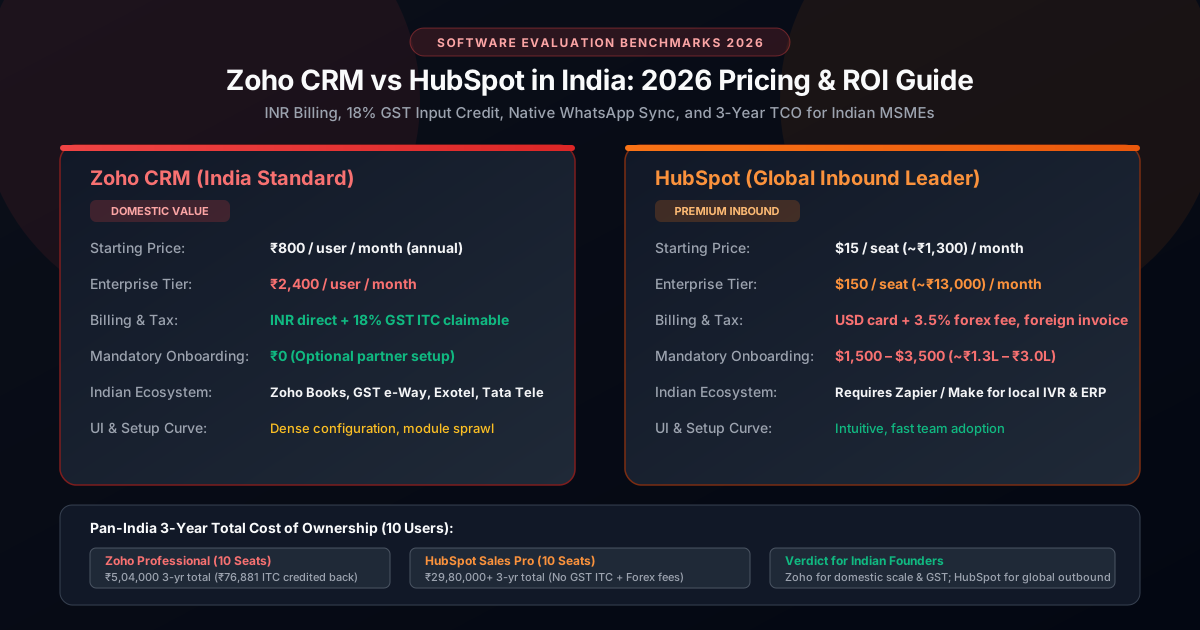
Zoho CRM delivers far superior ROI for Indian MSMEs selling domestically, offering native INR billing, an 18% claimable GST input tax credit, local telephony integrations, and enterprise features starting at ₹800 per user monthly. HubSpot offers a superior user experience and advanced marketing automation for VC-funded startups and export businesses selling to Western clients in USD, but costs 5x to 8x more once your contact list and sales team grow.
The Real Cost Difference: INR Billing vs USD Foreign Exchange
On paper, HubSpot looks accessible with free tiers and entry-level Starter seats priced at $15 per month. But for an Indian company, software pricing listed in foreign currency carries hidden costs that hit your monthly profit and loss statement:
- Forex Conversion & Card Markups: HubSpot bills in USD. When paying with an Indian corporate credit card or debit card, banks levy a 3.5% foreign currency markup plus applicable taxes on every single monthly billing cycle.
- The 18% GST Input Tax Credit Advantage: Zoho Corporation Private Limited is an Indian entity registered under GST. Your monthly or annual Zoho invoice carries a valid Indian GSTIN with state-specific CGST/SGST or IGST breakdowns. Your finance team claims 100% of that 18% tax as Input Tax Credit (ITC) against your sales liabilities. With HubSpot billed from overseas entities, reclaiming GST requires navigating complex reverse-charge mechanisms (RCM) or forfeiting tax credits entirely.
- Predictable Multi-Year Budgeting: Currency fluctuations directly impact software overhead. When the Indian Rupee depreciates against the US Dollar, your HubSpot bill expands automatically without adding a single seat. Zoho locks pricing in Indian Rupees with stable annual commitments.
Feature & Pricing Comparison Table: Zoho vs HubSpot (2026 Benchmarks)
To evaluate what your business actually gets at each budget tier, here is how the two platforms compare across key operational criteria in the Indian market:
| Evaluation Metric | Zoho CRM | HubSpot (Sales Hub) |
|---|---|---|
| Entry-Level Paid Plan | ₹800 / user / month (Standard tier, billed annually) | $15 / seat / month (~₹1,300, Starter tier) |
| Professional / Growth Tier | ₹1,400 / user / month (Includes Blueprint process workflows) | $90 – $100 / seat / month (~₹7,800 – ₹8,700) |
| Enterprise Tier | ₹2,400 / user / month (Custom modules, territory management) | $150 / seat / month (~₹13,000 / seat) |
| Mandatory Setup / Onboarding Fee | ₹0 (Self-onboarding or third-party agency support) | $1,500 to $3,500 (~₹1,30,000 to ₹3,00,000) for Pro/Enterprise |
| Contact Tier Pricing Penalties | Unlimited contacts on paid plans (storage expansion is affordable) | Steep monthly surcharges as marketing contact lists grow past tiers |
| Indian Telephony & Cloud IVR | Direct native integrations with Exotel, Tata Tele, Knowlarity, MyOperator | Requires custom Webhooks, Zapier middleware, or third-party CTI connectors |
| WhatsApp Business Automation | Built-in native WhatsApp channel messaging via official Meta Cloud API | Supported via app marketplace apps or custom integrations |
| Indian Accounting & ERP Sync | One-click synchronization with Zoho Books, GST e-invoices, and e-Way bills | Requires custom API engineering to sync with Indian GST accounting software |
3-Year Total Cost of Ownership (TCO) for a 10-Person Indian Sales Team
The true cost of business software is never just the sticker price on day one. Let us calculate the actual cash expenditure over a 36-month operational horizon for an Indian sales team with 10 sales executives and 15,000 marketing leads:
| Expense Component | Zoho Professional (10 Seats) | HubSpot Sales Pro (10 Seats) |
|---|---|---|
| Year 1 Subscription Fees | ₹1,68,000 (₹1,400 x 10 x 12) | ₹9,36,000 ($900/mo converted at ₹87/$) |
| Mandatory Vendor Onboarding | ₹0 | ₹1,30,500 ($1,500 fixed onboarding fee) |
| Years 2 & 3 Subscriptions | ₹3,36,000 | ₹18,72,000 |
| Forex Bank Surcharges (3.5%) | ₹0 | ₹1,02,840 |
| Gross 3-Year Outflow | ₹5,04,000 | ₹30,41,340 |
| 18% GST Input Tax Credit Recovered | -₹76,881 (Claimed back on GSTR-2B) | ₹0 (No domestic GST input credit) |
| Net 3-Year Cash Impact | ₹4,27,119 | ₹30,41,340 |
The difference is striking: over three years, HubSpot requires a net cash investment over 7 times higher than Zoho CRM for the same team size. For a growing manufacturer, healthcare clinic, or real estate firm in India, that ₹26 lakh difference funds multiple sales hires or quarters of customer acquisition ad spend.
WhatsApp and Indian Cloud Telephony: The Operational Reality
In mature Western markets, sales reps communicate primarily through corporate email inboxes and scheduled calendar invite links. In India, sales velocity happens on WhatsApp messages and direct phone calls. If your CRM cannot capture instant WhatsApp conversations or log inbound calls from IVR numbers automatically, your sales executives will abandon the tool within weeks.
Zoho has built direct integrations tailored to Indian sales workflows:
- Cloud Telephony Hookups: Zoho PhoneBridge connects natively with Indian telecom providers including Exotel, Tata Tele Business Services, Airtel Cloud IVR, and Knowlarity. When a prospective buyer calls your company IVR, the caller record pops up instantly inside Zoho CRM. Call recordings, duration, and disposition tags attach directly to the lead timeline without manual entry.
- Official WhatsApp Business API Sync: Sales reps can send templated quotation follow-ups, payment links, and service reminders directly from the Zoho lead view. Inbound buyer replies route into the shared team inbox.
- Zoho Books to CRM Billing Bridge: When an opportunity closes in Zoho CRM, your billing manager generates a GST tax invoice in Zoho Books with a single click, syncing GSTIN validation, payment status, and dispatch tracking without duplicate data entry.
HubSpot also supports WhatsApp through official integrations, but connecting Indian telecom providers requires third-party API aggregators or custom webhook pipelines. For businesses without a full-time in-house development team, maintaining those middleware connectors adds technical fragility and separate monthly subscription costs.
User Adoption and Team Learning Curve: Where HubSpot Leads
While Zoho wins decisively on price and Indian business infrastructure, HubSpot holds a clear advantage in user experience and interface design.
Zoho CRM is packed with deep configuration capabilities. However, its admin settings menu contains hundreds of nested options, sub-menus, and complex customization panels. Many Indian companies buy Zoho, attempt to set up custom modules without a structured roadmap, and end up with an unorganized database that sales reps resist using.
HubSpot, by contrast, provides one of the cleanest product interfaces in enterprise software. Sales representatives can master pipeline drag-and-drop boards, meeting schedulers, and email tracking templates within a single afternoon. If your sales organisation struggles with tech literacy or has high employee turnover, HubSpot reduces onboarding friction significantly.
Decision Framework: Which CRM Should Your Business Choose?
Choose Zoho CRM if:
- • You sell primarily to buyers in India with payments in INR.
- • Your business is GST-registered and reclaims 18% Input Tax Credit on operating software.
- • Your sales cycle relies on Indian cloud telephony (Exotel, Tata Tele, MyOperator) and WhatsApp messaging.
- • You use Zoho Books, Zoho Inventory, or Zoho Desk for back-office administration.
- • You want predictable software costs without contact penalty fees as your lead database scales to 50,000+ records.
Choose HubSpot if:
- • You are a venture-funded startup or B2B exporter selling primarily to North America or Europe in USD.
- • Your primary customer acquisition engine is organic inbound content marketing and automated email nurture sequences.
- • You need a unified CRM where marketing and sales teams can build campaigns without agency support.
- • You have the budget to afford $1,000+ monthly software bills and mandatory onboarding packages without straining cash reserves.
Common Implementation Mistakes Indian Companies Make
Regardless of whether you choose Zoho or HubSpot, CRM deployments fail when companies jump straight into software purchases without fixing basic operational handoffs:
- Buying High-Tier Licenses Too Early: Starting with 10 Enterprise licenses before your team has standardized basic deal stages wastes capital. Begin with Standard or Starter tiers, prove daily adoption, and upgrade only when you need custom automation rules.
- Uncleaned Data Import: Dumping unformatted Excel contact sheets with duplicate mobile numbers into your fresh CRM pollutes search results and skews conversion metrics from day one.
- Skipping Web Form Integration: Manually typing lead contact details from website inquiries or digital ad forms introduces delays. Ensure your website connects directly to your CRM API to trigger instant automated responses. Review our real-world work on client portals and conversion tracking in our healthcare client case study.
Frequently Asked Questions
Can I claim 18% GST Input Tax Credit on my CRM subscription in India?
Yes, if you purchase Zoho CRM from Zoho Corporation Private Limited with your company GSTIN registered, you receive an official GST invoice and can claim 100% of the 18% GST as Input Tax Credit (ITC). With HubSpot, billing originates outside India in foreign currency; you will not receive a standard domestic GST tax invoice, meaning the 18% tax cannot be reclaimed against your local output tax liabilities.
Which CRM is better for WhatsApp Business API integration in India?
Zoho CRM provides native integration with the WhatsApp Business Platform, allowing sales reps to initiate templated messages and manage customer replies from the CRM interface. While HubSpot supports WhatsApp through marketplace apps, Zoho provides tighter integration with local Indian telephony aggregators alongside WhatsApp communication.
Is HubSpot's free CRM plan sufficient for a small Indian business?
HubSpot's free tier is an effective tool for solopreneurs or teams of 1 to 2 people tracking basic deal stages. However, essential business features such as custom reporting, workflow automation, team permissions, and removal of HubSpot branding require upgrading to paid tiers where costs increase rapidly.
How long does a typical CRM setup and data migration take in India?
For a team of 5 to 20 users, a clean Zoho CRM implementation typically takes 2 to 4 weeks. This includes custom pipeline stage design, lead capture form integration, cloud telephony routing, and sales team training. HubSpot implementations for comparable team sizes generally require 3 to 6 weeks, often involving mandatory vendor onboarding milestones.
If you are planning to modernize your business lead capture, integrate your web forms directly into your CRM, or automate customer onboarding workflows across India, explore our web and digital software services, see our regional technology hubs, or contact our engineering team for an architecture and implementation consultation.