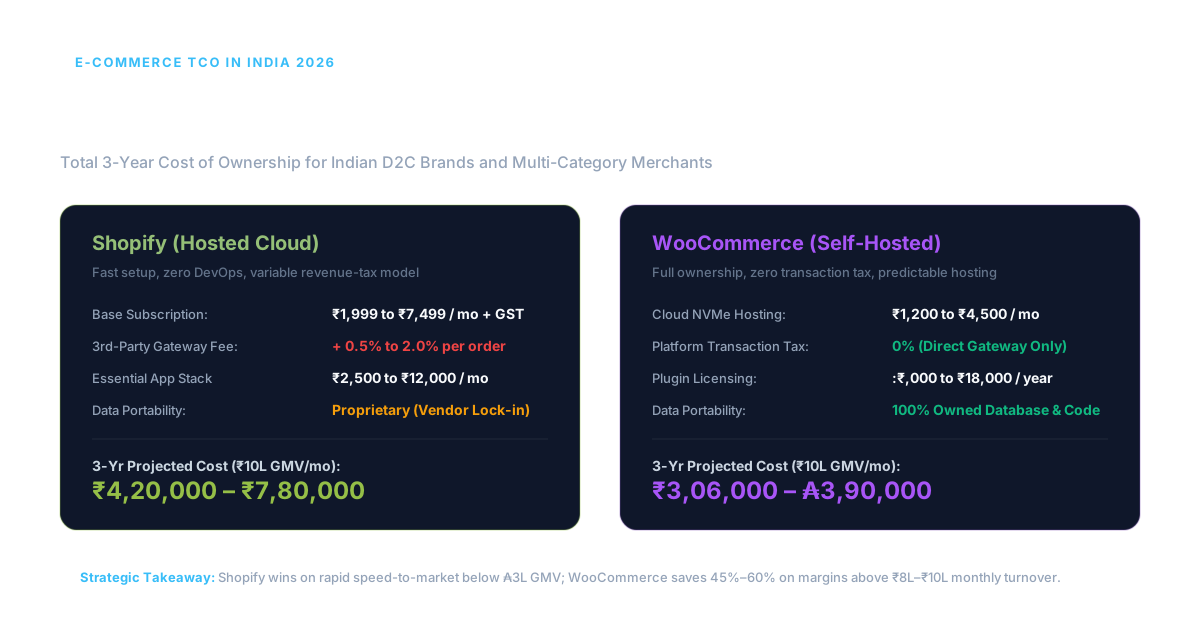
Shopify suits Indian businesses needing a store online within days with zero technical oversight, provided they accept monthly subscriptions starting at ₹1,999 plus 18% GST and an extra 0.5% to 2.0% fee on every external payment gateway transaction. WooCommerce requires dedicated hosting (₹1,200 to ₹4,500 monthly) and initial development setup, but eliminates platform transaction taxes entirely, cutting 3-year total operational costs by 45% to 60% once monthly sales cross ₹5,00,000.
The True Financial Trade-Off for Indian Merchants in 2026
When launching or scaling an online store in India, founders routinely face a binary choice: build on Shopify or deploy on WooCommerce. Most comparisons online evaluate both tools through a generic Western lens, quoting US dollar pricing and assuming native merchant payment rails like Shopify Payments. In India, the operational reality is substantially different.
Indian merchants deal with mandatory 18% GST surcharges on cloud software, statutory e-invoicing mandates, high customer preference for UPI and Cash on Delivery (COD), Return to Origin (RTO) logistics friction, and third-party payment gateway integration rules set by the Reserve Bank of India (RBI). Evaluating these two platforms requires tallying the exact line-item costs across hosting, transaction markups, local app ecosystems, and long-term data independence.
What Is the Real Setup and Recurring Cost Difference in India?
Shopify operates as a closed Software-as-a-Service (SaaS) platform where hosting, server security, payment compliance, and content delivery are bundled into a single recurring monthly fee. WooCommerce is an open-source e-commerce framework running on top of WordPress, meaning the software core is free, but hosting, server architecture, domain names, and performance caching must be provisioned independently.
Below is the baseline cost comparison in Indian Rupees (INR) excluding development labour:
| Expense Component | Shopify (India) | WooCommerce (Self-Hosted) |
|---|---|---|
| Core Platform Subscription | ₹1,999/mo (Basic), ₹7,499/mo (Shopify), ₹30,299/mo (Advanced) + 18% GST | ₹0 (Open-source core license) |
| Server Hosting & CDN | Included in monthly subscription | ₹1,200 to ₹4,500/mo (High-performance NVMe cloud VPS in Mumbai/Bangalore) |
| Third-Party Payment Fee | 0.5% to 2.0% per transaction (Levied on top of gateway MDR) | 0% platform fee (Direct gateway settlement only) |
| Essential Indian Business Apps | ₹2,500 to ₹12,000/mo (GST invoicing, WhatsApp cart recovery, pincode validation) | ₹9,000 to ₹18,000/year (One-time or annual plugin licenses) |
| Payment Gateway MDR | ~2.0% on domestic cards/net banking, 0% on standard UPI | ~2.0% on domestic cards/net banking, 0% on standard UPI |
| Data Portability & Code Access | Restricted proprietary database (Vendor lock-in) | 100% full database and code ownership |
How Payment Gateway Fees Impact Profit Margins in India
The single largest hidden cost for Indian businesses on Shopify stems from payment gateway fees. In overseas markets, merchants avoid transaction fees by adopting Shopify Payments. In India, Shopify Payments is not available for domestic INR merchant processing. Indian merchants must route payments through authorized aggregators such as Razorpay, Cashfree, PayU, or PhonePe.
Whenever an external gateway is used, Shopify levies an additional platform transaction tax:
- Shopify Basic Plan: 2.0% additional platform fee per order. Combined with Razorpay 2% standard MDR, you sacrifice 4.0% plus GST on non-UPI orders.
- Shopify Regular Plan: 1.0% additional platform fee per order (totaling 3.0% combined merchant processing cost).
- Shopify Advanced Plan: 0.5% additional platform fee per order (totaling 2.5% combined processing cost).
On WooCommerce, you connect directly to Razorpay or Cashfree via their official open-source plugins. Neither WooCommerce nor WordPress charges a single paisa on your sales volume. You pay only the negotiated 1.8% to 2.0% gateway fee, keeping the remaining margin inside your business.
Consider a direct-to-consumer (D2C) brand processing ₹10,00,000 in monthly Gross Merchandise Value (GMV):
- On Shopify Basic, the 2.0% platform penalty alone drains ₹20,000 every single month (₹2,40,000 per year), completely separate from the payment aggregator bill.
- On WooCommerce, that ₹2,40,000 annual margin remains entirely in the merchant bank account, easily covering two full years of premium cloud infrastructure.
The Hidden "App Tax" in the Shopify Ecosystem
Out of the box, a standard Shopify template lacks several operational features essential for Indian commerce. To operate compliantly and efficiently, merchants typically install third-party apps from the Shopify App Store. Almost all of these apps charge recurring monthly dollar subscriptions that compound over time:
- GST-Compliant Invoicing: Indian regulations require tax invoices showing HSN/SAC codes, state GST breakdowns (CGST + SGST or IGST), and reverse-charge notices. Shopify requires an app like Sufio or Easy Invoice, costing ₹800 to ₹2,500 per month.
- WhatsApp Automated Notifications: Sending automated order confirmations, shipping updates, and abandoned cart alerts via WhatsApp API integrations runs ₹1,200 to ₹4,000 monthly.
- Pincode & COD Serviceability Checks: Validating customer pincodes against courier delivery sheets (Delhivery, Shiprocket, Blue Dart) to prevent bogus COD dispatches costs ₹600 to ₹1,800 per month.
- Custom Form Fields & Personalization: Adding bespoke order instructions or GSTIN input fields at checkout requires apps starting at ₹800 per month.
Within six months of operation, a typical Indian store on Shopify pays ₹6,000 to ₹15,000 per month purely in auxiliary software fees. On WooCommerce, equivalent functionality is handled through one-time purchase or modestly priced annual developer extensions, eliminating runaway recurring monthly overhead.
Three-Year Total Cost of Ownership (TCO) Comparison
To evaluate the long-term investment, let us analyze three concrete business stages over a 36-month horizon for Indian enterprises operating with standard business volumes.
| Operational Stage | Shopify 3-Year Projected Spend | WooCommerce 3-Year Projected Spend | Net 3-Year Savings |
|---|---|---|---|
| Early Stage / Solo Brand (₹1.5 Lakhs GMV / mo) |
₹1,45,000 (Basic plan + apps + 2% Shopify tax) |
₹1,15,000 (Entry cloud hosting + theme + plugins) |
₹30,000 (Shopify offers faster time-to-market) |
| Growing D2C Brand (₹8 Lakhs GMV / mo) |
₹4,85,000 (Regular plan + full app stack + 1% tax) |
₹2,35,000 (Managed 4GB VPS + annual licenses + support) |
₹2,50,000 saved on WooCommerce (51% cost reduction) |
| Established E-Commerce Brand (₹25 Lakhs GMV / mo) |
₹9,60,000 (Advanced plan + high-volume apps + 0.5% tax) |
₹4,10,000 (Clustered NVMe server + Redis cache + SLA maintenance) |
₹5,50,000 saved on WooCommerce (57% cost reduction) |
Operational Checklist: Evaluating Platform Fit for Your Team
Cost is not the only metric. Operational bandwidth, team skills, and technical dependencies dictate whether the savings on WooCommerce justify managing the infrastructure:
- Choose Shopify If: You have no internal developer or technical partner, need to launch a catalog in under 7 days, sell standard non-customized physical goods, and prioritize zero server maintenance over profit margin retention.
- Choose WooCommerce If: Your monthly turnover exceeds ₹4,00,000, you require bespoke checkout flows (B2B wholesale pricing, custom GST validation, multi-vendor splits), or you refuse to pay volume-based platform transaction taxes.
- Infrastructure Readiness: If selecting WooCommerce, ensure your hosting is provisioned with LiteSpeed or Nginx reverse proxy, Object Cache (Redis), and automated daily off-site server snapshots rather than slow shared hosting.
- Catalog Portability: If selecting Shopify, establish monthly CSV data backups of customer records and product meta fields so you maintain access to proprietary business intelligence.
Infrastructure, Speed, and Technical Maintenance in India
The primary argument leveled against WooCommerce is that "it requires too much maintenance." In 2026, modern cloud management has streamlined this process significantly. High-performance cloud instances running on DigitalOcean, AWS, or Hetzner with localized data centers in Mumbai achieve sub-800ms Time to First Byte (TTFB) across all major Indian telecom networks (Jio, Airtel, Vi).
When pairing WooCommerce with server-level caching (Redis object cache) and modern PHP 8.3 engines, product catalogs with over 15,000 SKUs load instantaneously. Routine security patches, core updates, and automated off-site backups require 2 to 3 hours of scheduled administrative attention per month, typically packaged into predictable retainer agreements by specialized development agencies.
For businesses seeking tailor-made digital storefronts, exploring our custom e-commerce development services demonstrates how purpose-built architecture eliminates technical debt. Reviewing our healthcare booking implementation case study and our Adharva cold-pressed oil e-commerce case study highlights how direct-to-consumer businesses retain full operational control without paying recurring platform penalties. If you are assessing architecture choices across regional markets, our regional technology support hubs provide hands-on strategic assistance, or you can speak with our technical team for an objective platform audit.