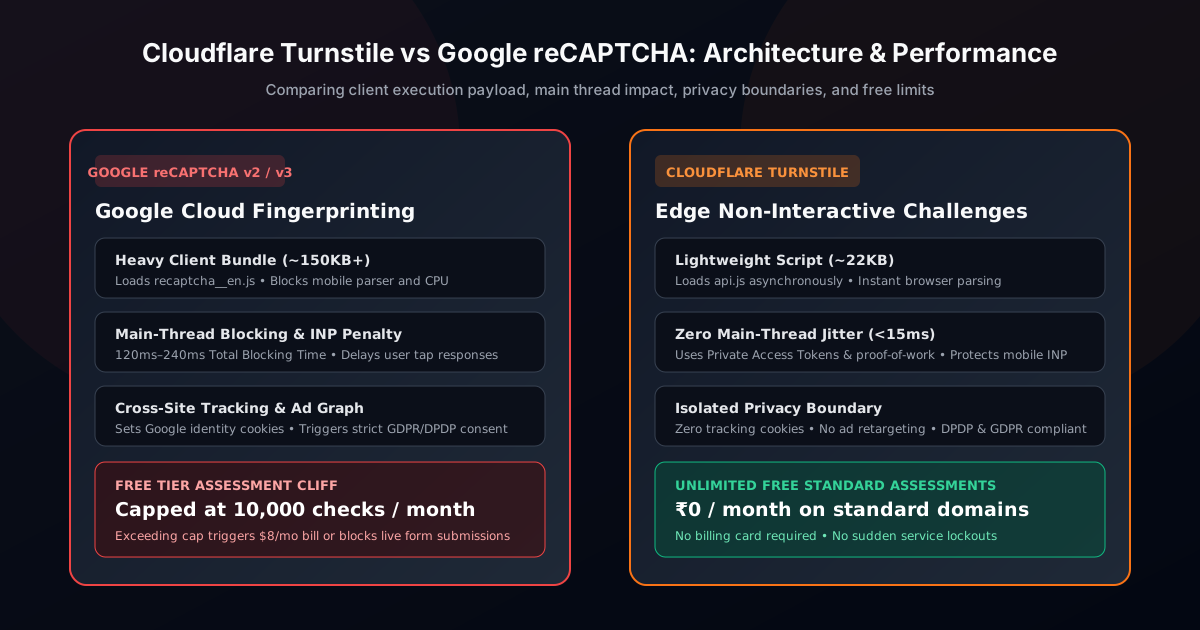
Cloudflare Turnstile is faster, more private, and cheaper than Google reCAPTCHA for web forms. Turnstile loads in ~22KB without tracking cookies or main-thread blocking, whereas reCAPTCHA loads ~150KB and caps its free tier at 10,000 monthly assessments before billing $8 per tier. For modern contact and checkout forms, Turnstile preserves Core Web Vitals and user conversion.
Why Form Security Became a Core Web Vitals Problem
For more than a decade, web teams dropped Google reCAPTCHA onto contact forms as an automatic reflex against automated spam. When reCAPTCHA v3 introduced score-based assessment without visual puzzles, it seemed like the ideal compromise between friction and security.
However, browser performance benchmarks tell a different story. Google reCAPTCHA v3 injects recaptcha__en.js, an obfuscated script bundle weighing roughly 150KB uncompressed. On mobile devices—which represent more than 75% of web enquiries across our client builds—the script triggers an intensive browser profiling loop on the main thread.
This profiling introduces 120ms to 240ms of Total Blocking Time (TBT). When a visitor taps an input field while the reCAPTCHA engine analyzes mouse movement and browser canvas telemetry, the interface stutters. Under Google’s Core Web Vitals criteria, this latency degrades Interaction to Next Paint (INP), hurting search ranking signals and user form completion rates simultaneously.
The 10,000 Assessment Cliff: Google reCAPTCHA Pricing Reality
In April 2024, Google overhauled reCAPTCHA pricing. Previously, the free tier allowed up to 1,000,000 monthly assessments. Under the updated policy, the free threshold dropped by 99% down to just 10,000 assessments per month across standard accounts.
For a low-traffic brochure website, 10,000 requests sounds generous until you examine how reCAPTCHA v3 functions. Because v3 calculates a continuous risk score, the recommended implementation mounts the badge across multiple page templates—not just the final submit button. A website with 3,500 monthly visitors browsing three pages each consumes 10,500 assessments, blowing past the free tier.
Once you cross that limit, Google requires a linked Google Cloud billing account and charges $8 per month for up to 100,000 assessments, scaling to $1 per 1,000 calls beyond that. If billing is misconfigured, form submissions fail outright. Cloudflare Turnstile takes the opposite approach: the standard non-interactive challenge is completely free with unlimited assessments on production web domains.
Side-by-Side Comparison: Turnstile vs reCAPTCHA
| Evaluation Metric | Cloudflare Turnstile (Managed) | Google reCAPTCHA v2 / v3 | Practical Advantage |
|---|---|---|---|
| Client Script Weight | ~22KB (lightweight async script) | ~150KB+ (recaptcha__en.js) | Turnstile (85% lighter) |
| Mobile Main-Thread Blocking | <15ms execution overhead | 120ms – 240ms Total Blocking Time | Turnstile (Zero INP penalty) |
| Monthly Free Tier Ceiling | Unlimited on standard domains | 10,000 assessments / month | Turnstile (No billing card) |
| Cross-Site Tracking & Cookies | Zero tracking cookies, no ad profiling | Google identity cookies & browsing history | Turnstile (DPDP & GDPR safe) |
| User Friction & Puzzles | Non-interactive cryptographic proof | Image grids (crosswalks/traffic lights) or hidden score | Turnstile (Higher conversion) |
| Enterprise Risk Scoring | Pass / fail verification token | Granular 0.0 to 1.0 probability score | reCAPTCHA (Complex fraud rules) |
| Server Handoff Speed | Edge API verify (~40ms roundtrip) | Google Cloud verify (~85ms roundtrip) | Turnstile |
How to Validate Turnstile Tokens on Your Server
Migrating from reCAPTCHA to Turnstile requires changing only two components: the frontend widget embed and the backend verification endpoint. On your frontend HTML form, load the Turnstile script and place the container element where you want the check to run:
<!-- Load Cloudflare Turnstile script asynchronously -->
<script src="https://challenges.cloudflare.com/turnstile/v0/api.js" async defer></script>

<form action="/submit-enquiry" method="POST">
  <input type="text" name="name" placeholder="Your Name" required>
  <input type="tel" name="phone" placeholder="Phone Number" required>

  <!-- Turnstile challenge widget -->
  <div class="cf-turnstile" data-sitekey="0x4AAAAAAAxXxXxXxXxXxXxX" data-theme="dark"></div>

  <button type="submit">Send Message</button>
</form>
When the user submits the form, Turnstile generates a POST parameter named cf-turnstile-response. On your backend server, validate this token by calling Cloudflare's siteverify endpoint. Here is the exact PHP verification implementation we deploy in production:
<?php
function verifyTurnstileToken(string $token, string $secretKey, ?string $remoteIp = null): bool {
    if (empty($token)) {
        return false;
    }

    $endpoint = 'https://challenges.cloudflare.com/turnstile/v0/siteverify';
    $postData = [
        'secret'   => $secretKey,
        'response' => $token,
    ];
    if ($remoteIp) {
        $postData['remoteip'] = $remoteIp;
    }

    $ch = curl_init($endpoint);
    curl_setopt($ch, CURLOPT_RETURNTRANSFER, true);
    curl_setopt($ch, CURLOPT_POST, true);
    curl_setopt($ch, CURLOPT_POSTFIELDS, http_build_query($postData));
    curl_setopt($ch, CURLOPT_TIMEOUT, 3);
    curl_setopt($ch, CURLOPT_SSL_VERIFYPEER, true);

    $response = curl_exec($ch);
    $httpCode = curl_getinfo($ch, CURLINFO_HTTP_CODE);
    curl_close($ch);

    if ($httpCode !== 200 || !$response) {
        return false;
    }

    $result = json_decode($response, true);
    return isset($result['success']) && $result['success'] === true;
}

// In your form handler:
$token = $_POST['cf-turnstile-response'] ?? '';
$secretKey = getenv('CLOUDFLARE_TURNSTILE_SECRET_KEY');

if (!verifyTurnstileToken($token, $secretKey, $_SERVER['REMOTE_ADDR'] ?? null)) {
    http_response_code(400);
    echo json_encode(['error' => 'Security challenge failed. Please refresh and try again.']);
    exit;
}
// Proceed with storing lead, sending WhatsApp alert, or processing order
?>
Privacy Compliance: The Indian DPDP Act and GDPR
Under the European General Data Protection Regulation (GDPR) and the Indian Digital Personal Data Protection (DPDP) Act, collecting user telemetry without clear necessity creates regulatory exposure. Google reCAPTCHA inspects cross-site cookies, browser hardware profiles, and active Google account logins to establish user trustworthiness.
If your website loads reCAPTCHA before visitors grant consent on a cookie banner, you risk regulatory non-compliance. Several European privacy regulators have flagged third-party CAPTCHA scripts that transmit personal behavioral data to US advertising networks.
Cloudflare Turnstile is built specifically around data isolation. Cloudflare operates as a data processor under its published Turnstile Privacy Addendum: it does not set persistent tracking cookies, does not read cross-site browsing histories, and never monetizes verification data for ad targeting. On modern operating systems (iOS, macOS, and recent Android versions), Turnstile supports Private Access Tokens (PATs), allowing devices to cryptographically assert authenticity without revealing user identity.
Five Production Rules for Deploying Turnstile
- Render the widget explicitly on dynamic forms: If your form loads inside a popup modal or renders via single-page navigation, invoke
turnstile.render()through JavaScript instead of waiting for automatic DOM scanning. - Validate the hostname in backend responses: When parsing the validation response, verify that
$result['hostname']matches your legitimate production domain to prevent replay attacks across different sites. - Handle token expiration gracefully: Turnstile tokens expire after 300 seconds. Add the
data-expired-callbackattribute to reset the challenge if a user spends several minutes drafting their enquiry. - Combine with a hidden honeypot input: Include a hidden input field styled with
display:none. Naive scraping scripts fill every form field indiscriminately, allowing your server to reject automated submissions before consuming a remote API call. - Configure a strict 3-second cURL timeout: Never let a third-party API outage freeze your checkout funnel. Use a 3-second connection timeout and log failures so legitimate customers are never stranded by network timeouts.
When You Should NOT Use Cloudflare Turnstile
While Turnstile is the superior choice for standard contact forms and lead generation funnels, specific technical architectures still justify alternatives:
First, if your fraud detection pipeline relies on granular probability scores—such as banking logins where a 0.2 score forces multi-factor SMS verification while a 0.8 score permits passwordless access—reCAPTCHA v3 or Cloudflare's paid Enterprise Bot Management provides numeric risk distributions that standard Turnstile omits.
Second, if a large proportion of your user base accesses your platform from mainland China behind state firewalls, Cloudflare edge networks can occasionally encounter latency spikes or transient DNS blocks. In those regional contexts, native domestic security solutions perform more reliably.
Finally, for low-volume administrative portals, a zero-JavaScript honeypot paired with IP-based rate limiting eliminates the need for any external client script entirely.
Frequently Asked Questions
Is Cloudflare Turnstile completely free for commercial websites?
Yes. Cloudflare Turnstile offers unlimited assessments on its standard tier without requiring a paid subscription or connected billing card. Unlike Google reCAPTCHA, which imposes a strict 10,000 monthly check ceiling before charging $8/month, Turnstile standard can be deployed on commercial production sites without usage caps.
Does Cloudflare Turnstile require routing website DNS through Cloudflare?
No. Turnstile is a standalone security widget. You do not need to use Cloudflare as your DNS provider, reverse proxy, or CDN. You can embed the Turnstile script on any website hosted on AWS, Vercel, traditional VPS servers, or local hosting.
How does Turnstile improve Interaction to Next Paint (INP) compared to reCAPTCHA?
Google reCAPTCHA v3 downloads a 150KB+ bundle (recaptcha__en.js) and executes continuous behavioral fingerprinting on the browser main thread, adding 120ms to 240ms of Total Blocking Time on mobile devices. Turnstile loads an asynchronous 22KB script and finishes non-interactive cryptographic checks in under 15ms, keeping the main thread free for user input.
Can Cloudflare Turnstile be bypassed by automated CAPTCHA solving farms?
Basic scrapers and headless browsers are blocked automatically by Turnstile proof-of-work and environment telemetry. While specialized human-operated solving farms can solve any challenge for a price, Turnstile rotates cryptographic tokens every 300 seconds and binds validations to your specific domain hostname, rendering harvested tokens useless.
What happens if a user disables JavaScript in their browser?
Both Cloudflare Turnstile and Google reCAPTCHA v3 require JavaScript to execute verification challenges. For visitors without JavaScript, forms will fail client token generation unless you provide an alternative server-side fallback, such as email confirmation or two-factor SMS authentication.
Looking to speed up your web applications and protect lead generation pipelines? Review our custom web development services, study our real-world clinic infrastructure in the Coimbatore Dental Foundation case study, check our regional development teams across Tamil Nadu location hubs, or get in touch with Epiqu's engineering team.